
Penny Dreadfuls, 1854 · page 384 of 399
Joseph Wilmot, or, The Memoirs of a Man-Servant — page 384: what you’re looking at
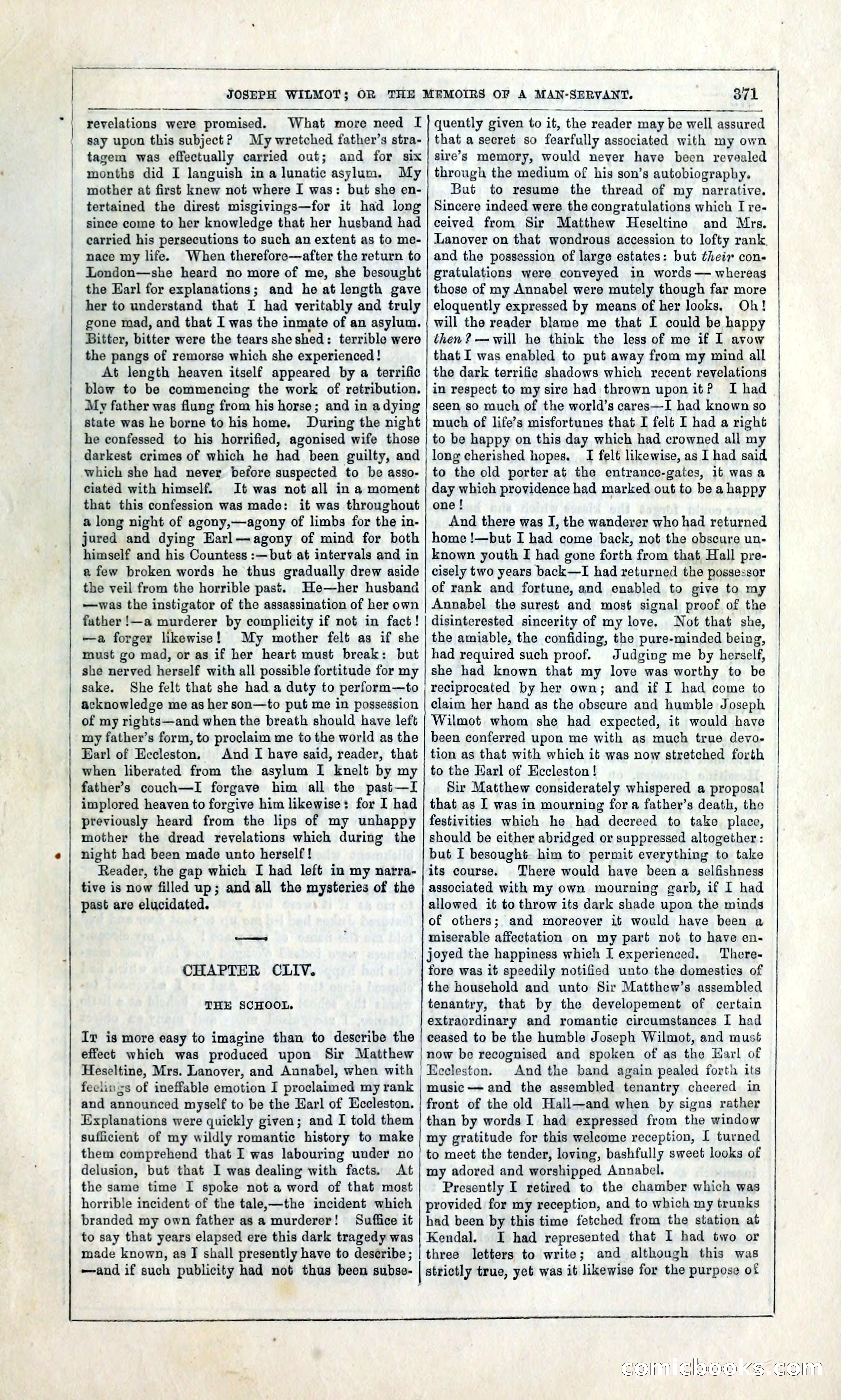
A restored page from Penny Dreadfuls, 1854. Page through the whole issue in the reader above.
📄 Transcribed text from this page (OCR, searchable)
Machine-transcribed from the original scan — historical spelling and the odd misread are preserved.
—_—- JOSEPH WILMOT; OR THE MEMOIRS OF A MAN-SERVANT. revelations were promised. What more need I say upon this subject? My wretched father’s stra- tagem was effectually carried out; and for six months did I languish ina lunatic asylum. My mother at first knew not where I was: but she en- tertained the direst misgivings—for it had long since come to her knowledge that her husband had earried his persecutions to such an extent as to me- nace my life. When therefore—after the return to London—she heard no more of me, she besought the Earl for explanations; and he at length gave her to understand that I had veritably and truly gone mad, and that I was the inmate of an asylum. Bitter, bitter were the tears she shed: terrible were the pangs of remorse which she experienced! At length heaven itself appeared by a terrific blow to be commencing the work of retribution. My father was flung from his horse; and in adying state was he borne to his home. During the night he confessed to his horrified, agonised wife those darkest crimes of which he had been guilty, and which she had never before suspected to be asso- ciated with himself. It was not all in a moment that this confession was made: it was throughout a long night of agony,—agony of limbs for the in- jured and dying Harl—agony of mind for both himself and his Countess :—but at intervals and in a few broken words he thus gradually drew aside the veil from the horrible past. He—her husbana —was the instigator of the assassination of her own father !—a murderer by complicity if not in fact! —a forger likewise! My mother felt as if she must go mad, or as if her heart must break: but she nerved herself with all possible fortitude for my sake. She felt that she had a duty to perform—to acknowledge me as her son—to put me in possession of my rights—and when the breath should have left my father’s form, to proclaim me to the world as the Harl of Eccleston, And I have said, reader, that when liberated from the asylum I knelt by my father’s couch—I forgave him all the past—I implored heaven to forgive him likewise: for I had previously heard from the lips of my unhappy mother the dread revelations which during the night had been made unto herself ! Reader, the gap which I had left in my narra- tive is now filled up; and all tho mysteries of the past are elucidated. to a? CHAPTER CLIV. THE SCHOOL. Ir is more easy to imagine than to describe the effect which was produced upon Sir Matthew Heseltine, Mrs. Lanover, and Aunabel, when with feelings of ineffable emotion I proclaimed my rank and announced myself to be the Harl of Eccleston. Explanations were quickly given; and I told them sufficient of my wildly romantic history to make them comprehend that I was labouring under no delusion, but that I was dealing with facts. At the same time I spoke not a word of that most horrible incident of the tale—the incident which branded my own father as a murderer! Suffice it to say that years elapsed ere this dark tragedy was made known, as I shall presently have to deseribe; —and if such publicity had not thus been subse- | ee 371 — quently given to it, the reader may be well assured that a secret so fearfully associated with my own sire’s memory, would never have been revealed through the medium of his son’s autobiography. But to resume the thread of my narrative. Sincere indeed were the congratulations which I re- ceived from Sir Matthew Heseltine and Mrs. Lanover on that wondrous accession to lofty rank, and the possession of large estates: but their con- gratulations were conveyed in words— whereas those of my Annabel were mutely though far more eloquently expressed by means of her looks. Oh! will the reader blame me that I could be happy then? — will he think the less of me if I avow that I was enabled to put away from my mind all the dark terrific shadows which recent revelations in respect to my sire had thrown uponitP I had seen so rouch of the world’s cares—I had known so much of life’s misfortunes that I felt I had a right to be happy on this day which had crowned all my long cherished hopes. I felt likewise, as I had said to the old porter at the entrance-gates, 16 wasa day which providence had marked out to be a happy one! And there was I, the wanderer who had returned home !—but I had come back, not the obscure un- known youth I had gone forth from that Hall pre- cisely two years back—I had returned the possessor of rank and fortune, and enabled to give to my Annabel the surest and most signal proof of the disinterested sincerity of my love. Not that she, the amiable, the confiding, the pure-minded being, had required such proof. Judging me by herself, she had known that my love was worthy to be reciprocated by her own; and if I had come to claim her hand as the obscure and humble Joseph Wilmot whom she had expected, it would have been conferred upon me with as much true devo- tion as that with which it was now stretched forth to the Earl of Eccleston! Sir Matthew considerately whispered a proposal that as I was in mourning fora father’s death, tho festivities which he had decreed to take place, should be either abridged or suppressed altogether : but I besought. him to permit everything to take its course. There would have been a selfishness associated with my own mourning garb, if I had allowed it to throw its dark shade upon the minds of others; and moreover it would have been a miserable affectation on my part not to have en- joyed the happiness which I experienced. There- fore was it speedily notified unto the domestics of the household and unto Sir Matthew’s assembled tenantry, that by the developement of certain extraordinary and romantic circumstances I had ceased to be the humble Joseph Wilmot, and must now be recognised and spoken of as the Harl of Eccleston. And the band again pealed forth its music -—— and the assembled tenantry cheered in front of the old Hall—and when by signs rather than by wordsI had expressed from the window my gratitude for this welcome reception, I turned to meet the tender, loving, bashfully sweet looks of my adored and worshipped Annabel. Presently I retired to the chamber which was provided for my reception, and to which my trunks had been by this time fetched from the station at Kendal. I had represented that I had two or three letters to write; and although this was strictly true, yet was it likewise for the purpose of Gaook (EO)