
Penny Dreadfuls, 1854 · page 381 of 399
Joseph Wilmot, or, The Memoirs of a Man-Servant — page 381: what you’re looking at
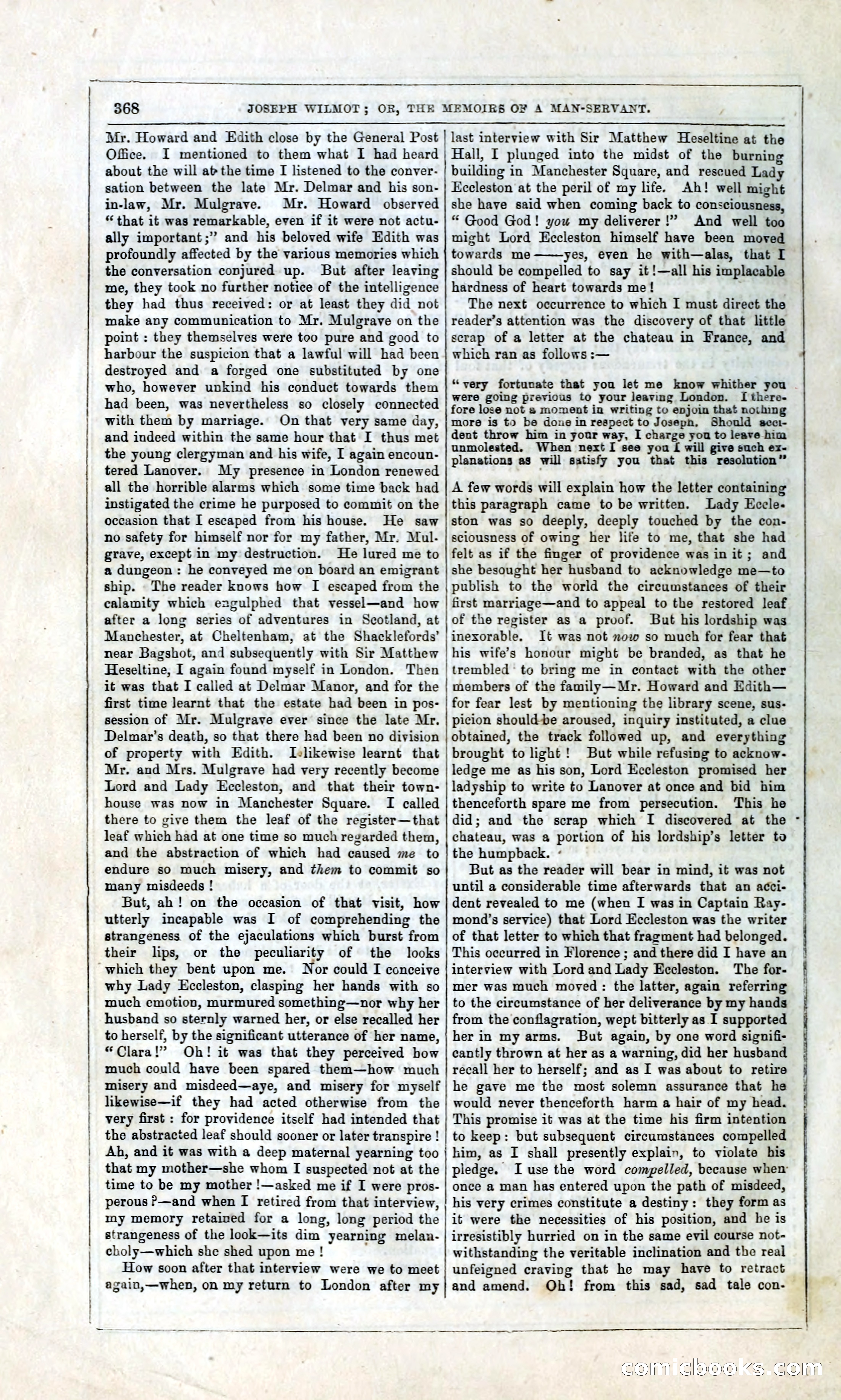
A restored page from Penny Dreadfuls, 1854. Page through the whole issue in the reader above.
📄 Transcribed text from this page (OCR, searchable)
Machine-transcribed from the original scan — historical spelling and the odd misread are preserved.
which they bent upon me. 368 JOSEPH WILMOT; OR, THE MEMOIRS OF A MAN-SERVANT. Mr. Howard and Edith close by the General Post Office. I mentioned to them what I had heard about the will atthe time I listened to the conver- sation between the late Mr. Delmar and his son- in-law, Mr. Mulgrave. Mr. Howard observed “that it was remarkable, even if it were not actu- ally important ;” and his beloved wife Edith was profoundly affected by the various memories which the conversation conjured up. But after leaving me, they took no further notice of the intelligence they had thus received: or at least they did not make any communication to Mr. Mulgrave on the point : they themselves were too pure and good to harbour the suspicion that a lawful will had been destroyed and a forged one substituted by one who, however unkind his conduct towards them had been, was nevertheless so closely connected with them by marriage. On that very same day, and indeed within the same hour that I thus met the young clergyman and his wife, I again encoun- tered Lanover. My presence in London renewed all the horrible alarms which some time back had instigated the crime he purposed to commit on the occasion that I escaped from his house. He saw no safety for himself nor for my father, Mr. Mul- grave, except in my destruction. He lured me to a dungeon: he conveyed me on board an emigrant ship. The reader knows how I escaped from the calamity which engulphed that vessel—and how after a long series of adventures in Scotland, at Manchester, at Cheltenham, at the Shacklefords’ near Bagshot, and subsequently with Sir Matthew Heseltine, I again found myself in London. Then it was that I called at Delmar Manor, and for the first time Jearnt that the estate had been in pos- session of Mr. Mulgrave ever since the late Mr. Delmar’s death, so that there had been no division of property with Edith. Ivlikewise learnt that Mr. and Mrs. Mulgrave had very recently become Lord and Lady Eccleston, and that their town- house was now in Manchester Square. I called there to give them the leaf of the register—that leaf which had at one time so much regarded them, and the abstraction of which had caused me to endure so much misery, and them to commit so many misdeeds ! But, ah! on the occasion of that visit, how utterly incapable was I of comprehending the strangeness of the ejaculations which burst from their lips, or the peculiarity of the looks or could I conceive why Lady Eccleston, clasping her hands with so much emotion, murmured something—nor why her husband so sternly warned her, or else recalled her to herself, by the significant utterance of her name, “Clara!” Oh! it was that they perceived how much could have been spared them—how much misery and misdeed—aye, and misery for myself likewise—if they had acted otherwise from the very first : for providence itself had intended that the abstracted leaf should sooner or later transpire ! Ah, and it was with a deep maternal yearning too that my mother—she whom I suspected not at the time to be my mother !—asked me if I were pros- perous P—and when I retired from that interview, my memory retained for a long, long period the strangeness of the look—its dim yearning melan- choly—which she shed upon me! How soon after that interview were we to meet again,—when, on my return to London after my last interview with Sir Matthew Heseltine at the Hall, I plunged into the midst of the burning building in Manchester Square, and rescued Lady Eccleston at the peril of my life. Ah! well might she have said when coming back to consciousness, “ Good God! you my deliverer!” And well too might Lord Eccleston himself have been moved towards me yes, even he with—alas, that I should be compelled to say it!—all his implacable hardness of heart towards me! | The next occurrence to which I must direct the reader’s attention was the discovery of that little scrap of a letter at the chateau in France, and which ran as follows :— “very fortunate that you let me know whither you | were going previous to your leaving London. I there- fore lose not 8 moment in writing to enjoin that nothng more is to be done in respect to Joseph. Should acci- dent throw him in your way, I charge yon to leave him unmolested. When next I see you [ will give such ex- planstions as will satisfy you that this resolution” A few words will explain how the letter containing this paragraph came to be written. Lady Eccle- ston was so deeply, deeply touched by the con- sciousness of owing her life to me, that she had felt as if the finger of providence was init; and she besought her husband to acknowledge me—to publish to the world the circumstances of their first marriage—and to appeal to the restored leaf of the register as a prvof. But his lordship was inexorable. It was not now so much for fear that his wife’s honour might be branded, as that he trembled’ to bring me in contact with the other members of the family—Mr. Howard and Edith— for fear lest by mentioning the library scene, sus- picion should-be aroused, inquiry instituted, a clue obtained, the track followed up, and everything brought to light! But while refusing to acknow- ledge me as his son, Lord Eccleston promised her ladyship to write to Lanover at once and bid him thenceforth spare me from persecution. This he did; and the scrap which I discovered at the chateau, was a portion of his lordship’s letter to the humpback. « But as the reader will bear in mind, it was not until a considerable time afterwards that an acci- dent revealed to me (when I was in Captain Ray- mond’s service) that Lord Eccleston was the writer of that letter to which that fragment had belonged. This occurred in Florence ; and there did I have an interview with Lord and Lady Eccleston. The for- mer was much moved: the latter, again referring to the circumstance of her deliverance by my hands from the conflagration, wept bitterly as I supported her in my arms. But again, by one word signifi- cantly thrown af her as a warning, did her husband recall her to herself; and as I was about to retire he gave me the most solemn assurance that he would never thenceforth harm a hair of my head. This promise it was at the time his firm intention to keep: but subsequent circumstances compelled kim, as I shall presently explain, to violate his pledge. I use the word compelled, because when: once a man has entered upon the path of misdeed, his very crimes constitute a destiny: they form as it were the necessities of his position, and he is irresistibly hurried on in the same evil course not- withstanding the veritable inclination and the real unfeigned craving that he may have to retract and amend. GDOaks Oh! from this sad, sad tale con-~ com