
Penny Dreadfuls, 1854 · page 377 of 399
Joseph Wilmot, or, The Memoirs of a Man-Servant — page 377: what you’re looking at
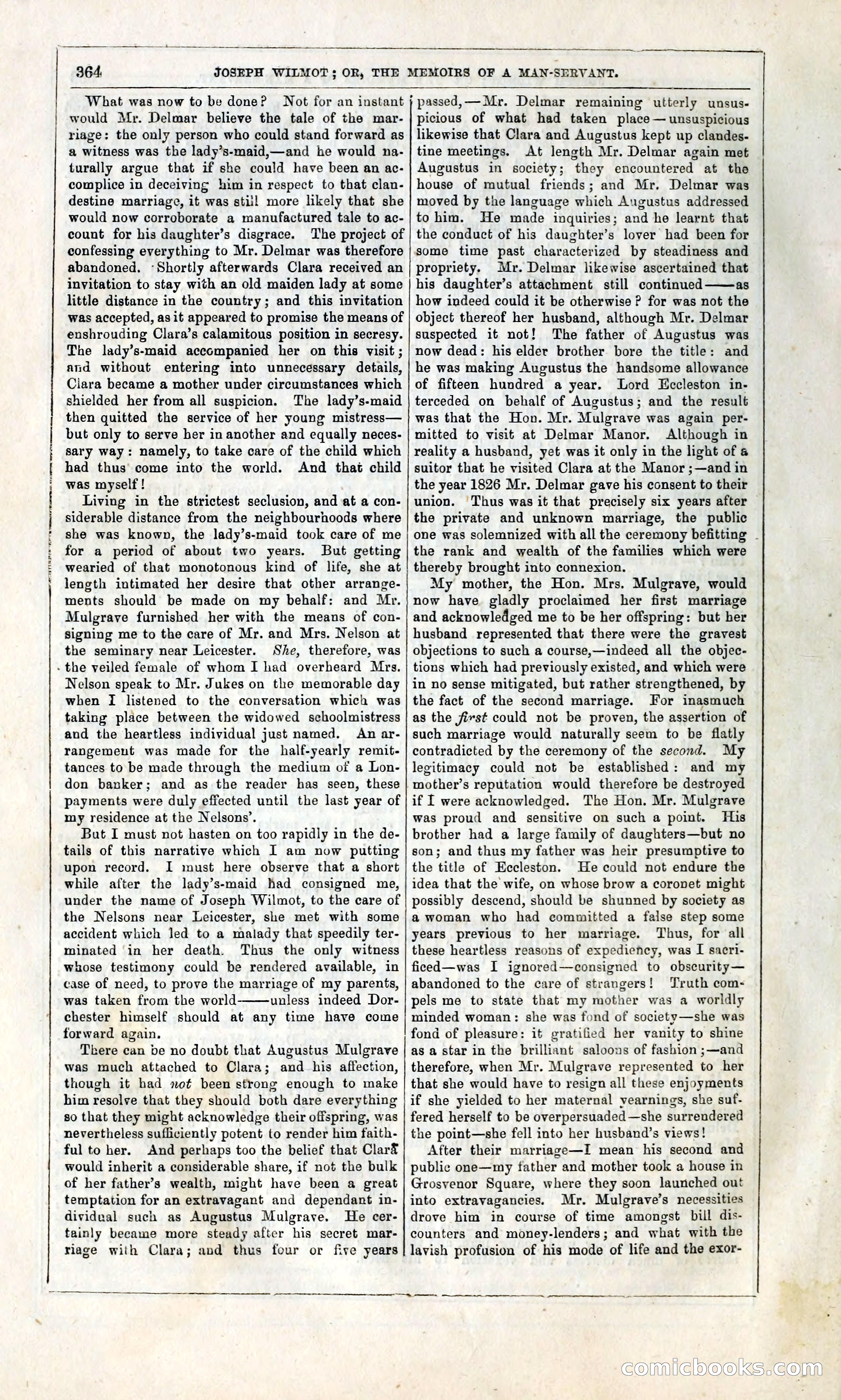
A restored page from Penny Dreadfuls, 1854. Page through the whole issue in the reader above.
📄 Transcribed text from this page (OCR, searchable)
Machine-transcribed from the original scan — historical spelling and the odd misread are preserved.
CS 8 I Oe ee ee ©) re ee oe ree, | EEE eee | LO = 364, What was now to be done? would Mr. Delmar believe the tale of the mar- riage: the only person who could stand forward as a witness was the lady’s-maid,—and he would na- turally argue that if she could have been an ac- complice in deceiving him in respect to that clan- destine marriage, it was stiil more likely that she would now corroborate a manufactured tale to ac- count for his daughter’s disgrace. The project of confessing everything to Mr. Delmar was therefore abandoned. ‘Shortly afterwards Clara received an invitation to stay with an old maiden lady at some little distance in the country; and this invitation was accepted, asit appeared to promise the means of enshrouding Clara’s calamitous position in secresy. The lady’s-maid accompanied her on this visit ; and without entering into unnecessary details, Ciara became a mother under circumstances which shielded her from all suspicion. The lady’s-maid then quitted the service of her young mistress— but only to serve her in another and equally neces- sary way: namely, to take care of the child which had thus’ come into the world. And that child was myself ! Living in the strictest seclusion, and at a con- siderable distance from the neighbourhoods where she was known, the lady’s-maid took care of me for a period of about two years. But getting wearied of that monotonous kind of life, she at length intimated her desire that other arrange- ments should be made on my behalf: and Mr. Mulgrave furnished her with the means of con- signing me to the care of Mr. and Mrs. Nelson at the seminary near Leicester. She, therefore, was - the veiled female of whom I had overheard Mrs. Nelson speak to Mr. Jukes on the memorable day when I listened to the conversation which was taking place between the widowed schoolmistress and the heartless individual just named. An ar- rangement was made for the half-yearly remit- tances to be made through the medium of a Lon- don banker; and as the reader has seen, these payments were duly effected until the last year of my residence at the Nelsons’. But I must not hasten on too rapidly in the de- tails of this narrative which I am now putting upon record. I must here observe that a short while after the lady’s-maid had consigned me, under the name of Joseph Wilmot, to the care of the Nelsons near Leicester, she met with some accident which led to a malady that speedily ter- minated in her death. Thus the only witness whose testimony could be rendered available, in case of need, to prove the marriage of my parents, was taken from the world unless indeed Dor- chester himself should at any time have come forward again. There can be no doubt that Augustus Mulgrave was much attached to Clara; and his affection, though it had not been strong enough to make him resolve that they should both dare everything so that they might acknowledge their offspring, was nevertheless sufficiently potent to render him faith- ful to her. And perhaps too the belief that Clar& would inherit a considerable share, if not the bulk of her father’s wealth, might have been a great temptation for an extravagant and dependant in- dividual such as Augustus Mulgrave, He cer- tainly became more steady after his secret mar- riage with Clara; and thus four or five years Not for an instant ; = nN nee ee ——— JOSEPH WILMOT; OR, THE MEMOIRS OF A MAN-SERVANT. passed, — Mr. Delmar remaining utterly unsus- picious of what had taken place —unsuspicious likewise that Clara and Augustus kept up clandes- tine meetings, At length Mr. Delmar again met Augustus in society; they encountered at the house of mutual friends; and Mr. Delmar was moved by the language which Augustus addressed to him. He made inquiries; and he learnt that the conduct of his daughter’s lover had been for some time past characterized by steadiness and propriety. Mr. Delmar likewise ascertained that his daughter’s attachment still continued ——as how indeed could it be otherwise ? for was not the object thereof her husband, although Mr. Delmar suspected it not! The father of Augustus was now dead: his elder brother bore the title: and he was making Aucustus the handsome allowance of fifteen hundred a year, Lord Eccleston in- terceded on behalf of Augustus; and the result was that the Hon. Mr. Mulgrave was again per- mitted to visit at Delmar Manor. Although in reality a husband, yet was it only in the light of suitor that he visited Clara at the Manor ;—and in the year 1826 Mr. Delmar gave his consent to their union. Thus was it that precisely six years after the private and unknown marriage, the public one was solemnized with all the ceremony befitting - the rank and wealth of the families which were thereby brought into connexion. My mother, the Hon. Mrs. Mulgrave, would now have gladly proclaimed her first marriage and acknowledged me to be her offspring: but her husband represented that there were the gravest objections to such a course,—indeed all the objec- tions which had previously existed, and which were in no sense mitigated, but rather strengthened, by the fact of the second marriage. For inasmuch as the first could not be proven, the assertion of such marriage would naturally seem to be flatly contradicted by the ceremony of the second. My legitimacy could not be established: and my mother’s reputation would therefore be destroyed if [ were acknowledged. The Hon. Mr. Mulgrave was proud and sensitive on such a point. His brother had a large family of daughters—but no son; and thus my father was heir presumptive to the title of Eccleston. He could not endure the idea that the wife, on whose brow a coronet might possibly descend, should be shunned by society as a woman who had committed a false step some years previous to her marriage. Thus, for all these heartless reasons of expediency, was I sacri- ficed—was I ignored—consigned to obscurity— abandoned to the care of strangers! Truth com- pels me to state that my mother was a worldly minded woman: she was fond of society—she was fond of pleasure: it gratified her vanity to shine as a star in the brilliant saloons of fashion ;—and therefore, when Mr. Mulgrave represented to her that she would have to resign all these enjoyments if she yielded to her maternal yearnings, she suf- fered herself to be overpersuaded—she surrendered the point—she fell into her husband’s views! After their marriage—I mean his second and public one—my father and mother took a house in Grosvenor Square, where they soon launched out into extravagancies. Mr. Mulgrave’s necessities drove him in course of time amongst bill dis- counters and money-lenders; and what with the lavish profusion of his mode of life and the exor- OOO) <S (Cc)