
Penny Dreadfuls, 1854 · page 37 of 399
Joseph Wilmot, or, The Memoirs of a Man-Servant — page 37: what you’re looking at
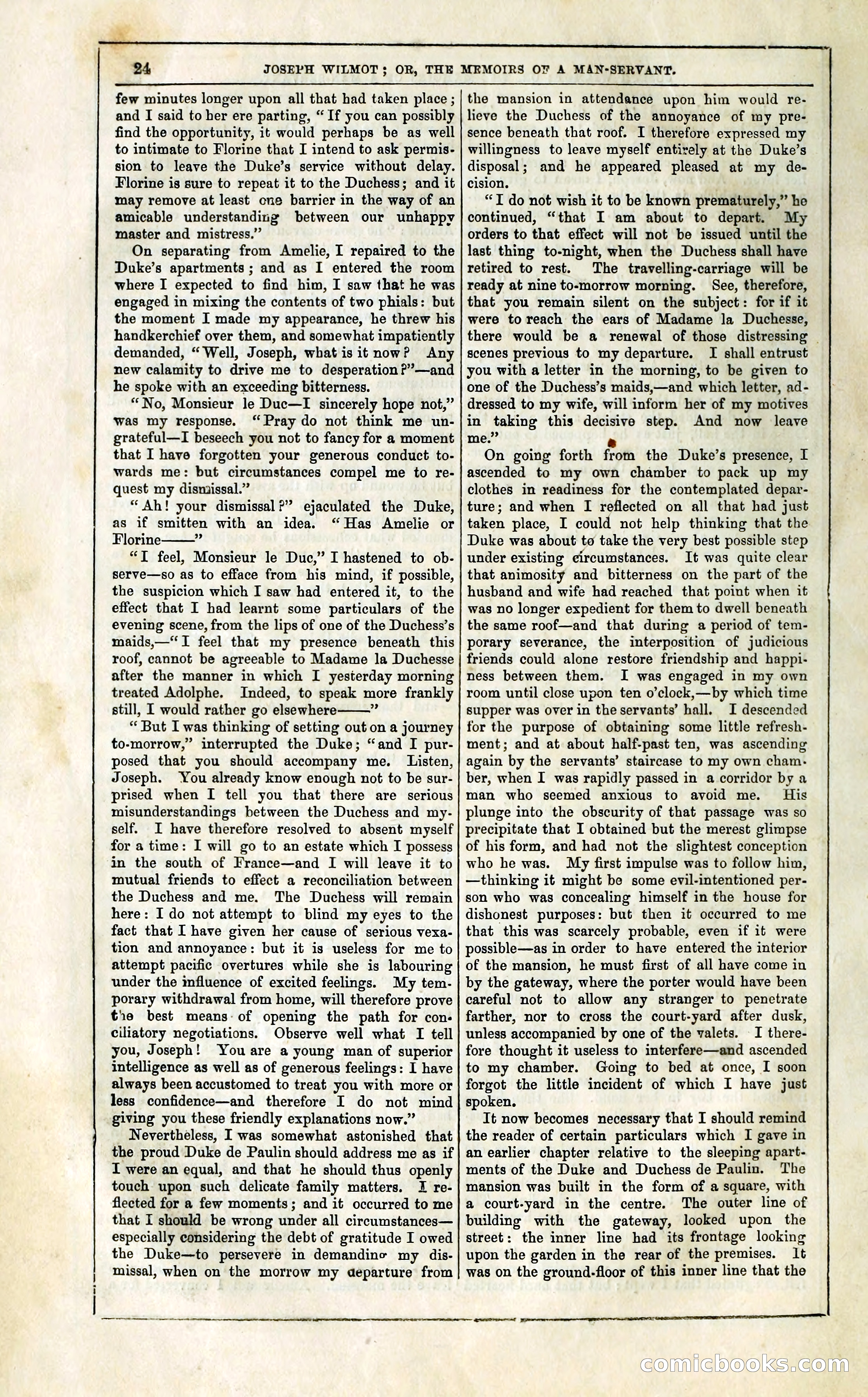
A restored page from Penny Dreadfuls, 1854. Page through the whole issue in the reader above.
📄 Transcribed text from this page (OCR, searchable)
Machine-transcribed from the original scan — historical spelling and the odd misread are preserved.
re = ee ot 24 few minutes longer upon all that had taken place ; and I said to her ere parting, “ If you can possibly find the opportunity, it would perhaps be as well to intimate to Florine that I intend to ask permis- sion to leave the Duke’s service without delay. Florine is sure to repeat it to the Duchess; and it may remove at least one barrier in the way of an amicable understanding between our unhappy master and mistress.” On separating from Amelie, I repaired to the Duke’s apartments ; and as I entered the room where I expected to find him, I saw that he was engaged in mixing the contents of two phials: but the moment I made my appearance, he threw his handkerchief over them, and somewhat impatiently demanded, “ Well, Joseph, whatisit now? Any new calamity to drive me to desperation ?”—and he spoke with an exceeding bitterness. “No, Monsieur le Duc—I sincerely hope not,” Was my response. “Pray do not think me un- grateful—I beseech you not to fancy for a moment that I have forgotten your generous conduct to- wards me: but circumstances compel me to re- quest my disnaissal.” “Ah! your dismissal?” ejaculated the Duke, as if smitten with an idea. “ Has Amelie or Florine ‘ “TI feel, Monsieur le Duc,” I hastened to ob- serve—so as to efface from his mind, if possible, the suspicion which I saw had entered it, to the effect that I had learnt some particulars of the evening scene, from the lips of one of the Duchess’s maids,—“ I feel that my presence beneath this roof, cannot be agreeable to Madame la Duchesse after the manner in which I yesterday morning treated Adolphe. Indeed, to speak more frankly still, I would rather go elsewhere a “ But I was thinking of setting out on a journey to-morrow,” interrupted the Duke; “and I pur- posed that you should accompany me. Listen, Joseph. You already know enough not to be sur- prised when I tell you that there are serious misunderstandings between the Duchess and my- self. I have therefore resolved to absent myself for a time: I will go to an estate which I possess in the south of France—and I will leave it to mutual friends to effect a reconciliation between the Duchess and me. The Duchess will remain here: I do not attempt to blind my eyes to the fact that I have given her cause of serious vexa- tion and annoyance: but it is useless for me to attempt pacific overtures while she is labouring under the imfluence of excited feelings. My tem- porary withdrawal from home, will therefore prove the best means: of opening the path for con- ciliatory negotiations. Observe well what I tell you, Joseph! You are a young man of superior intelligence as well as of generous feelings: I have always been accustomed to treat you with more or less confidence—and therefore I do not mind giving you these friendly explanations now.” Nevertheless, I was somewhat astonished that the proud Duke de Paulin should address me as if I were an equal, and that he should thus openly | touch upon such delicate family matters. I re- flected for a few moments; and it occurred to me that I should be wrong under all circumstances— especially considering the debt of gratitude I owed the Duke—to persevere in demandine my dis- missal, when on the morrow my departure from /a court-yard in the centre. JOSEPH WILMOTs; OR, THE MEMOIRS OF A MAN-SERVANT. the mansion in attendance upon him would re- lieve the Duchess of the annoyance of my pre- sence beneath that roof. I therefore expressed my willingness to leave myself entirely at the Duke’s disposal; and he appeared pleased at my de- cision. “TI do not wish it to be known prematurely,” he continued, “that I am about to depart. My orders to that effect will not be issued until the last thing to-night, when the Duchess shall have retired to rest. The travelling-carriage will be ready at nine to-morrow morning. See, therefore, that you remain silent on the subject: for if it were to reach the ears of Madame la Duchesse, there would be a renewal of those distressing ~ scenes previous to my departure. I shall entrust you with a letter in the morning, to be given to one of the Duchess’s maids,—and which letter, ad- dressed to my wife, will inform her of my motives in taking this decisive step. And now leave me.” o On going forth from the Duke’s presence, I ascended to my own chamber to pack up my clothes in readiness for the contemplated depar- ture; and when I reflected on all that had just taken place, I could not help thinking that the Duke was about to take the very best possible step under existing circumstances. It was quite clear that animosity and bitterness on the part of the husband and wife had reached that point when it was no longer expedient for them to dwell beneath the same roof—and that during a period of tem- porary severance, the interposition of judicious friends could alone restore friendship and happi- ness between them. I was engaged in my own room until close upon ten o’clock,—by which time supper was over in the servants’ hall. I descended for the purpose of obtaining some little refresh- ment; and at about half-past ten, was ascending again by the servants’ staircase to my own cham. ber, when I was rapidly passed in a corridor by a man who seemed anxious to avoid me. His plunge into the obscurity of that passage was so precipitate that I obtained but the merest glimpse of his form, and had not the slightest conception who he was. My first impulse was to follow him, —thinking it might be some evil-intentioned per- son who was concealing himself in the house for dishonest purposes: but then it occurred to me that this was scarcely probable, even if it were possible—as in order to have entered the interior of the mansion, he must first of all have come in by the gateway, where the porter would have been careful not to allow any stranger to penetrate farther, nor to cross the court-yard after dusk, unless accompanied by one of the valets. I there- fore thought it useless to interfere—and ascended to my chamber. Going to bed at once, I soon forgot the little incident of which I have just spoken. It now becomes necessary that I should remind the reader of certain particulars which I gave in an earlier chapter relative to the sleeping apart- ments of the Duke and Duchess de Paulin. The mansion was built in the form of a square, with The outer line of building with the gateway, looked upon the street: the inner line had its frontage looking upon the garden in the rear of the premises. It was on the ground-floor of this inner line that the nae CONMNEDOOKS im (E(@)