
Penny Dreadfuls, 1854 · page 369 of 399
Joseph Wilmot, or, The Memoirs of a Man-Servant — page 369: what you’re looking at
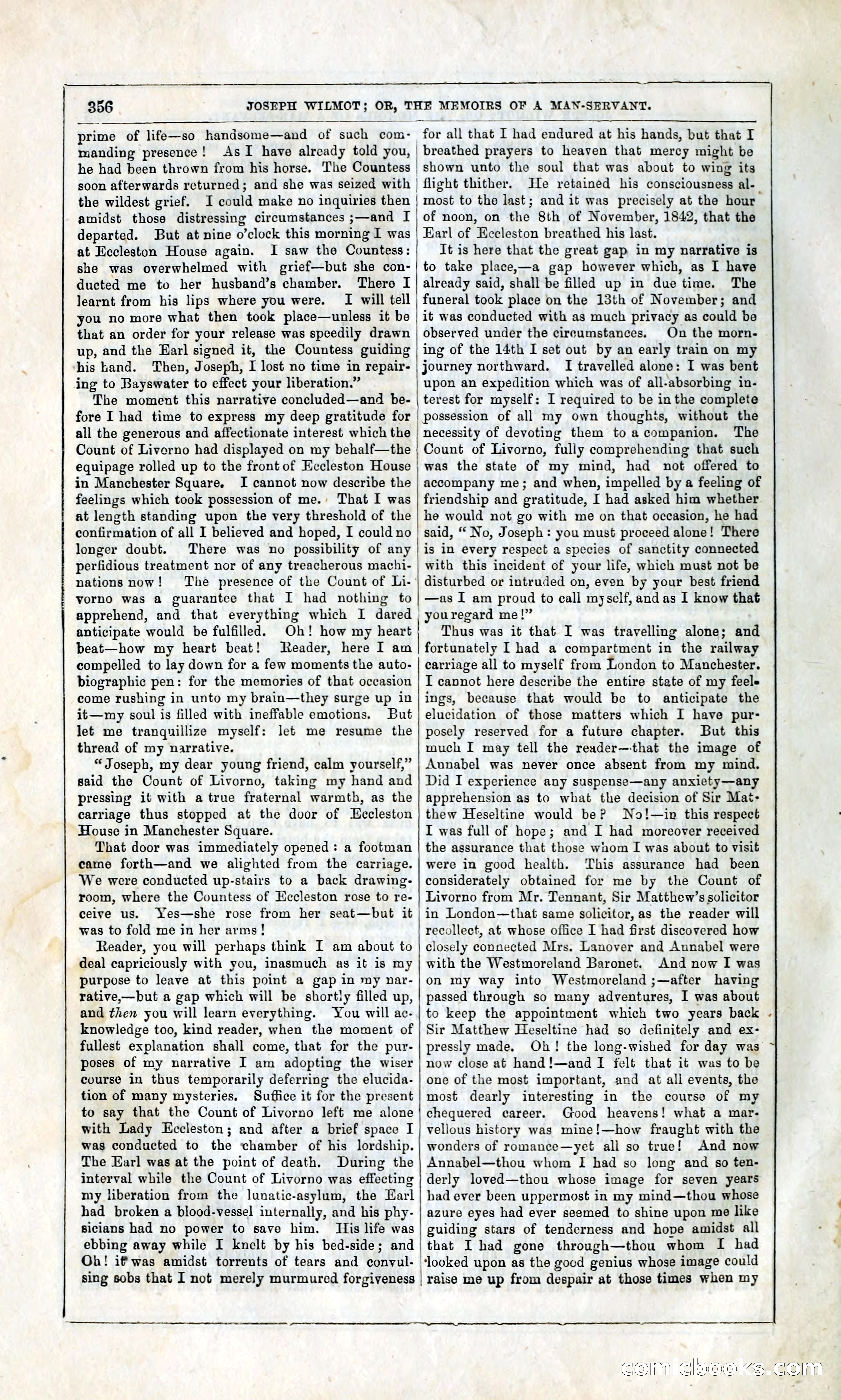
A restored page from Penny Dreadfuls, 1854. Page through the whole issue in the reader above.
📄 Transcribed text from this page (OCR, searchable)
Machine-transcribed from the original scan — historical spelling and the odd misread are preserved.
356 —_——— — prime of life—so handsome—and of such com- manding presence! AsI have already told you, he had been thrown from his horse. The Countess the wildest grief. JOSEPH WILMOT; OR, THE MEMOIRS OF A MAN-SERVANT. for all that I had endured at his hands, but that I breathed prayers to heaven that mercy might be ‘shown unto the soul that was about to wing its soon afterwards returned; and she was seized with | flight thither. I could make no inquiries then | most to the last; and it was precisely at the hour He retained his consciousness al- amidst those distressing circumstances ;—and I | of noon, on the 8th of November, 1842, that the departed. But at nine o’clock this morning I was | Earl of Eccleston breathed his last. at Eccleston House again. I saw the Countess: she was overwhelmed with grief—but she con- ducted me to her husband’s chamber. There I learnt from his lips where you were. I will tell you no more what then took place—unless it be that an order for your release was speedily drawn up, and the Earl signed it, the Countess guiding ‘his hand. Then, Joseph, I lost no time in repair- ing to Bayswater to effect your liberation.” The moment this narrative concluded—and be- fore I had time to express my deep gratitude for all the generous and affectionate interest which the Count of Liverno had displayed on my behalf—the equipage rolled up to the front of Eccleston House in Manchester Square. I cannot now describe the feelings which took possession of me. That I was at length standing upon the very threshold of the confirmation of all I believed and hoped, I could no longer doubt. There was no possibility of any perfidious treatment nor of any treacherous machi- nations now! ‘The presence of the Count of Li- vorno was a guarantee that I had nothing to apprehend, and that everything which I dared anticipate would be fulfilled. Oh! how my heart beat—how my heart beat! Reader, here I am compelled to lay down for a few moments the auto- biographic pen: for the memories of that occasion come rushing in unto my brain—they surge up in it—my soul is filled with ineffable emotions. But let me tranquillize myself: let me resume the thread of my narrative. “Joseph, my dear young friend, calm yourself,” said the Count of Livorno, taking my hand and pressing it with a true fraternal warmth, as the carriage thus stopped at the door of Eccleston House in Manchester Square. That door was immediately opened: a footman came forth—and we alighted from the carriage. We were conducted up-stairs to a back drawing- room, where the Countess of Eccleston rose to re- ceive us. Yes—she rose from her seat—but it was to fold me in her arms! Reader, you will perhaps think I am about to deal capriciously with you, inasmuch as it is my purpose to leave at this point a gap in my nar- rative,—but a gap which will be shortly filled up, and then you will learn everything. You will ac- knowledge too, kind reader, when the moment of fullest explanation shall come, that for the pur- poses of my narrative I am adopting the wiser course in thus temporarily deferring the elucida- tion of many mysteries. Suflice it for the present to say that the Count of Livorno left me alone with Lady Eccleston; and after a brief space I was conducted to the chamber of his lordship. The Earl was at the point of death. During the interval while the Count of Livorno was effecting my liberation from the lunatic-asylum, the Earl had broken a blood-vessel internally, and his phy- sicians had no power to save him. His life was It is here that the great gap in my narrative is to take place,—a gap however which, as I have already said, shall be filled up in due time. The funeral took place on the 13th of November; and it was conducted with as much privacy as could be observed under the circumstances. On the morn- ing of the 14th I set out by an early train on my journey northward. I travelled alone: I was bent upon an expedition which was of all-absorbing in- terest for myself: I required to be in the complete possession of all my own thoughts, without the necessity of devoting them to acompanion. The | Count of Livorno, fully comprehending that such | was the state of my mind, had not offered to accompany me; and when, impelled by a feeling of friendship and gratitude, I had asked him whether. he would not go with me on that occasion, he had said, ““ No, Joseph: you must proceed alone! There is in every respect a species of sanctity connected with this incident of your life, which must not be | disturbed or intruded on, even by your best friend —as I am proud to call myself, and as I know that youregard me!” Thus was it that I was travelling alone; and | féktanately I had a compartment in the railway carriage all to myself from London to Manchester. I cannot here describe the entire state of my feele ings, because that would be to anticipate the elucidation of those matters which I have pur- posely reserved for a future chapter. But this much I may tell the reader—-that the image of Aunabel was never once absent from my mind. Did I experience any suspense—any anxiety—any apprehension as to what the decision of Sir Mat- thew Heseltine would be? No!—in this respect I was full of hope; and I had moreover received the assurance that those whom I was about to visit were in good health. This assurance had been considerately obtained for me by the Count of Livorno from Mr. Tennant, Sir Matthew’s solicitor in London—that same solicitor, as the reader will recollect, at whose office I had first discovered how closely connected Mrs. Lanover and Annabel were with the Westmoreland Baronet. And now I was on my way into Westmoreland ;—after having passed through so many adventures, I was about to keep the appointment which two years back Sir Matthew Heseltine had so definitely and ex- pressly made. Oh! the long-wished for day was now close at hand!—and I felt that it was to be one of the most important, and at all events, the most dearly interesting in the course of my chequered career. Good heavens! what a mar- vellous history was mine!—how fraught with the wonders of romance—yet all so true! And now Annabel—thou whom I had so long and so ten- derly loved—thou whose image for seven years had ever been uppermost in my mind—thou whose azure eyes had ever seemed to shine upon me like guiding stars of tenderness and hope amidst all ebbing away while I knelt by his bed-side; and | that I had gone through—thou whom I had Ob! ifwas amidst torrents of tears and convul- |‘looked upon as the good genius whose image could sing sobs that I not merely murmured forgiveness | raise me up from despair at those times when my COM GOS (c@)