
Penny Dreadfuls, 1854 · page 367 of 399
Joseph Wilmot, or, The Memoirs of a Man-Servant — page 367: what you’re looking at
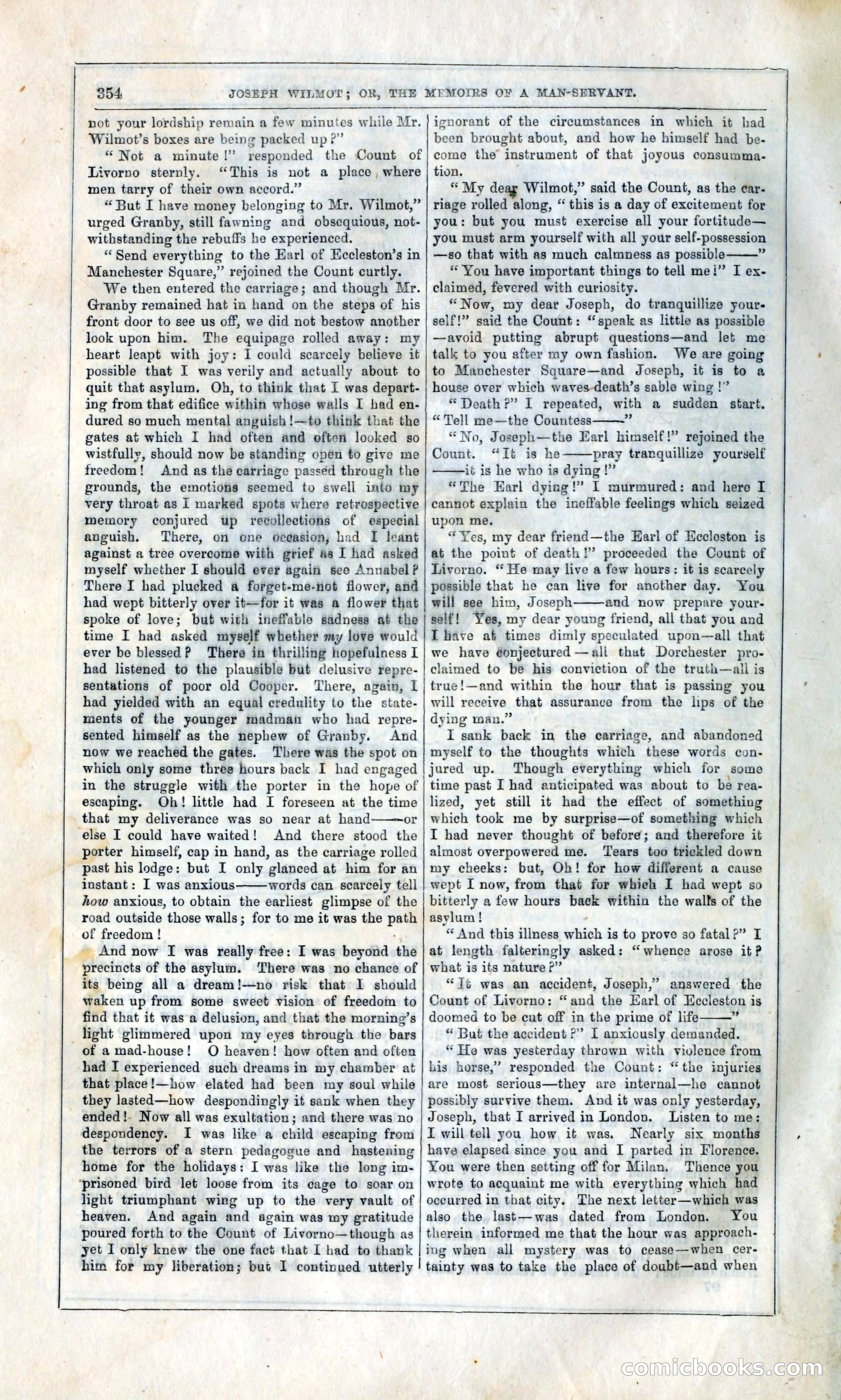
A restored page from Penny Dreadfuls, 1854. Page through the whole issue in the reader above.
📄 Transcribed text from this page (OCR, searchable)
Machine-transcribed from the original scan — historical spelling and the odd misread are preserved.
/ else I could have waited ! 354 not your lordship remain a few minutes while Mr. Wilmot’s boxes are being packed up?” * Not a minute!” responded the Count of Livorno sternly. “This is not a place, where men tarry of their own accord.” “But I have money belonging to Mr. Wilmot,” urged Granby, still fawning and obsequious, not- withstanding the rebuffs he experienced. “Send everything to the Karl of Hecleston’s in Manchester Square,” rejoined the Count curtly. We then entered the carriage; and though Mr. Granby remained hat in hand on the steps of his front door to see us off, we did not bestow another look upon him. The equipage rolled away: my heart leapt with joy: I could scarcely believe it possible that I was verily and actually about to quit that asylum. Oh, to think that I was depart- ing from that edifice within whose walls I had en- dured so much mental anguish!—to think that the gates at which I had often and often looked so wistfully, should now be standing open to give me freedom! And as the carriage passed through the grounds, the emotions seemed to swell into my very throat as I marked spots where retrospective memory conjured up recollections of especial anguish. There, on one oeeasion, had I leant against a tree overcome with grief as I had asked myself whether I should ever again see Annabel P There I had plucked a forget-me-not flower, and had wept bitterly over it—for it was a flowe# that spoke of love; but with ineffable sadness at the time I had asked myself whether my love would ever be blessed? There in thrilling hopefulness I had listened to the plausible but delusive repre- sentations of poor old Cooper. ‘There, again, L had yielded with an equal credulity to the state- ments of the younger madman who had repre- sented himself as the nephew of Granby. And now we reached the gates. There was the spot on which only some three hours back I had engaged in the struggle with the porter in the hope of escaping. Oh! little had I foreseen at the time that my deliverance was so near at hand or And there stood the porter himself, cap in hand, as the carriage rolled past his lodge: but I only glanced at him for an instant: I was anxious words can scarcely tell how anxious, to obtain the earliest glimpse of the road outside those walls; for to me it was the nea of freedom ! - And now I was really free: I was beyond the precincts of the asylum. ‘There was no chance of its being all a dream!—no risk that I should waken up from some sweet vision of freedom to find that it was a delusion, and that the mornine’s JOSEPH WIDLMOT; light glimmered upon my eyes through the bars of a mad-house! O heaven! how often and often had I experienced such dreams in my chamber at that place!—how elated had been my soul while they lasted—how despondingly it sank when they ended !. Now all was exultation; and there was no despondency. I was like a child escaping from the terrors of a stern pedagogue and hastening home for the holidays: I was like the long im- ‘prisoned bird let loose from its cage to soar on light triumphant wing up to the very vault of heaven. And again and again was wy gratitude poured forth to the Count of Livorno—though as yet I only knew the one fact that I had to thank —_— eee ignorant of the circumstances in which it had been brought about, and how he himself had be- come the instrument of that joyous consumma- tion. “My deag Wilmot,” said the Count, as the car. riage rolled along, “ this is a day of excitement for you: but you must exercise all your fortitude— you must arm yourself with all your self-possession —so that with as much calmness as possible o “You have important things to tell mei” claimed, fevered with curiosity. “Now, my dear Joseph, do tranquillize your- self!” said the Count: “speak as little as possible —avoid putting abrupt questions—and let me talk to you after my own fashion. We are going to Manchester Square—and Joseph, it is to a house over which waves-death’s sable wing !” I ex- “Death?” I repeated, with a sudden start. “Tell me—the Countess 74 “Wo, Joseph—the Earl himself!” rejoined the Count. “It is he pray tranquillize yourself it is he who is dying!” “The Earl dying!” I murmured: and here I cannot explain the ineffable feelings which seized upon me, “Yes, my dear friend—the Harl of Hecleston is at the point of death!’ proceeded the Count of Livorno. “ He may live a few hours: it is scarcely possible that he can live for another day. You will see him, Joseph and now prepare your- self! Yes, my dear young friend, all that you and I have at times dimly speculated upon—all that we have éonjectured —all that Dorchester pro- claimed to be his conviction of the truth—all is true!—and within the hour that is passing you will receive that assurance from the lips of the dying man.” I sank back in the carriage, and abandoned myself to the thoughts which these words con- jured up. Though everything which for some time past I had anticipated was about to be rea- lized, yet still it had the effect of something which took me by surprise—of something which I had never thought of before; and therefore it almost overpowered me. ‘Tears too trickled down my cheeks: but, Oh! for how different a cause wept I now, from that for whieh I had wept so bitterly a few hours back within the walls of the asylum ! “© And this illness sith is to prove so fatal?” I at length falteringly asked: “whence arose it? what is its nature P” “16 was an accident, Joseph,’ answered the Count of Livorno: “and the Earl of Eccleston is doomed to be cut off in the prime of life # “ But the accident P” I anxiously demanded. “ He was yesterday thrown with violence from his horse,’ responded the Count: “the injuries are most serious—they are internal—he cannot possibly survive them. And it was only yesterday, Joseph, that I arrived in London. Listen to me: I will tell you how it was. Nearly six months have elapsed since you and I parted in Florence. You were then setting off for Milan. Thence you wrote to acquaint me with everything which had occurred in that city. The next letter—which was also the last—was dated from London. You therein informed me that the hour was approach- ing when all mystery was to cease—when cer- him for my liberation; but I continued utterly | tainty was to take the place of doubt—and when EE ANSE OE ST TTD TT EE TST OES ST Se RT TET CW FF See re ee ee ee = eee Pe OR, THE MEMOIRS OF A MAN-SERVANT. , CORNICLOOLK