
Penny Dreadfuls, 1854 · page 364 of 399
Joseph Wilmot, or, The Memoirs of a Man-Servant — page 364: what you’re looking at
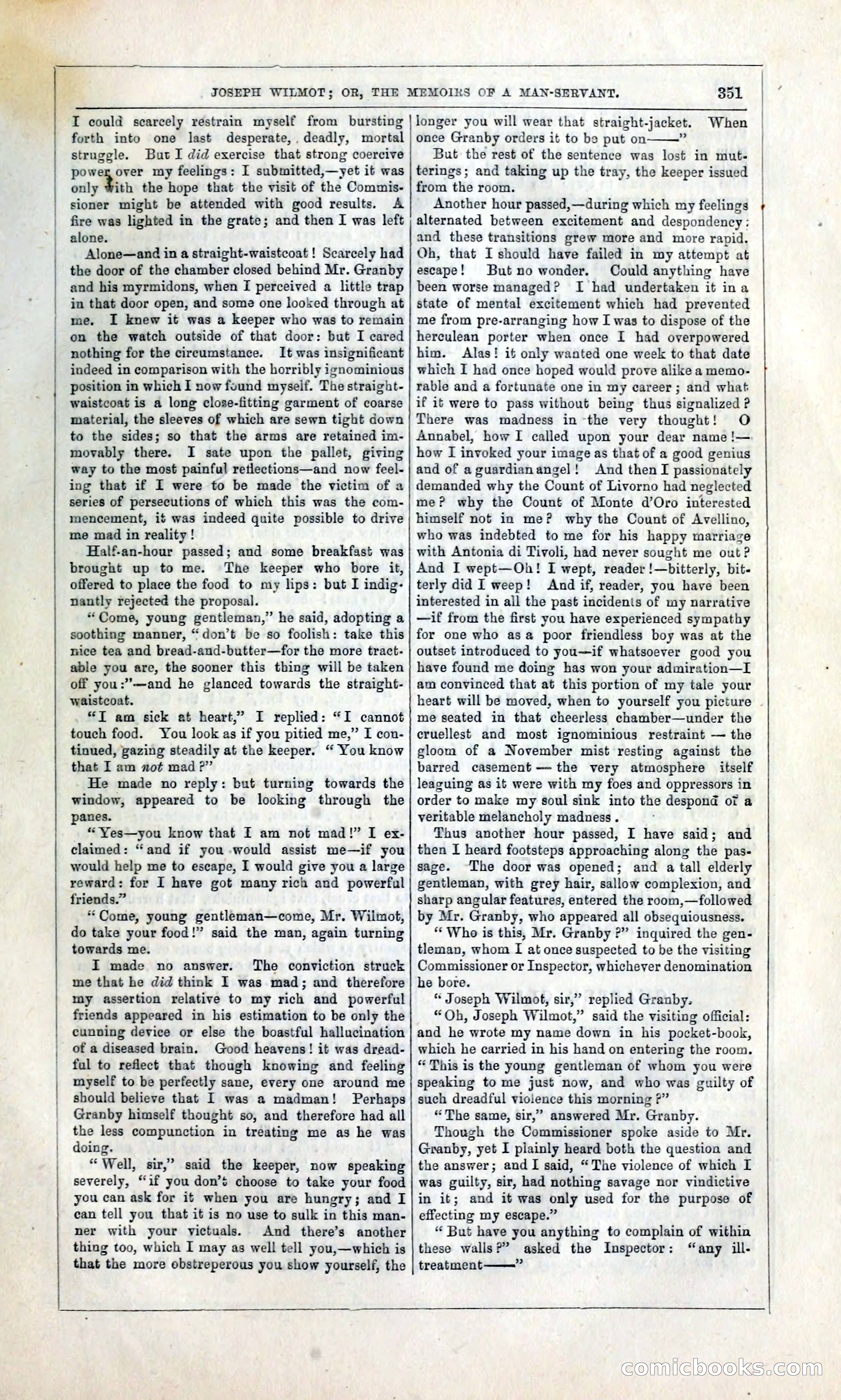
A restored page from Penny Dreadfuls, 1854. Page through the whole issue in the reader above.
📄 Transcribed text from this page (OCR, searchable)
Machine-transcribed from the original scan — historical spelling and the odd misread are preserved.
fi ~ Se / 4 | JOSEPH WILMOT; OR, THE MEMOIRS OF A MAN-SERVANT. 301 IT could scarcely restrain myself from bursting forth into one last desperate,. deadly, mortal struggle. But I did exercise that strong coercive power over my feelings: I submitted,—yet it was only Sith the hope that the visit of the Commis- sioner might be attended with good results. A fire was lighted in the grate; and then I was left alone. Alone—and in a straight-waistcoat! Scarcely had the door of the chamber closed behind Mr. Granby and his myrmidons, when I perceived a little trap in that door open, and some one looked through at me. I knew it was a keeper who was to remain on the watch outside of that door: but I cared nothing for the circumstance. It was insignificant indeed in comparison with the horribly ignominious position in which I now found myseif. The straight- waistcoat is a long close-fitting garment of coarse material, the sleeves of which are sewn tight down to the sides; so that the arms are retained im- movably there. I sate upon the pallet, giving way to the most painful retlections—and now feel- ing that if I were to be made the victim of a series of persecutions of which this was the com- mencement, if was indeed quite possible to drive me mad in reality ! Half-an-hour passed; and some breakfast was brought up to me. The keeper who bore it, offered to place the food to my lips: but I indig- nantly rejected the proposal. “Come, young gentleman,” he said, adopting a soothing manner, “don’t be so foolish: take this nice tea and bread-and-butter—for the more tract- able you are, the sooner this thing will be taken off you:”—and he glanced towards the straight- waistcoat. *T am sick at heart,” I replied: “I cannot touch food. You look as if you pitied me,” I con- tinued, gazing steadily at the keeper. “ You know that I am not mad ?” He made no reply: but turning towards the window, appeared to be looking through the panes. *“ Yes—you know that I am not mad!” I ex- claimed: “and if you would assist me—if you would help me to escape, I would give you a large reward: for I have got many rich and powerful friends.” “Come, young gentleman—come, Mr. Wiimot, do take your food!” said the man, again turning towards me. I made no answer. The conviction struck me that he did think I was mad; and therefore my assertion relative to my rich and powerful friends appeared in his estimation to be only the cunning device or else the boastful hallucination of a diseased brain. Good heavens! it was dread- ful to reflect that though knowing and feeling myself to be perfectly sane, every one around me should believe that I was a madman! Perhaps Granby himself thought so, and therefore had all the less compunction in treating me as he was doing. “ Well, sir,” said the keeper, now speaking severely, “if you don’s choose to take your food you can ask for it when you are hungry; and I can tell you that it is no use to sulk in this man- ner with your victuals. And there’s another thing too, which I may as well tell you,—which is that the more obstreperous you show yourself, the longer you will wear that straight-jacket. When once Granby orders it to bs put on - But the rest of the sentence was lost in mut- terings; and taking up the tray, the keeper issued from the room. Another hour passed,—during which my feelings alternated between excitement and despondency: and these transitions grew more and more rapid. Oh, that I should have failed in my attempt at escape! Butno wonder. Could anything have been worse managed? I had undertaken it ina state of mental excitement which had prevented me from pre-arranging how I was to dispose of the herculean porter when once I had overpowered him. Alas! if only wanted one week to that date which I had once hoped would prove alike a memo- rable and a fortunate one in my career; and what if 16 were to pass without being thus signalized ? There was madness in -the very thought! O Annabel, how I called upon your dear name !—. how I invoked your image as that of a good genius and of aguardianangel! And then I passionately demanded why the Count of Livorno had neglected me? why the Count of Monte d’Oro interested himself not in me? why the Count of Avellino, who was indebted to me for his happy marriage with Antonia di Tivoli, had never sought me out ? And I wept—Oh! I wept, reader !—bitterly, bit- terly did I weep! And if, reader, you have been interested in all the past incidents of my narrative —if from the first you have experienced sympathy for one who asa poor friendless boy was at the outset introduced to you—if whatsoever good you have found me doing has won your admiration—I am convinced that at this portion of my tale your heart will be moved, when to yourself you picture ~ me seated in that cheerless chamber—under the eruellest and most ignominious restraint — the gloom of a November mist resting against the barred casement——the very atmosphere itself leacuing as it were with my foes and oppressors in order to make my soul sink into the despond of a veritable melancholy madness . Thus another hour passed, I have said; and then I heard footsteps approaching along the pas- sage. ‘The door was opened; and a tall elderly gentleman, with grey hair, sallow complexion, and sharp angular features, entered the room,—followed by Mr. Granby, who appeared all obsequiousness. ** Who is this, Mr. Granby ?” inquired the gen- tleman, whom I at once suspected to be the visiting Commissioner or Inspector, whichever denomination he bore. “ Joseph Wilmot, sir,” replied Granby. “Ob, Joseph Wilmot,” said the visiting official: and he wrote my name down in his pocket-book, which he carried in his hand on entering the room. “This is the young gentleman of whom you were speaking to me just now, and who was guilty of such dreadful violence this morning ?” “The same, sir,” answered Mr. Granby. Though the Commissioner spoke aside to Mr. Granby, yet I plainly heard both the question and the answer; and I said, “The violence of which I was guilty, sir, had nothing savage nor vindictive in it; and it was only used for the purpose of effecting my escape.” “ But have you anything to complain of within these walls?” asked the Inspector: “any ill- treatment ”? EloOOl< (GO)