
Penny Dreadfuls, 1854 · page 361 of 399
Joseph Wilmot, or, The Memoirs of a Man-Servant — page 361: what you’re looking at
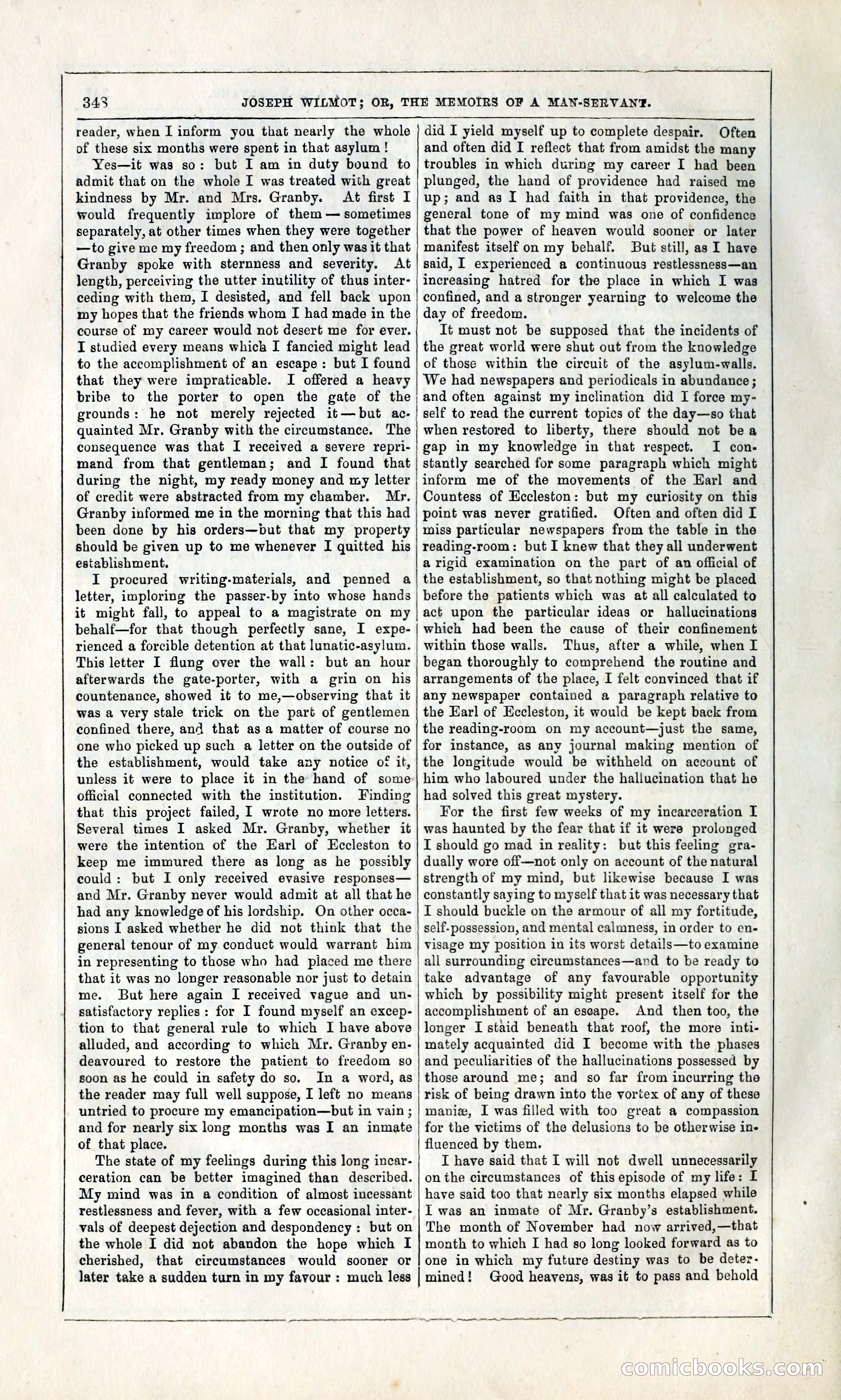
A restored page from Penny Dreadfuls, 1854. Page through the whole issue in the reader above.
📄 Transcribed text from this page (OCR, searchable)
Machine-transcribed from the original scan — historical spelling and the odd misread are preserved.
345 reader, when I inform you that nearly the whole of these six months were spent in that asylum! Yes—it was so: but I am in duty bound to admit that on the whole I was treated with great kindness by Mr. and Mrs. Granby. At first I would frequently implore of them — sometimes separately, at other times when they were together —to give me my freedom ; and then only was it that Granby spoke with sternness and severity. At length, perceiving the utter inutility of thus inter- ceding with them, I desisted, and fell back upon my hopes that the friends whom I had made in the course of my career would not desert me for ever. I studied every means which I fancied might lead to the accomplishment of an escape: but I found that they were impraticable. I offered a heavy bribe to the porter to open the gate of the grounds: he not merely rejected it—but ac- quainted Mr. Granby with the circumstance. The consequence was that I received a severe repri- mand from that gentleman; and I found that during the night, my ready money and wy letter of credit were abstracted from my chamber. Mr. Granby informed me in the morning that this had been done by his orders—but that my property should be given up to me whenever I quitted his establishment. I procured writing-materials, and penned a letter, imploring the passer-by into whose hands it might fall, to appeal to a magistrate on my behalf—for that though perfectly sane, I expe- rienced a forcible detention at that lunatic-asylum. This letter I flung over the wall: but an hour afterwards the gate-porter, with a grin on his countenance, showed it to me,—observing that it was a very stale trick on the part of gentlemen confined there, and that as a matter of course no one who picked up such a letter on the outside of the establishment, would take any notice of it, unless it were to place it in the hand of some official connected with the institution. Finding that this project failed, I wrote no more letters. Several times I asked Mr. Granby, whether it were the intention of the Earl of Eccleston to keep me immured there as long as he possibly could: but I only received evasive responses— ard Mr. Granby never would admit at all that he had any knowledge of his lordship. On other occa- sions I asked whether he did not think that the general tenour of my conduct would warrant him in representing to those who had placed me there that it was no longer reasonable nor just to detain me. But here again I received vague and un- satisfactory replies: for I found myself an excep- tion to that general rule to which I have above alluded, and according to which Mr. Granby en- deavoured to restore the patient to freedom so soon as he could in safety do so. In a word, as the reader may full well suppose, I left no means untried to procure my emancipation—but in vain ; and for nearly six long months was I an inmate of that place. The state of my feelings during this long incar- ceration can be better imagined than described. My mind was in a condition of almost incessant restlessness and fever, with a few occasional inter- vals of deepest dejection and despondency : but on the whole I did not abandon the hope which I cherished, that circumstances would sooner or later take a sudden turn in my favour: much less | mined! — en JOSEPH WILMOT; OR, THE MEMOIRS OF A MAN-SERVAN®. did I yield myself up to complete despair. Often and often did I reflect that from amidst the many troubles in which during my career I had been plunged, the hand of providence had raised me up; and as I had faith in that providence, the general tone of my mind was one of confidence that the power of heaven would sooner or later manifest itself on my behalf. But still, as I have said, I experienced a continuous restlessness—an increasing hatred for the place in which I was confined, and a stronger yearning to welcome the day of freedom. It must not be supposed that the incidents of the great world were shut out from the knowledge of those within the circuit of the asylum-walls. We had newspapers and periodicals in abundance; and often against my inclination did I force my- self to read the current topics of the day—so that when restored to liberty, there should not bea gap in my knowledge in that respect. I con- stantly searched for some paragraph which might inform me of the movements of the Earl and Countess of Eccleston: but my curiosity on this point was never gratified. Often and often did I miss particular newspapers from the table in the reading-room: but I knew that they all underwent a rigid examination on the part of an official of the establishment, so that nothing might be placed before the patients which was at all calculated to act upon the particular ideas or hallucinations which had been the cause of their confinement within those walls. Thus, after a while, when I began thoroughly to comprehend the routine and arrangements of the place, I felt convinced that if any newspaper contained a paragraph relative to the Earl of Eccleston, it would be kept back from the reading-room on my account—just the same, for instance, as any journal making mention of the longitude would be withheld on account of him who laboured under the hallucination that he had solved this great mystery. For the first few weeks of my incarceration I was haunted by the fear that if it were prolonged IT should go mad in reality: but this feeling gra- dually wore off—not only on account of the natural strength of my mind, but likewise because I was constantly saying to myself that it was necessary that I should buckle on the armour of all my fortitude, self- possession, and mental calmness, in order to en- visage my position in its worst details—to examine all surrounding circumstances—and to be ready to take advantage of any favourable opportunity which by possibility might present itself for the accomplishment of an escape. And then too, the longer I staid beneath that roof, the more inti- mately acquainted did I become with the phases and peculiarities of the hallucinations possessed by those around me; and so far from incurring the risk of being drawn into the vortex of any of these maniz, I was filled with too great a compassion for the victims of the delusions to be otherwise in- fluenced by them. I have said that I will not dwell unnecessarily on the circumstances of this episode of my life: I have said too that nearly six months elapsed while YT was an inmate of Mr. Granby’s establishment. The month of November had now arrived,—that month to which I had so long looked forward as to one in which my future destiny was to be deter- Good heavens, was it to pass and behold OOO) SS (©)