
Penny Dreadfuls, 1854 · page 352 of 399
Joseph Wilmot, or, The Memoirs of a Man-Servant — page 352: what you’re looking at
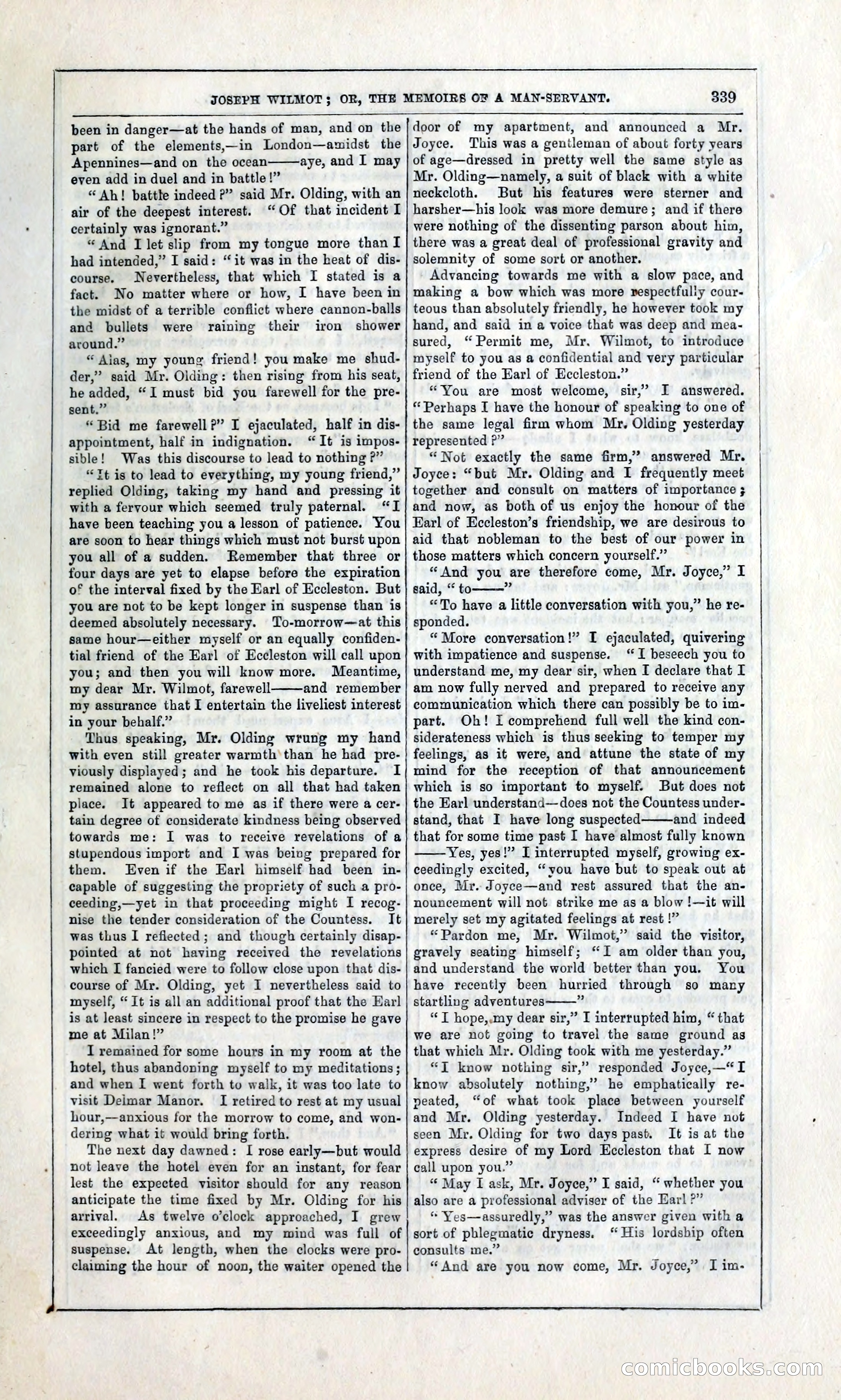
A restored page from Penny Dreadfuls, 1854. Page through the whole issue in the reader above.
📄 Transcribed text from this page (OCR, searchable)
Machine-transcribed from the original scan — historical spelling and the odd misread are preserved.
JOSEPH WILMOT; OR, THE MEMOIRS OF A MAN-SERVANT. 339 been in danger—at the hands of man, and on the part of the elements,—in London—amidst the Apennines—and on the ocean aye, and I may even add in duel and in battle!” “Ah! battle indeed ?” said Mr. Olding, with an air of the deepest interest. “Of that incident I certainly was ignorant.” “And I let slip from my tongue more than I had intended,” I said: “it was in the heat of dis- course. Nevertheless, that which I stated is a fact. No matter where or how, I have been in the midst of a terrible conflict where cannon-balls and bullets were raining their iron shower around.” “ Aias, my young friend! you make me shud- der,” said Mr. Olding: then rising from his seat, he added, “I must bid you farewell for the pre- sent.” “Bid me farewell?” I ejaculated, half in dis- appointment, half in indignation. “It is impos- sible! Was this discourse to lead to nothing ?” “Tt is to lead to everything, my young friend,” replied Olding, taking my hand and pressing it with a feryour which seemed truly paternal. “I have been teaching you a lesson of patience. You are soon to hear things which must not burst upon you all of a sudden. Remember that three or four days are yet to elapse before the expiration of the interval fixed by the Earl of Eccleston. But you are not to be kept longer in suspense than is deemed absolutely necessary. To-morrow—at this same hour—either myself or an equally confiden- tial friend of the Earl of Eccleston will call upon you; and then you will know more. Meantime, my dear Mr. Wilmot, farewell and remember my assurance that I entertain the liveliest interest in your behalf.” Thus speaking, Mr. Olding wrung my hand with even still greater warmth than he had pre- viously displayed; and he took his departure. I remained alone to reflect on all that had taken place. It appeared to me as if there were a cer- tain degree of considerate kindness being observed towards me: I was to receive revelations of a stupendous import and I was beivg prepared for them. Even if the Earl himself had been in- capable of suggesting the propriety of such a pro- ceeding,—yet in that proceeding might I recog- nise the tender consideration of the Countess. It was thus I refiected; and though certainly disap- pointed at not having received the revelations which I fancied were to follow close upon that dis- course of Mr. Olding, yet I nevertheless said to myself, “It is all an additional proof that the Ear! is at least sincere in respect to the promise he gave me at Milan!” I remained for some hours in my room at the hotel, thus abandoning myself to my meditations; and when I went forth to walk, it was too late to visit Deimar Manor. [I retired to rest at my usual hour,—anxious for the morrow to come, and won- dering what it would bring forth. The next day dawned: I rose early—but would not leave the hotel even for an instant, for fear lest the expected visitor should for any reason anticipate the time fixed by Mr. Olding for his arrival. As twelve o’clock approached, I grew exceedingly anxious, and my mind was full of suspense. At length, when the clocks were pro- claiming the hour of noon, the waiter opened the door of my apartment, and announced a Mr. Joyce. This was a gentleman of about forty years of age—dressed in pretty well the same style as Mr. Olding—namely, a suit of black with a white neckcloth. But his features were sterner and harsher—his look was more demure; and if there were nothing of the dissenting parson about him, there was a great deal of professional gravity and solemnity of some sort or another. Advancing towards me with a slow pace, and making a bow which was more respectfully cour- teous than absolutely friendly, he however took my hand, and said in a voice that was deep and mea- sured, “Permit me, Mr. Wilmot, to introduce myself to you as a confidential and very particular friend of the Earl of Eccleston.” “You are most welcome, sir,’ I answered. “Perhaps I have the honour of speaking to one of the same legal firm whom Mr, Olding yesterday represented P” “Not exactly the same firm,’ answered Mr. Joyce: “but Mr. Olding and I frequently meet together and consult on matters of importance ; and now, as both of us enjoy the honour of the Earl of Eccleston’s friendship, we are desirous to aid that nobleman to the best of our power in those matters which concern yourself.” “And you are therefore come, Mr. Joyce,” I said, “ to # “To have a little conversation with you,” he re- sponded. “ More conversation!” I ejaculated, quivering with impatience and suspense. “I beseech you to understand me, my dear sir, when I declare that I am now fully nerved and prepared to receive any communication which there can possibly be to im- part. Oh! I comprehend full well the kind con- siderateness which is thus seeking to temper my feelings, as it were, and attune the state of my mind for the reception of that announcement which is so important to myself. But does not the Earl understand—does not the Countess under- stand, that I have long suspected and indeed that for some time past I have almost fully known Yes, yes!” I interrupted myself, growing ex- ceedingly excited, “vou have but to speak out at once, Mr. Joyce—and rest assured that the an- nouncement will not strike me as a blow !—it will merely set my agitated feelings at rest !” “Pardon me, Mr. Wilmot,” said the visitor, gravely seating himself; “1 am older than you, and understand the world better than you. You have recently been hurried through so many startling adventures 8 “T hope,.my dear sir,” I interrupted him, “that we are not going to travel the same ground as that which Mr. Olding took with me yesterday.” “J know nothing sir,” responded Joyce,—*I know absolutely nothing,’ he emphatically re- yeated, “of what took place between yourself and Mr. Olding yesterday. Indeed I have not seen Mr. Olding for two days past. It is at the express desire of my Lord Eccleston that I now call upon you.” “ May I ask, Mr. Joyce,” I said, “ whether you also are a professional adviser of the Har! ?” * Yes—assuredly,” was the answer given with a sort of phlegmatic dryness. “His lordsbip often consults me.” “And are you now come, Mr. Joyce,” I im- 39 Giook (EO)