
Penny Dreadfuls, 1854 · page 346 of 399
Joseph Wilmot, or, The Memoirs of a Man-Servant — page 346: what you’re looking at
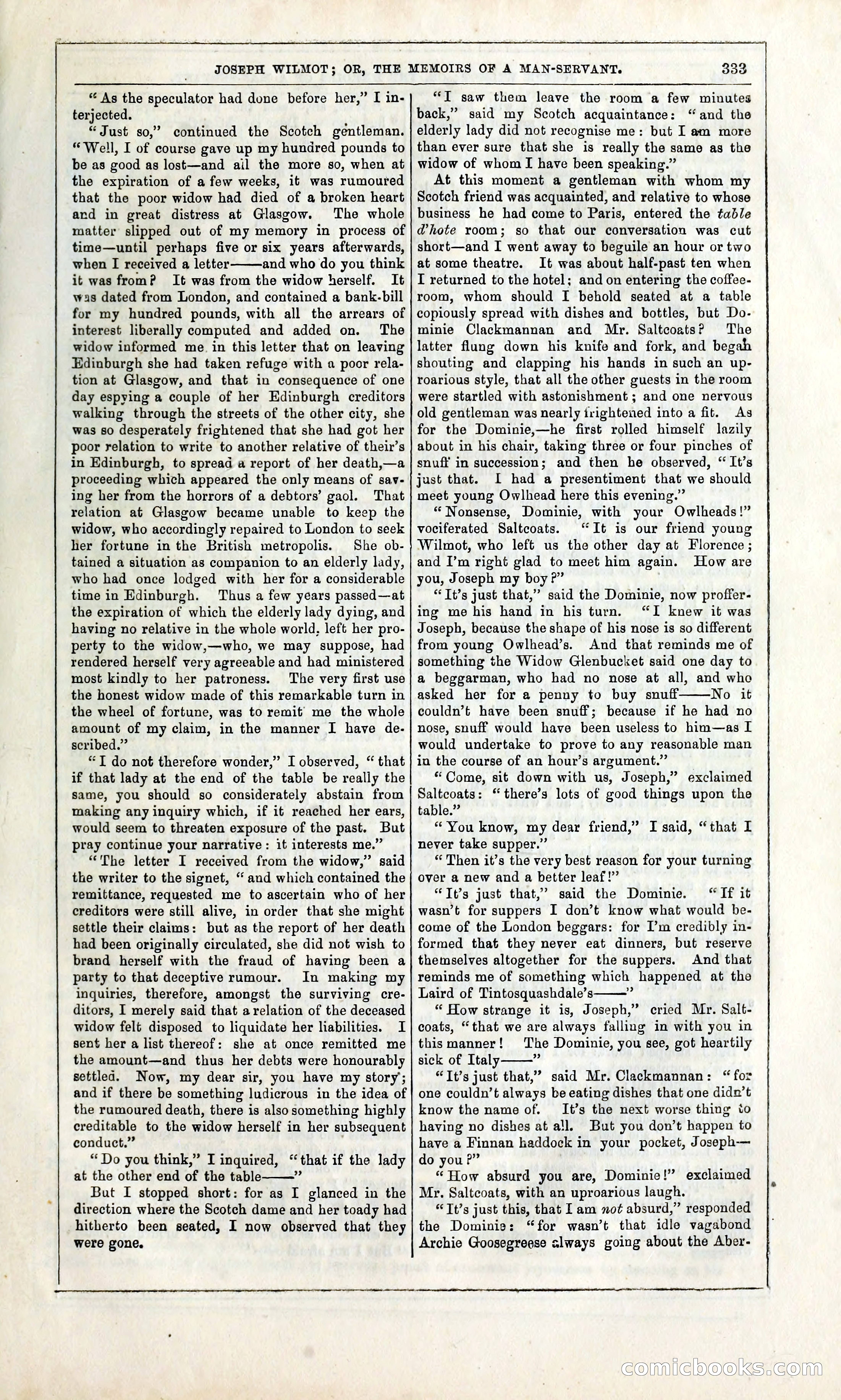
A restored page from Penny Dreadfuls, 1854. Page through the whole issue in the reader above.
📄 Transcribed text from this page (OCR, searchable)
Machine-transcribed from the original scan — historical spelling and the odd misread are preserved.
JOSEPH WILMOT; OR, THE MEMOIRS OF A MAN-SERVANT. 333 “ As the speculator had done before her,” I in- terjected. “Just so,” continued the Scotch gentleman. “Well, I of course gave up my hundred pounds to be as good as lost—and ail the more so, when at the expiration of a few weeks, it was rumoured that the poor widow had died of a broken heart ard in great distress at Glasgow. The whole matter slipped out of my memory in process of time—until perhaps five or six years afterwards, when I received a letter and who do you think it was from? It was from the widow herself. It was dated from London, and contained a bank-bill for my hundred pounds, with all the arrears of interest liberally computed and added on. The widow informed me. in this letter that on leaving Edinburgh she had taken refuge with a poor rela- tion at Glasgow, and that in consequence of one day espying a couple of her Edinburgh creditors walking through the streets of the other city, she was so desperately frightened that she had got her poor relation to write to another relative of their’s in Edinburgh, to spread a report of her death,—a proceeding which appeared the only means of sav- ing her from the horrors of a debtors’ gaol. That relation at Glasgow became unable to keep the widow, who accordingly repaired to London to seek her fortune in the British metropolis. She ob- tained a situation as companion to an elderly lady, who had once lodged with her for a considerable time in Edinburgh. ‘Thus a few years passed—at the expiration of which the elderly lady dying, and having no relative in the whole world, left her pro- perty to the widow,—who, we may suppose, had rendered herself very agreeable and had ministered most kindly to her patroness. The very first use the honest widow made of this remarkable turn in the wheel of fortune, was to remit me the whole amount of my claim, in the manner I have de- scribed.” “I do not therefore wonder,” I observed, “ that if that lady at the end of the table be really the Same, you should so considerately abstain from making any inquiry which, if it reached her ears, would seem to threaten exposure of the past. But pray continue your narrative: it interests me.” “The letter I received from the widow,” said the writer to the signet, “ and which contained the remittance, requested me to ascertain who of her creditors were still alive, in order that she might settle their claims: but as the report of her death had been originally circulated, she did not wish to brand herself with the fraud of having been a party to that deceptive rumour. In making my inquiries, therefore, amongst the surviving cre- ditors, I merely said that a relation of the deceased widow felt disposed to liquidate her liabilities. I sent her a list thereof: she at once remitted me the amount—and thus her debts were honourably settled. Now, my dear sir, you have my story; and if there be something ludicrous in the idea of the ramoured death, there is also something highly creditable to the widow herself in her subsequent conduct.” : “Do you think,” I inquired, “that if the lady at the other end of the table-——” But I stopped short: for as I glanced in the direction where the Scotch dame and her toady had hitherto been seated, I now observed that they were gone. — “YT saw them leave the room a few minutes back,” said my Scotch acquaintance: “and the elderly lady did not recognise me: but I am more than ever sure that she is really the same as the widow of whom I have been speaking.” At this moment a gentleman with whom my Scotch friend was acquainted, and relative to whose business he had come to Paris, entered the table @hote room; so that our conversation was cut short—and I went away to beguile an hour or two at some theatre. It was about half-past ten when I returned to the hotel; and on entering the coffee- room, whom should I behold seated at a table copiously spread with dishes and bottles, but Do- minie Clackmannan ard Mr. Saltcoats? The latter flung down his knife and fork, and begah shouting and clapping his hands in such an up- roarious style, that all the other guests in the room were startled with astonishment ; and one nervous old gentleman was nearly irightened into a fit. As for the Dominie,—he first rolled himself lazily about in his chair, taking three or four pinches of snuff in succession; and then he observed, “ It’s just that. I had a presentiment that we should meet young Owlhead here this evening.” “Nonsense, Dominie, with your Owlheads!” vociferated Saltcoats. “It is our friend young ‘Wilmot, who left us the other day at Florence ; and I’m right glad to meet him again. How are you, Joseph my boy ?” “It’s just that,” said the Dominie, now proffer- ing me his hand in his turn. “I knew it was Joseph, because the shape of his nose is so different from young Owlhead’s. And that reminds me of something the Widow Glenbucket said one day to a beggarman, who had no nose at all, and who asked her for a penny to buy snuff No it couldn’t have been snuff; because if he had no nose, snuff would have been useless to him—as I would undertake to prove to any reasonable man in the course of an hour’s argument.” “Come, sit down with us, Joseph,” exclaimed Saltcoats: “there’s lots of good things upon the table.” “You know, my dear friend,” I said, “that I never take supper.” “Then it’s the very best reason for your turning over a new and a better leaf!” “Tt’s just that,’ said the Dominie. “If it wasn’t for suppers I don’t know what would be- come of the London beggars: for I’m credibly in- formed that they never eat dinners, but reserve themselves altogether for the suppers. And that reminds me of something which happened at the Laird of Tintosquashdale’s K “ How strange it is, Joseph,” cried Mr. Salt- coats, “that we are always falling in with you in this manner! The Dominie, you see, got heartily sick of Italy a “It’s just that,” said Mr. Clackmannan: “for one couldn’t always be eating dishes that one didn’t know the name of. It’s the next worse thing to having no dishes at a!]. But you don’t happen to have a Finnan haddock in your pocket, Joseph-— do you P” “ How absurd you are, Dominie!” exclaimed | Mr. Saltcoats, with an uproarious laugh. “Tt’s just this, that Iam not absurd,” responded the Dominig: “for wasn’t that idle vagabond Archie Goosegreese always going about the Aber- CoOnnicloookks (SO)