
Penny Dreadfuls, 1854 · page 341 of 399
Joseph Wilmot, or, The Memoirs of a Man-Servant — page 341: what you’re looking at
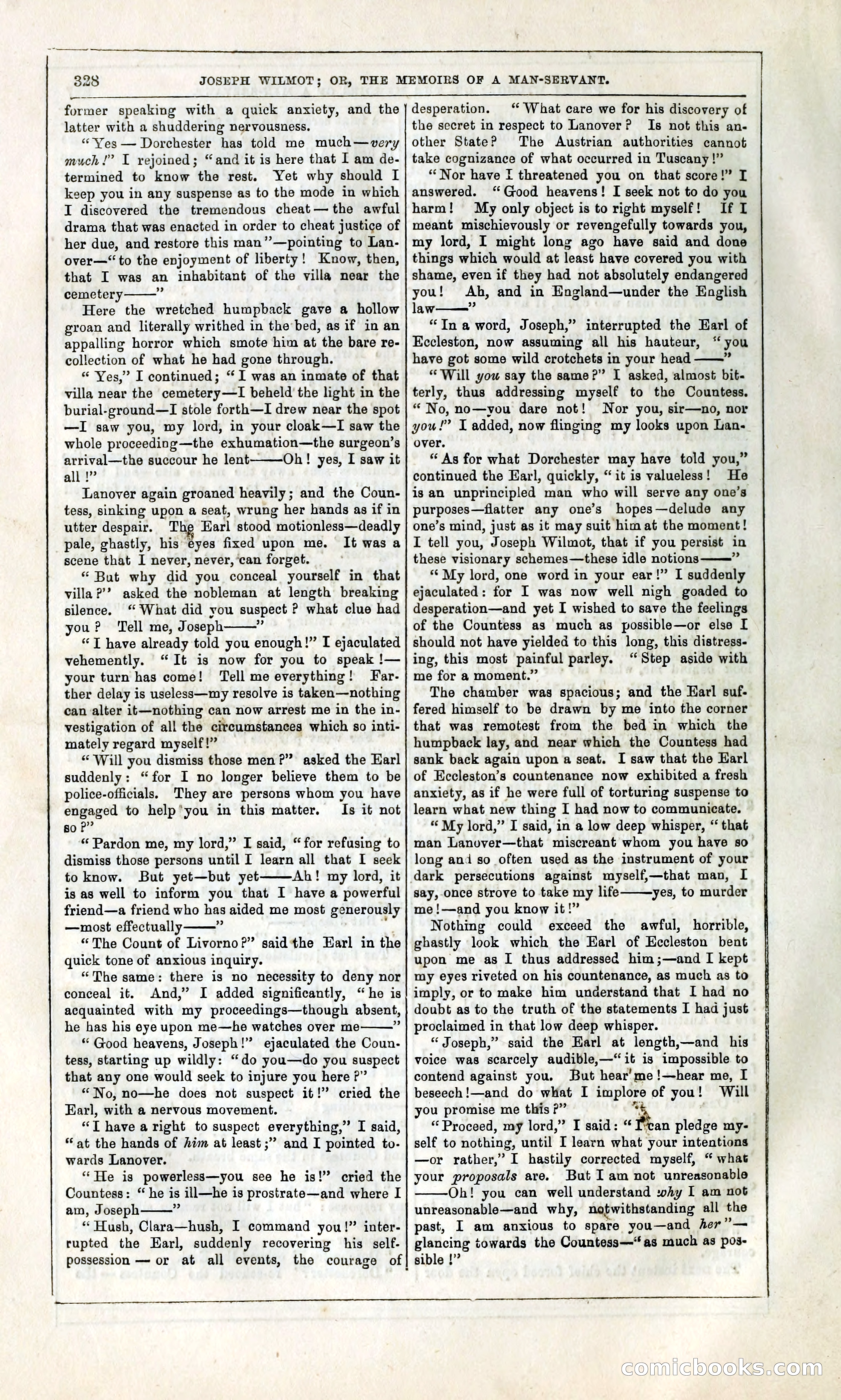
A restored page from Penny Dreadfuls, 1854. Page through the whole issue in the reader above.
📄 Transcribed text from this page (OCR, searchable)
Machine-transcribed from the original scan — historical spelling and the odd misread are preserved.
= 328 JOSEPH WILMOT; OR, THE MEMOIRS OF A MAN-SERVANT. former speaking with a quick anxiety, and the latter with a shuddering nervousness. “Yes — Dorchester has told me much—very much!” I rejoined; “and it is here that I am de- termined to know the rest. Yet why should I keep you in any suspense as to the mode in which I discovered the tremendous cheat— the awful drama that was enacted in order to cheat justice of her due, and restore this man”’—pointing to Lan- over—“ to the enjoyment of liberty! Know, then, that I was an inhabitant of the villa near the cemetery i Here the wretched humpback gave a hollow groan and literally writhed in the’bed, as if in an appalling horror which smote him at the bare re- collection of what he had gone through. “ Yes,” I continued; “I was an inmate of that villa near the cemetery—I beheld the light in the burial-ground—I stole forth—I drew near the spot —I saw you, wy lord, in your cloak—lI saw the whole proceeding—the exhumation—the surgeon’s arrival—the succour he lent-———-Oh! yes, I saw it all !” Lanover again groaned heavily; and the Coun- tess, sinking upon a seat, wrung her hands as if in utter despair. The Earl stood motionless—deadly pale, ghastly, his eyes fixed upon me. It was a scene that I never, never, ‘can forget. “ But why did you conceal yourself in that villa???’ asked the nobleman at length breaking silence. “ What did you suspect what clue had you? ‘Tell me, Joseph “T have already told you enough!” [ ejaculated vehemently. “It is now for you to speak !— your turn has come! Tell me everything! Far- ther delay is useless—my resolve is taken—nothing can alter it—nothing can now arrest me in the in- vestigation of all the circumstances which so inti- mately regard myself!” “Will you dismiss those men P” asked the Harl suddenly: “for I no longer believe them to be police-officials. They are persons whom you have engaged to help*you in this matter. Is it not g0 P” “Pardon me, my lord,” I said, “for refusing to dismiss those persons until I learn all that I seek to know. But yet—but yet Ah! my lord, it is as well to inform you that I have a powerful friend—a friend who has aided me most generously —most effectually “The Count of Livorno?” saidthe Earl in the quick tone of anxious inquiry. “The same: there is no necessity to deny nor conceal it. And,” I added significantly, “he is acquainted with my proceedings—though absent, he has his eye upon me—he watches over me r “ Good heavens, Joseph!” ejaculated the Coun- tess, starting up wildly: “do you—do you suspect that any one would seek to injure you here P” “No, no—he does not suspect it!” cried the Earl, with a nervous movement. “T have aright to suspect everything,” I said, at the hands of Aim at least ;” and I pointed to- wards Lanover. “‘ He is powerless—you see he is!” cried the Countess: “ he is ill—he is prostrate—and where I am, Joseph “Hush, Clara—hush, I command you!” inter- rupted the Earl, suddenly recovering his self: possession — or at all events, the courage of desperation. ‘ What care we for his discovery of the secret in respect to LanoverP Is not this an- other State? The Austrian authorities cannot take cognizance of what occurred in Tuscany !” “Nor have I threatened you on that score!” I answered. ‘Good heavens! I seek not to do you harm! My only object is to right myself! If I meant mischievously or revengefully towards you, my lord, I might long ago have said and done things which would at least have covered you with shame, even if they had not absolutely endangered you! Ab, and in England—under the English law ¢ “In a word, Joseph,” interrupted the Harl of Eccleston, now assuming all his hauteur, * you have got some wild crotchets in your head is “Will you say the same?” I asked, almost bit- terly, thus addressing myself to the Countess. “ No, no—you dare not! Nor you, sir—no, nor you!” I added, now flinging my looks upon lan. over. “As for what Dorchester may have told you,” continued the Earl, quickly, “it is valueless! He is an unprincipled man who will serve any one’s purposes—flatter any one’s hopes—delude any one’s mind, just as it may suit him at the moment! I tell you, Joseph Wilmot, that if you persist in these visionary schemes—these idle notions i “© My lord, one word in your ear!” I suddenly ejaculated: for I was now well nigh goaded to desperation—and yet I wished to save the feelings of the Countess as much as possible—or else I should not have yielded to this long, this distress- ing, this most painful parley. “Step aside with me for a moment.” The chamber was spacious; and the Earl suf- fered himself to be drawn by me into the corner that was remotest from the bed in which the humpback lay, and near which the Countess had sank back again upon a seat. I saw that the Harl of Eccleston’s countenance now exhibited a fresh anxiety, as if he were full of torturing suspense to learn what new thing I had now to communicate. “ My lord,” I said, in a low deep whisper, “ that man Lanuver—that miscreant whom you have so long and so often used as the instrument of your dark persecutions against myself,—that man, I say, once strove to take my life me!—and you know it!” Nothing could exceed the awful, horrible, ghastly look which the Harl of Eccleston bent upon me as I thus addressed him;—and I kept my eyes riveted on his countenance, as much as to imply, or to make him understand that I had no doubt as to the truth of the statements I had just proclaimed in that low deep whisper. “ Joseph,” said the Earl at length,—and his voice was scarcely audible,—“it is impossible to yes, to murder | contend against you. But hear'me !—hear me, I beseech!—and do what I implore of you! Will you promise me this ?” es “Proceed, my lord,” I said: an pledge my- self to nothing, until I learn what your intentions —or rather,” I hastily corrected myself, “ what your proposals are. But Iam not unreasonable Oh! you can well understand why I am not unreasonable—and why, notwithstanding all the past, I am anxious to spare you—and her” glancing towards the Countess—“as much as es. | sible 1” CoOnnicloookks (c@)