
Penny Dreadfuls, 1854 · page 333 of 399
Joseph Wilmot, or, The Memoirs of a Man-Servant — page 333: what you’re looking at
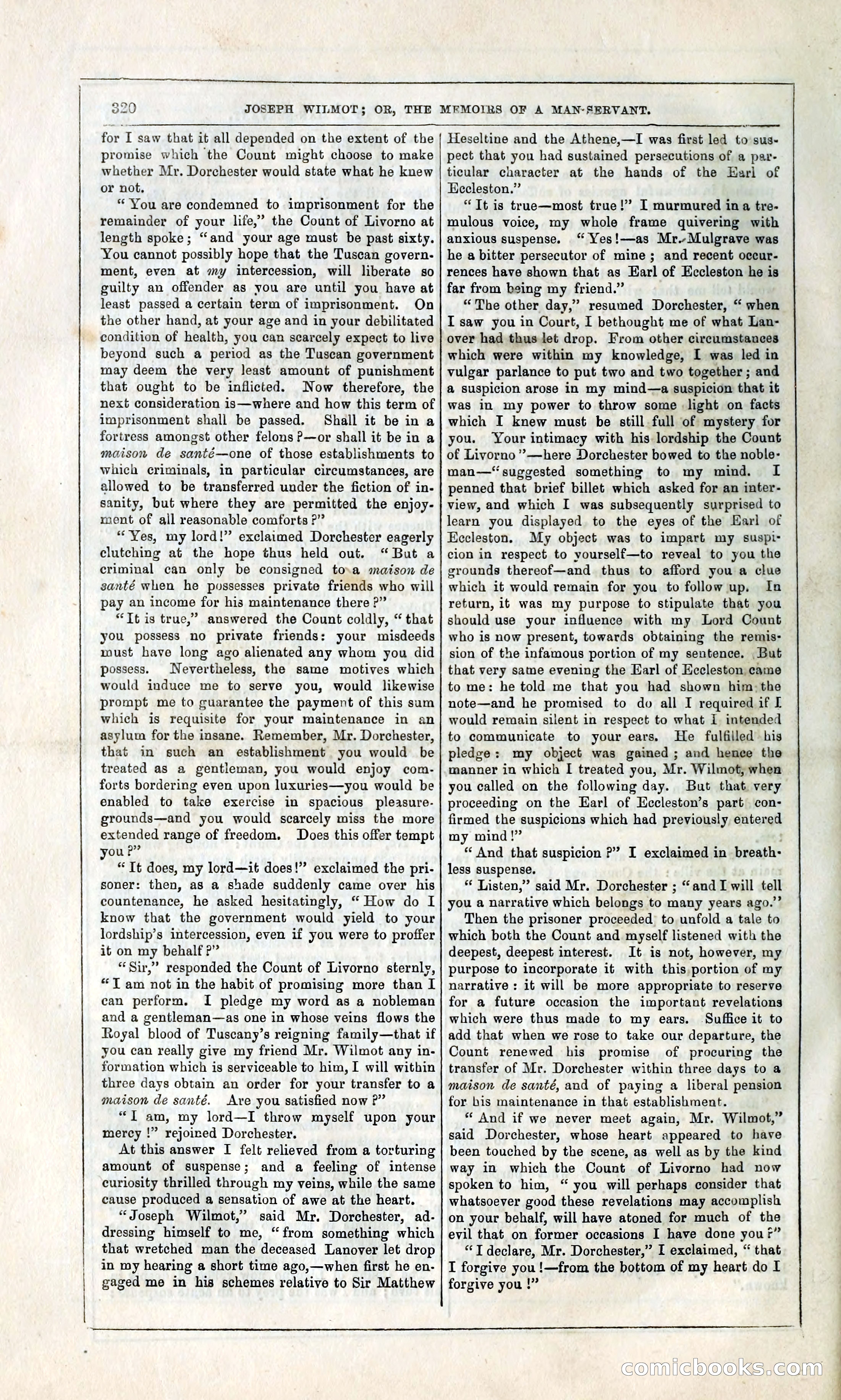
A restored page from Penny Dreadfuls, 1854. Page through the whole issue in the reader above.
📄 Transcribed text from this page (OCR, searchable)
Machine-transcribed from the original scan — historical spelling and the odd misread are preserved.
for I saw that it all depended on the extent of the promise which the Count might choose to make whether Mr. Dorchester would state what he knew or not. * You are condemned to imprisonment for the remainder of your life,” the Count of Livorno at length spoke; “and your age must be past sixty. You cannot possibly hope that the Tuscan govern- ment, even at my intercession, will liberate so guilty an offender as you are until you have at least passed a certain term of imprisonment. On the other hand, at your age and in your debilitated condition of health, you can scarcely expect to live beyond such a period as the Tuscan government may deem the very least amount of punishment that ought to be inflicted. Now therefore, the next consideration is—where and how this term of imprisonment shall be passed. Shall it be in a fortress amongst other felons P—or shall it be in a maison de santé—one of those establishments to which criminals, in particular circumstances, are allowed to be transferred under the fiction of in- sanity, but where they are permitted the enjoy- ment of all reasonable comforts P” “Yes, my lord!” exclaimed Dorchester eagerly clutching at the hope thus held out. “But a criminal can only be consigned tora maison de santé when he possesses private friends who will pay an income for his maintenance there ?” “Tt is true,” answered the Count coldly, “ that you possess no private friends: your misdeeds must have long ago alienated any whom you did possess. Nevertheless, the same motives which would induce me to serve you, would likewise prompt me to guarantee the payment of this sum which is requisite for your maintenance in an asylum for the insane. Remember, Mr. Dorchester, that in such an establishment you would be treated as a gentleman, you would enjoy com- forts bordering even upon luxuries—you would be enabled to take exercise in spacious pleasure- grounds—and you would scarcely miss the more extended range of freedom. Does this offer tempt you Pp” “Tt does, my lord—it does!” exclaimed the pri- soner: then, as a shade suddenly came over his countenance, he asked hesitatingly, “ How do I know that the government would yield to your lordship’s intercession, even if you were to proffer it on my behalf P” “Sir,” responded the Count of Livorno sternly, “T am not in the habit of promising more than I can perform. I pledge my word as a nobleman and a gentleman—as one in whose veins flows the Royal blood of Tuscany’s reigning family—that if you can really give my friend Mr. Wilmot any in- formation which is serviceable to him, I will within three days obtain an order for your transfer to a maison de santé. Ave you satisfied now P” “IT am, my lord—I throw myself upon your mercy !” rejoined Dorchester. At this answer I felt relieved from a torturing amount of suspense; and a feeling of intense curiosity thrilled through my veins, while the same cause produced a sensation of awe at the heart. “Joseph Wilmot,” said Mr. Dorchester, ad- dressing himself to me, “from something which that wretched man the deceased Lanover let drop | in my hearing a short time ago,—when first he en- | gaged me in his schemes relative to Sir Matthew JOSEPH WILMOT; OR, THE MEMOIRS OF A MAN-SERVANT. ros Heseltine and the Athene,—I was first led to sus- pect that you had sustained persecutions of a par- ticular character at the hands of the Earl of EKecleston.” “It is true—most true!” I murmured ina tre- mulous voice, my whole frame quivering with anxious suspense. “ Yes!—as Mr.-Mulgrave was he a bitter persecutor of mine; and recent occur- rences have shown that as Earl of Eccleston he is far from being my friend.” “The other day,” resumed Dorchester, “ when I saw you in Court, I bethought me of what Lan- over had thus let drop. From other circumstances which were within my knowledge, I was led in vulgar parlance to put two and two together; and & suspicion arose in my mind—a suspicion that it was in my power to throw some light on facts which I knew must be still full of mystery for you. Your intimacy with his lordship the Count of Livorno’’—here Dorchester bowed to the noble- man—‘ suggested something to my mind. I penned that brief billet which asked for an inter- view, and which I was subsequently surprised to learn you displayed to the eyes of the Earl of Eccleston. My object was to impart my suspi- cion in respect to vourself—to reveal to you the grounds thereof—and thus to afford you a clue which it would remain for you to follow up. In return, it was my purpose to stipulate that you should use your influence with my Lord Count who is now present, towards obtaining the remis- sion of the infamous portion of my sentence. But that very same evening the Earl of Eccleston came to me: he told me that you had shown him: the note—and he promised to do all I required if I would remain silent in respect to what i intended to communicate to your ears. He fulfilled his pledge: my object was gained ; and hence the manner in which I treated you, Mr. Wilmot; when you called on the following day. But that very proceeding on the Earl of Eccleston’s part con- firmed the suspicions which had previously entered my mind!” * And that suspicion P” I exclaimed in breath- less suspense. * Listen,” said Mr. Dorchester ; “and I will tell you a narrative which belongs to many years ago.’ Then the prisoner proceeded to unfold a tale to which both the Count and myself listened with the deepest, deepest interest. It is not, however, my purpose to incorporate it with this portion of my narrative : it will be more appropriate to reserve for a future occasion the important revelations which were thus made to my ears. Suffice it to add that when we rose to take our departure, the Count renewed his promise of procuring the transfer of Mr. Dorchester within three days to a maison de santé, and of paying a liberal pension for bis maintenance in that establishment. * And if we never meet again, Mr. Wilmot,” said Dorchester, whose heart appeared to have been touched by the scene, as well as by the kind way in which the Count of Livorno had now spoken to him, “ you will perhaps consider that whatsoever good these revelations may accomplish on your behalf, will have atoned for much of the evil that on former occasions I have done your” “TI declare, Mr. Dorchester,” I exclaimed, “ that I forgive you!—from the bottom of my heart do I forgive you !” 0)(0) (E <SriG (0)