
Penny Dreadfuls, 1854 · page 330 of 399
Joseph Wilmot, or, The Memoirs of a Man-Servant — page 330: what you’re looking at
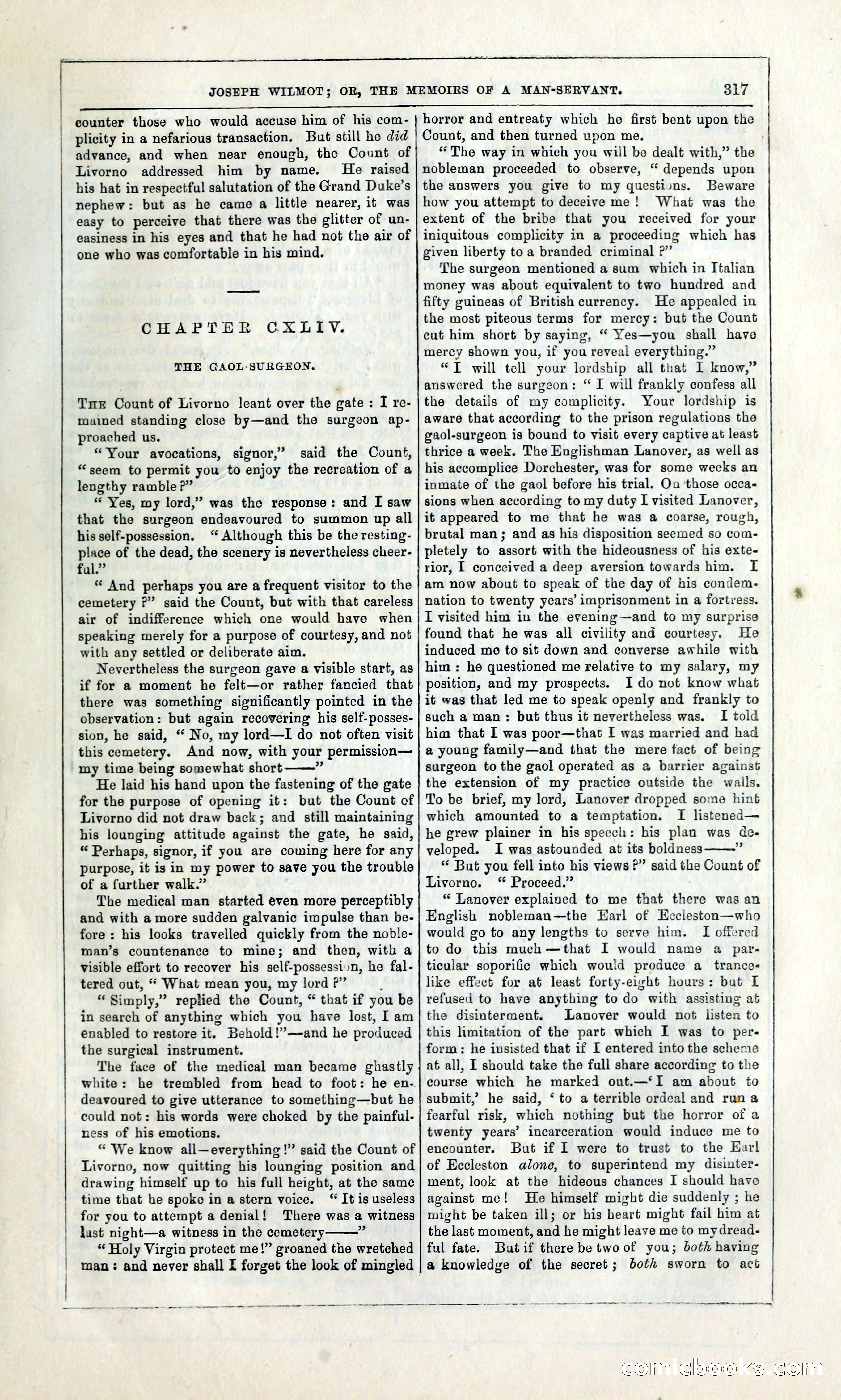
A restored page from Penny Dreadfuls, 1854. Page through the whole issue in the reader above.
📄 Transcribed text from this page (OCR, searchable)
Machine-transcribed from the original scan — historical spelling and the odd misread are preserved.
JOSEPH WILMOT; OR, THE MEMOIRS OF A MAN-SERVANT. counter those who would accuse him of his com- plicity in a nefarious transaction. But still he did advance, and when near enough, the Count of Livorno addressed him by name. He raised his hat in respectful salutation of the Grand Duke’s nephew: but as he came a little nearer, it was easy to perceive that there was the glitter of un- easiness in his eyes and that he had not the air of one who was comfortable in his mind. CHAPTER CXLIV. THE GAOL-SURGEON. Tux Count of Livorno leant over the gate: I re- mained standing close by—and the surgeon ap- proached us. “Your avocations, signor,” said the Count, “seem to permit you to enjoy the recreation of a lengthy ramble?” * Yes, my lord,” was the response: and I saw that the surgeon endeavoured to summon up all his self-possession. ‘* Although this be the resting- place of the dead, the scenery is nevertheless cheer- ful.” « And perhaps you are a frequent visitor to the cemetery ?” said the Count, but with that careless air of indifference which one would have when speaking merely for a purpose of courtesy, and not with any settled or deliberate aim. Nevertheless the surgeon gave a visible start, as if for a moment he felt—or rather fancied that there was something significantly pointed in the observation: but again recovering his self-posses- sion, he said, “* No, my lord—I do not often visit this cemetery. And now, with your permission— my time being somewhat short ‘g He laid his hand upon the fastening of the gate for the purpose of opening it: but the Count cf Livorno did not draw back; and still maintaining his lounging attitude against the gate, he said, “ Perhaps, signor, if you are coming here for any purpose, it is in my power to save you the trouble of a further walk.” The medical man started even more perceptibly and with a more sudden galvanic impulse than be- fore : his looks travelled quickly from the noble- man’s countenance to mine; and then, with a visible effort to recover his self-possessi on, he fal- tered out, “ What mean you, my lord ?” “ Simply,” replied the Count, “ that if you be in search of anything which you have lost, I am enabled to restore it. Behold!”’—and he produced the surgical instrument. The face of the medical man became ghastly white: he trembled from head to foot: he en-. deavoured to give utterance to something—but he could not: his words were choked by the painful- ness of his emotions. “ We know all—everything!” said the Count of Livorno, now quitting his lounging position and drawing himself up to his full height, at the same time that he spoke in a stern voice. “ It is useless for you to attempt a denial! There was a witness last night—a witness in the cemetery a “ Holy Virgin protect me!” groaned the wretched man: and never shall — forget the look of mingled —=> eee Oo RN a ee 317 horror and entreaty which he first bent upon the Count, and then turned upon me. “The way in which you will be dealt with,” the nobleman proceeded to observe, “ depends upon the answers you give to my questions. Beware how you attempt to deceive me! What was the extent of the bribe that you received for your iniquitous complicity in a proceeding which has given liberty to a branded criminal ?” The surgeon mentioned a sum which in Italian money was about equivalent to two hundred and fifty guineas of British currency. He appealed in the most piteous terms for mercy: but the Count cut him short by saying, “ Yes—you shall have mercy shown you, if you reveal everything.” “TI will tell your lordship all that IL know,” answered the surgeon: “ I will frankly confess all the details of my complicity. Your lordship is aware that according to the prison regulations the gaol-surgeon is bound to visit every captive at least thrice a week. The Englishman Lanover, as well as his accomplice Dorchester, was for some weeks an inmate of the gaol before his trial. Ou those occa- sions when according to my duty I visited Lanover, it appeared to me that he was a coarse, rough, brutal man; and as his disposition seemed so com- pletely to assort with the hideousness of his exte- rior, I conceived a deep aversion towards him. [ am now about to speak of the day of his condem- nation to twenty years’ imprisonment in a fortress. I visited him in the evening—and to my surprise found that he was all civility and courtesy. He induced me to sit down and converse awhile with him : he questioned me relative to my salary, my position, and my prospects. Ido not know what it was that led me to speak openly and frankly to such a man: but thus it nevertheless was. I told him that I was poor—that I was married and had a young family—and that the mere fact of being surgeon tothe gaol operated as a barrier against the extension of my practice outside the walls. To be brief, my lord, Lanover dropped some hint which amounted to a temptation. I listened— he grew plainer in his speech: his plan was de- veloped. I was astounded at its boldness +3 “ But you fell into his views ?” said the Count of Livorno. “ Proceed.” ** Lanover explained to me that there was an English nobleman—the Earl of Eccleston—who would go to any lengths to serve him. I offered to do this much—that I would name a par- ticular soporific which would produce a_ trance- like effect for at least forty-eight hours: but [ refused to have anything todo with assisting at the disinterment. Lanover would not listen to this limitation of the part which I was to per- form : he insisted that if I entered into the scheme at all, I should take the full share according to the course which he marked out.—‘I am about to submit,’ he said, ‘ to a terrible ordeal and run a fearful risk, which nothing but the horror of a twenty years’ incarceration would induce me to encounter. But if I were to trust to the Earl of Eccleston alone, to superintend my disinter- ment, look at the hideous chances I should havo against me! He himself might die suddenly ; he might be taken ill; or his heart might fail him at the last moment, and he might leave me to my dread- ful fate. Butif there be twoof you; both having @ knowledge of the secret; both sworn to act ee ee eS ee ae re eee oe OOO) (C S co