
Penny Dreadfuls, 1854 · page 33 of 399
Joseph Wilmot, or, The Memoirs of a Man-Servant — page 33: what you’re looking at
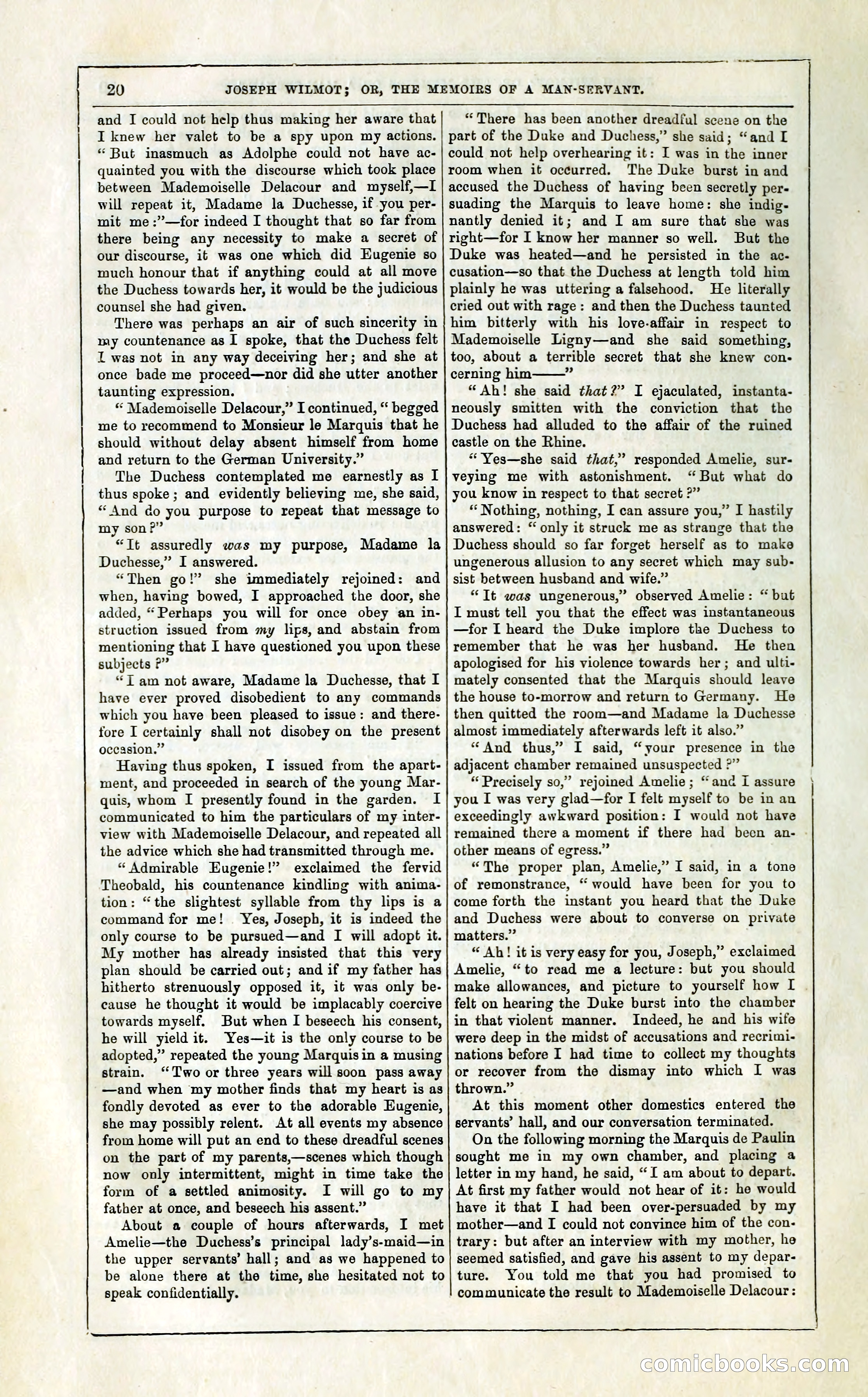
A restored page from Penny Dreadfuls, 1854. Page through the whole issue in the reader above.
📄 Transcribed text from this page (OCR, searchable)
Machine-transcribed from the original scan — historical spelling and the odd misread are preserved.
20 JOSEPH WILMOT; OR, THE MEMOIRS OF A MAN-SERVANT. and I could not help thus making her aware that I knew her valet to be a spy upon my actions. “ But inasmuch as Adolphe could not have ac- quainted you with the discourse which took place between Mademoiselle Delacour and myself,—I will repeat it, Madame la Duchesse, if you per- mit me :”’—for indeed I thought that so far from there being any necessity to make a secret of our discourse, it was one which did Eugenie so much honour that if anything could at all move the Duchess towards her, it would be the judicious counsel she had given. There was perhaps an air of such sincerity in my countenance as I spoke, that the Duchess felt L was not in any way deceiving her; and she at once bade me proceed—nor did she utter another taunting expression. “ Mademoiselle Delacour,” I continued, “ begged me to recommend to Monsieur le Marquis that he should without delay absent himself from home and return to the German University.” The Duchess contemplated me earnestly as I thus spoke; and evidently believing me, she said, ** And do you purpose to repeat that message to my son?” “Tt assuredly was my purpose, Madame la Duchesse,” I answered. “Then go!” she immediately rejoined: and when, having bowed, I approached the door, she added, “Perhaps you will for once obey an in- struction issued from my lips, and abstain from mentioning that I have questioned you upon these subjects ?” “T am not aware, Madame la Duchesse, that I have ever proved disobedient to any commands which you have been pleased to issue: and there- fore I certainly shall not disobey on the present occasion.” Having thus spoken, I issued from the apart- ment, and proceeded in search of the young Mar- quis, whom I presently found in the garden. I communicated to him the particulars of my inter- view with Mademoiselle Delacour, and repeated all the advice which she had transmitted through me. “ Admirable Eugenie!” exclaimed the fervid Theobald, his countenance kindling with anima- tion: “the slightest syllable from thy lips is a command for me! Yes, Joseph, it is indeed the only course to be pursued—and I will adopt it. My mother has already insisted that this very plan should be carried out; and if my father has hitherto strenuously opposed it, it was only be- cause he thought it would be implacably coercive towards myself. But when I beseech his consent, he will yield it. Yes—it is the only course to be adopted,” repeated the young Marquis in a musing strain. “Two or three years will soon pass away —and when my mother finds that my heart is as fondly devoted as ever to the adorable Eugenie, she may possibly relent. At all events my absence from home will put an end to these dreadful scenes on the part of my parents,—scenes which though now only intermittent, might in time take the form of a settled animosity. I will go to my father at once, and beseech his assent.” About a couple of hours afterwards, I met Amelie—the Duchess’s principal lady’s-maid—in the upper servants’ hall; and as we happened to be alone there at the time, she hesitated not to speak confidentially. “There has been another dreadful scene on the part of the Duke and Duchess,” she said; “and I could not help overhearing it: I was in the inner room when it occurred. The Duke burst in and accused the Duchess of having been secretly per- suading the Marquis to leave home: she indig- nantly denied it; and I am sure that she was right—for I know her manner so well. But the Duke was heated—and he persisted in the ac- cusation—so that the Duchess at length told him plainly he was uttering a falsehood. He literally cried out with rage: and then the Duchess taunted him bitterly with his love-affair in respect to Mademoiselle Ligny—and she said something, too, about a terrible secret that she knew con- cerning him 3 “Ah! she said that?” I ejaculated, instanta- neously smitten with the conviction that the Duchess had alluded to the affair of the ruined castle on the Rhine. ““"Yes—she said that,’ responded Amelie, sur- veying me with astonishment. “But what do you know in respect to that secret ?” “‘ Nothing, nothing, I can assure you,” I hastily answered: “only it struck me as strange that the Duchess should so far forget herself as to make ungenerous allusion to any secret which may sub- sist between husband and wife.” “Tt was ungenerous,” observed Amelie: “ but I must tell you that the effect was instantaneous —for I heard the Duke implore the Duchess to remember that he was her husband. He then apologised for his violence towards her; and ulti- mately consented that the Marquis should leave the house to-morrow and return to Germany. He then quitted the room—and Madame la Duchesse almost immediately afterwards left it also.” “And thus,” I said, “your presence in the adjacent chamber remained unsuspected ?” “Precisely so,” rejoined Amelie; “and Ii assure you I was very glad—for I felt myself to be in an exceedingly awkward position: I would not have remained there a moment if there had been an- | other means of egress.” “The proper plan, Amelie,” I said, in a tone of remonstrance, “would have been for you to come forth the instant you heard that the Duke and Duchess were about to converse on private matters.” “ Ah! it is very easy for you, Joseph,” exclaimed Amelie, “to read me a lecture: but you should make allowances, and picture to yourself how I | felt on hearing the Duke burst into the chamber in that violent manner. Indeed, he and his wife were deep in the midst of accusations and recrimi- nations before I had time to collect my thoughts or recover from the dismay into which I was thrown.” At this moment other domestics entered the servants’ hall, and our conversation terminated. On the following morning the Marquis de Paulin sought me in my own chamber, and placing a letter in my hand, he said, “I am about to depart. At first my father would not hear of it: he would have it that I had been over-persuaded by my mother—and I could not convince him of the con- trary: but after an interview with my mother, he seemed satisfied, and gave his assent to my depar- ture. You told me that you had promised to communicate the result to Mademoiselle Delacour: pn TE A ES See a S| a ae CONnNEDOOKS co