
Penny Dreadfuls, 1854 · page 324 of 399
Joseph Wilmot, or, The Memoirs of a Man-Servant — page 324: what you’re looking at
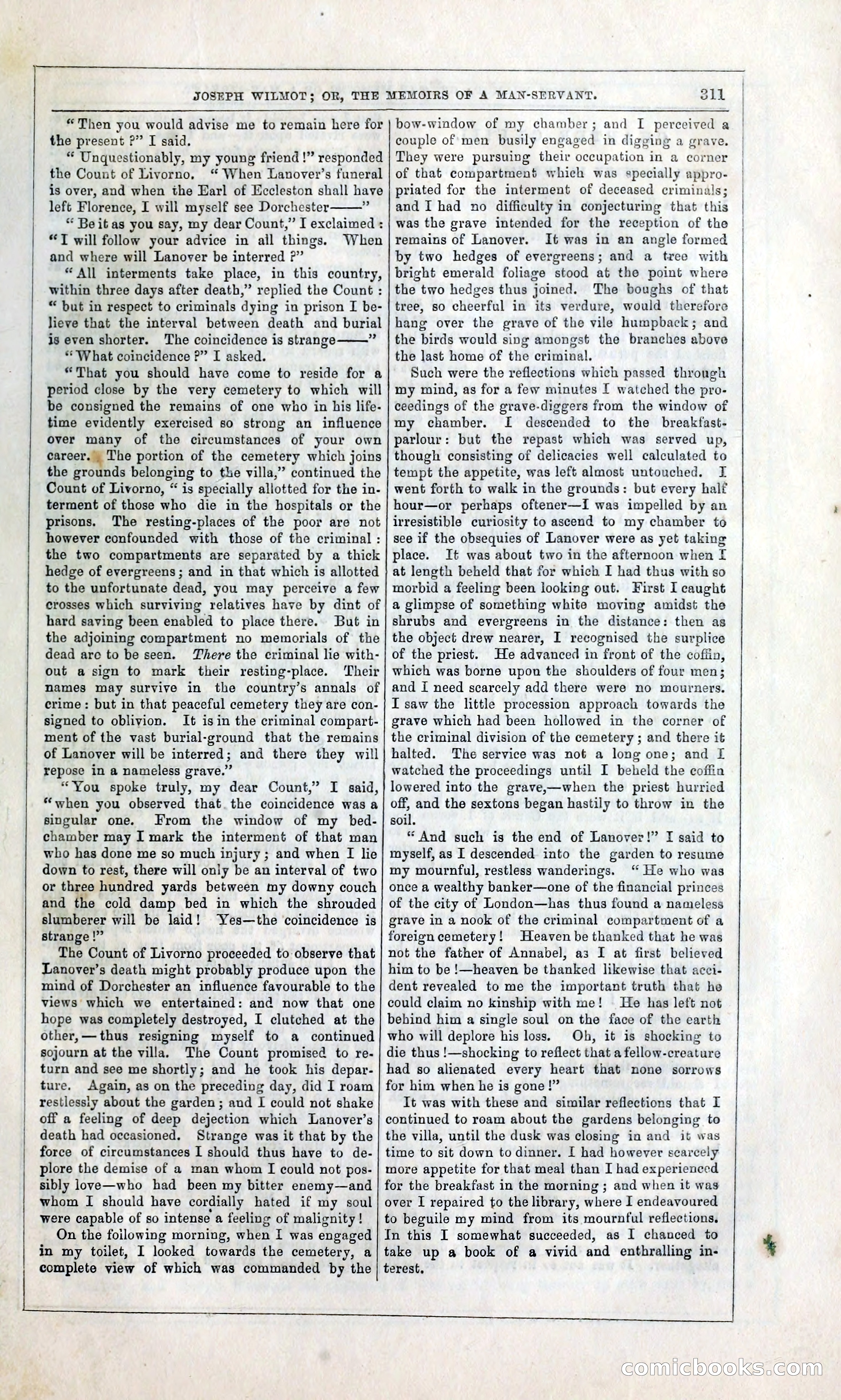
A restored page from Penny Dreadfuls, 1854. Page through the whole issue in the reader above.
📄 Transcribed text from this page (OCR, searchable)
Machine-transcribed from the original scan — historical spelling and the odd misread are preserved.
JOSEPH WILMOT; OR, THE MEMOIRS OF A MAN-SERVANT. “Then you would advise me to remain here for the present ?” I said. “ Unquestionably, my young friend !” responded the Count of Livorno, “ When Lanover’s funeral is over, and when the Earl of Eccleston shall have left Florence, I will myself see Dorchester r * Beit as you say, my dear Count,” I exclaimed : “TI will follow your advice in all things. When and where will Lanover be interred ?” “All interments take place, in this country, within three days after death,” replied the Count : “ but in respect to criminals dying in prison I be- lieve that the interval between death and burial is even shorter. The coincidence is strange - **'W hat coincidence ?” I asked. “That you should have come to reside for a period close by the very cemetery to which will be consigned the remains of one who in his life- time evidently exercised so strong an influence over many of the circumstances of your own The portion of the cemetery which joins the grounds belonging to the villa,” continued the career Count of Livorno, “ is specially allotted for the in- terment of those who die in the hospitals or the The resting-places of the poor are not prisons. however confounded with those of the criminal : the two compartments are separated by a thick hedge of evergreens; and in that which is allotted to the unfortunate dead, you may perceive a few crosses which surviving relatives have by dint of But in the adjoining compartment no memorials of the hard saving been enabled to place there. dead are to be seen. There the criminal lie with- out a sign to mark their resting-place. crime: but in that peaceful cemetery they are con- signed to oblivion. repose in a nameless grave.” “You spoke truly, my dear Count,” I said, “when you observed that. the coincidence was a singular one. From the window of my bed- chamber may I mark the interment of that man who has done me so much injury ; and when [I lie down to rest, there will only be an interval of two or three hundred yards between my downy couch and the cold damp bed in which the shrouded slumberer will be laid! Yes—the coincidence is strange !” The Count of Livorno proceeded to observe that Lanover’s death might probably produce upon the mind of Dorchester an influence favourable to the views which we entertained: and now that one hope was completely destroyed, I clutched at the other,—thus resigning myself to a continued sojourn at the villa. The Count promised to re- turn and see me shortly; and he took his depar- ture. Again, as on the preceding day, did I roam restlessiy about the garden; and I could not shake off a feeling of deep dejection which Lanover’s death had occasioned. Strange was it that by the force of circumstances I should thus have to de- plore the demise of a man whom I could not pos- sibly love—who had been my bitter enemy—and whom I should have cordially hated if my soul were capable of so intense a feeling of malignity! On the foilowing morning, when I was engaged in my toilet, I looked towards the cemetery, a complete view of which was commanded by the Their names may survive in the country’s annals of It isin the criminal compart- ment of the vast burial-ground that the remains of Lanover will be interred; and there they will oll bow-window of my chamber; and I perceived a couple of men busily engaged in digging a grave. They were pursuing their occupation in a corner of that compartment which was specially appro- priated for the interment of deceased criminals; and I had no difficulty in conjecturing that this was the grave intended for the reception of the remains of Lanover. It was in an angle formed by two hedges of evergreens; and a tree with bright emerald foliage stood at the point where the two hedges thus joined. The boughs of that tree, so cheerful in its verdure, would therefore hang over the grave of the vile humpback; and the birds would sing amongst the branches above the last home of the criminal. Such were the reflections which passed through my mind, as for a few minutes I watched the pro- ceedings of the grave-diggers from the window of my chamber. I descended to the breakfast- parlour: but the repast which was served up, though consisting of delicacies well calculated to tempt the appetite, was left almost untouched. I went forth to walk in the grounds: but every half hour—or perhaps oftener—I was impelled by an irresistible curiosity to ascend to my chamber to see if the obsequies of Lanover were as yet taking place. It was about two in the afternoon when f at length beheld that for which I had thus with so morbid a feeling been looking out. First I caught a glimpse of something white moving amidst the shrubs and evergreens in the distance: then as the object drew nearer, I recognised the surplice of the priest. He advanced in front of the coffin, which was borne upon the shoulders of four men; and I need scarcely add there were no mourners. I saw the little procession approach towards the grave which had been hollowed in the corner of the criminal division of the cemetery ; and there it halted. The service was not a long one; and [I watched the proceedings until I beheld the coffin lowered into the grave,—when the priest hurried off, and the sextons began hastily to throw in the soil. “ And such is the end of Lanover!” I said to myself, as I descended into the garden to resume my mournful, restless wanderings. ‘“ He who was once a wealthy banker—one of the financial princes of the city of London—has thus found a nameless grave in a nook of the criminal compartment of a foreigncemetery! Heaven be thanked that he was not the father of Annabel, as I at first believed him to be !—heaven be thanked likewise that acci- dent revealed to me the important truth that he could claim no kinship with me! He has left not behind him a single soul on the face of the earth who will deplore his loss. Ob, it is shocking to die thus !—shocking to reflect that a fellow-creature had so alienated every heart that none sorrows for him when he is gone!” It was with these and similar reflections that I continued to roam about the gardens belonging to the villa, until the dusk was closing in and it was time to sit down to dinner. I had however scarcely more appetite for that meal than I had experienced for the breakfast in the morning ; and when it was over I repaired to the library, where I endeavoured to beguile my mind from its mournful reflections. In this I somewhat succeeded, as I chanced to take up a book of a vivid and enthralling in- terest. Giook (EO)