
Penny Dreadfuls, 1854 · page 317 of 399
Joseph Wilmot, or, The Memoirs of a Man-Servant — page 317: what you’re looking at
A restored page from Penny Dreadfuls, 1854. Page through the whole issue in the reader above.
📄 Transcribed text from this page (OCR, searchable)
Machine-transcribed from the original scan — historical spelling and the odd misread are preserved.
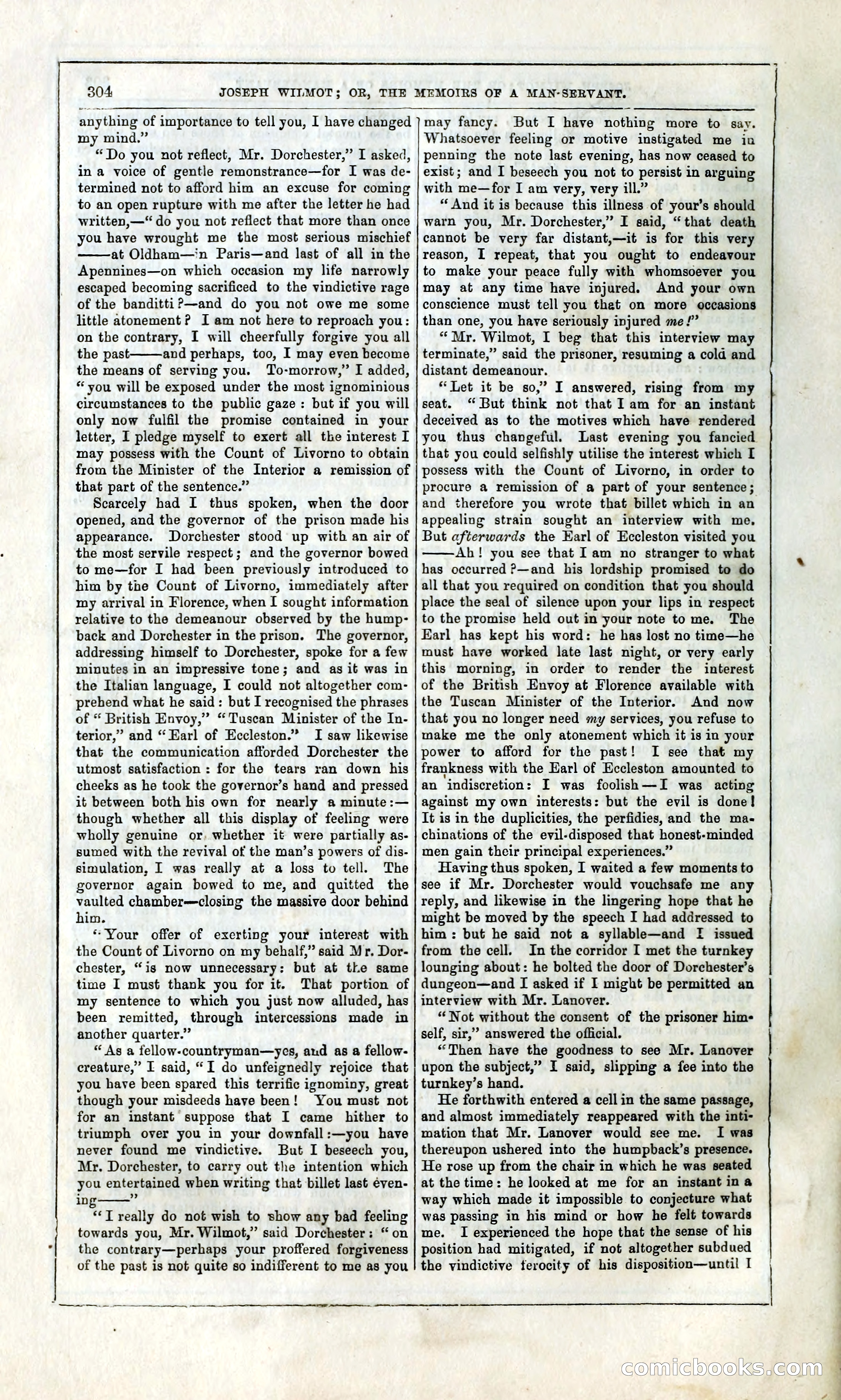
304 JOSEPH WIIMOT; OR, THE MEMOIRS OF A MAN-SERVANT. anything of importance to tell you, I have changed my mind.” “Do you not reflect, Mr. Dorchester,’ I asked, in a voice of gentle remonstrance—for I was de- termined not to afford him an excuse for coming to an open rupture with me after the letter he had written,—“ do you not reflect that more than once you have wrought me the most serious mischief at Oldham—‘n Paris—and last of all in the Apennines—on which occasion my life narrowly escaped becoming sacrificed to the vindictive rage of the banditti?—and do you not owe me some little atonement? I am not here to reproach you: on the contrary, I will cheerfully forgive you all the past and perhaps, too, I may even become the means of serving you. To-morrow,” I added, “you will be exposed under the most ignominious circumstances to the public gaze: but if you will only now fulfil the promise contained in your letter, I pledge myself to exert all the interest I may possess with the Count of Livorno to obtain from the Minister of the Interior a remission of that part of the sentence.” Scarcely had I thus spoken, when the door opened, and the governor of the prison made his appearance. Dorchester stood up with an air of the most servile respect; and the governor bowed to me—for I had been previously introduced to him by the Count of Livorno, immediately after my arrival in Florence, when [ sought information relative to the demeanour observed by the hump- back and Dorchester in the prison. The governor, addressing himself to Dorchester, spoke for a few minutes in an impressive tone; and as it was in the Italian language, I could not altogether com- prehend what he said: but I recognised the phrases of “ British Envoy,” “Tuscan Minister of the In- terior,” and “ Earl of Eccleston.” I saw likewise that the communication afforded Dorchester the utmost satisfaction : for the tears ran down his cheeks as he took the governor’s hand and pressed it between both his own for nearly s minute :— though whether all this display of feeling were wholly genuine or, whether it were partially as- sumed with the revival of the man’s powers of dis- simulation, I was really at a loss to tell. The governor again bowed to me, and quitted the vaulted chamber—closing the massive door behind him. * Your offer of exerting your interest with the Count of Livorno on my behalf,” said Mr, Dor- chester, “is now unnecessary: but at the same time I must thank you for it. That portion of my sentence to which you just now alluded, has been remitted, through intercessions made in another quarter.” “ As a fellow-countryman—yes, and as a fellow- creature,” I said, “I do unfeignedly rejoice that you have been spared this terrific ignominy, great though your misdeeds have been! You must not for an instant suppose that I came hither to triumph over you in your downfall:—you have never found me vindictive. But I beseech you, Mr. Dorchester, to carry out the intention which you entertained when writing that billet last éven- iD >? **T really do not wish to show any bad feeling towards you, Mr. Wilmot,” said Dorchester: “on the contrary—perhaps your proffered forgiveness of the past is not quite so indifferent to me as you may fancy. But I have nothing more to say. Whatsoever feeling or motive instigated me in penning the note last evening, has now ceased to exist; and I beseech you not to persist in arguing with me—for I am very, very ill.” “And it is because this illness of your’s should warn you, Mr. Dorchester,” I said, “that death cannot be very far distant,—it is for this very reason, I repeat, that you ought to endeavour to make your peace fully with whomsoever you may at any time have injured. And your own conscience must tell you thet on more occasions than one, you have seriously injured me !” “Mr. Wilmot, I beg that this interview may terminate,” said the prisoner, resuming a cold and distant demeanour. “Let it be so,’ I answered, rising from my seat. “ But think not that Iam for an instant deceived as to the motives which have rendered you thus changeful. Last evening you fancied that you could selfishly utilise the interest which I possess with the Count of Livorno, in order to procure a remission of a part of your sentence; and therefore you wrote that billet which in an appealing strain sought an interview with me. But afterwards the Earl of Eccleston visited you Ah! you see that [am no stranger to what has occurred P—and his lordship promised to do all that you required on condition that you should place the seal of silence upon your lips in respect to the promise held out in your note to me. The Earl has kept his word: he has lost no time—he must have worked late last night, or very early this morning, in order to render the interest of the British Envoy at Florence available with the Tuscan Minister of the Interior. And now that you no longer need my services, you refuse to make me the only atonement which it is in your power to afford for the past! I see that my frankness with the Harl of Eccleston amounted to an indiscretion: I was foolish—I was acting against my own interests: but the evil is done! It is in the duplicities, the perfidies, and the ma- chinations of the evil-disposed that honest-minded men gain their principal experiences.” Having thus spoken, I waited a few moments to see if Mr. Dorchester would vouchsafe me any reply, and likewise in the lingering hope that he might be moved by the speech I had addressed to him : but he said not a syllable—and I issued from the cell. In the corridor I met the turnkey lounging about: he bolted the door of Dorchester’s dungeon—and I asked if I might be permitted an interview with Mr. Lanover. “ Not without the consent of the prisoner him- self, sir,” answered the official. | “Then have the goodness to see Mr. Lanover upon the subject,” I said, slipping a fee into the turnkey’s hand. He forthwith entered a cell in the same passage, and almost immediately reappeared with the inti- mation that Mr. Lanover would see me. I was thereupon ushered into the humpback’s presence. He rose up from the chair in which he was seated at the time: he looked at me for an instant in a way which made it impossible to conjecture what was passing in his mind or how he felt towards me. I experienced the hope that the sense of his position had mitigated, if not altogether subdued the vindictive ferocity of his disposition—until I " ———_————-__ ee COMmicoooks (EO)