
Penny Dreadfuls, 1854 · page 313 of 399
Joseph Wilmot, or, The Memoirs of a Man-Servant — page 313: what you’re looking at
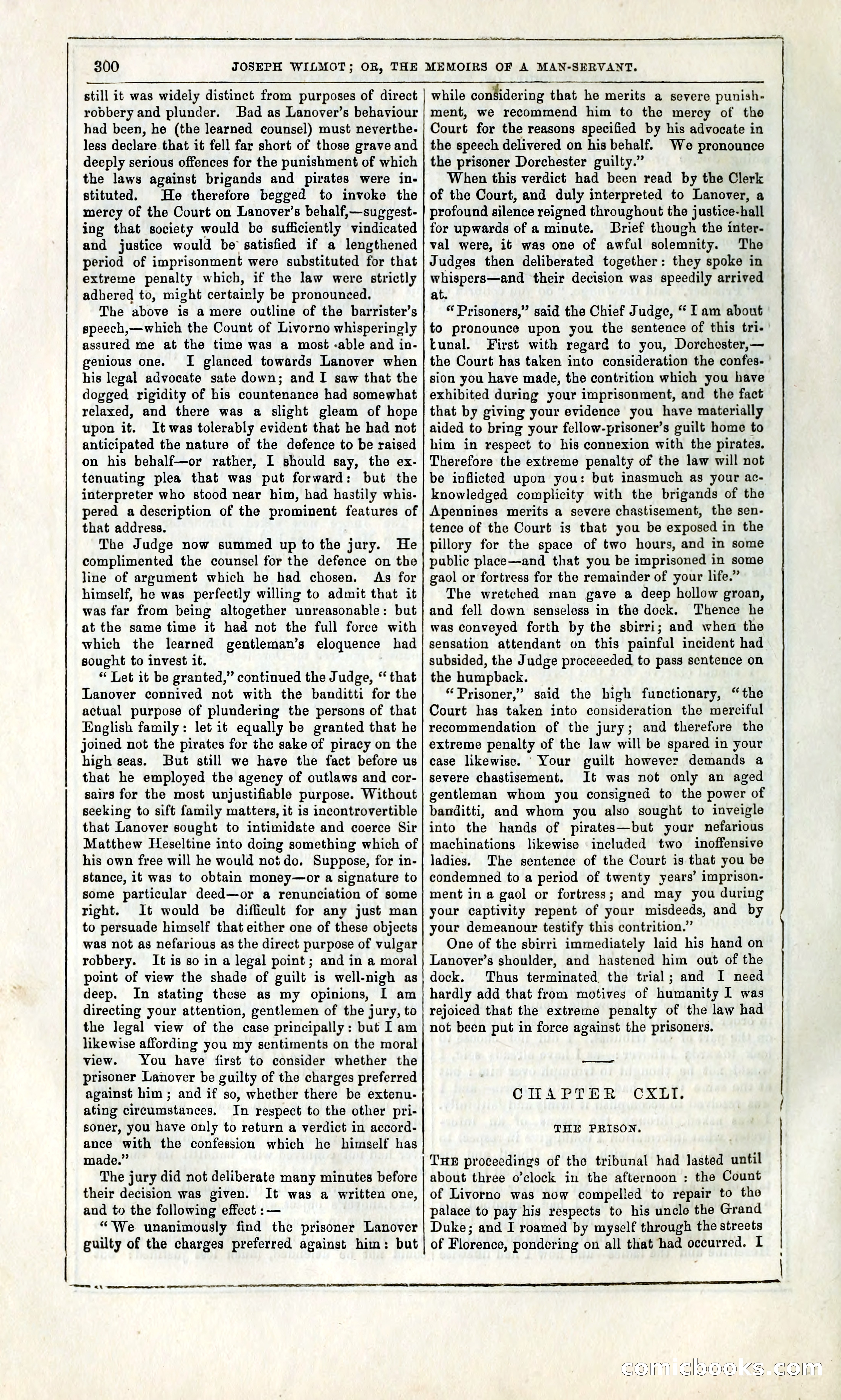
A restored page from Penny Dreadfuls, 1854. Page through the whole issue in the reader above.
📄 Transcribed text from this page (OCR, searchable)
Machine-transcribed from the original scan — historical spelling and the odd misread are preserved.
amen ee 300 JOSEPH WILMOT; OR, THE still it was widely distinct from purposes of direct robbery and plunder. Bad as Lanover’s behaviour had been, he (the learned counsel) must neverthe- less declare that it fell far short of those grave and deeply serious offences for the punishment of which the laws against brigands and pirates were in- stituted. He therefore begged to invoke the mercy of the Court on Lanover’s behalf,—suggest- ing that society would be sufficiently vindicated and justice would be satisfied if a lengthened period of imprisonment were substituted for that extreme penalty which, if the law were strictly adhered to, might certainly be pronounced. The above is a mere outline of the barrister’s speech,—which the Count of Livorno whisperingly assured me at the time was a most -able and in- genious one. I glanced towards Lanover when his legal advocate sate down; and I saw that the dogged rigidity of his countenance had somewhat relaxed, and there was a slight gleam of hope upon it. Itwas tolerably evident that he had not anticipated the nature of the defence to be raised on his behalf—or rather, I should say, the ex- tenuating plea that was put forward: but the interpreter who stood near him, had hastily whis- pered a description of the prominent features of that address. The Judge now summed up tothe jury. He complimented the counsel for the defence on the line of argument which he had chosen. As for himself, he was perfectly willing to admit that it was far from being altogether unreasonable: but at the same time it had not the full force with which the learned gentleman’s eloquence had sought to invest it. “ Let it be granted,” continued the Judge, “ that Lanover connived not with the banditti for the actual purpose of plundering the persons of that English family: let it equally be granted that he joined not the pirates for the sake of piracy on the high seas. But still we have the fact before us that he employed the agency of outlaws and cor- sairs for the most unjustifiable purpose. Without seeking to sift family matters, it is incontrovertible that Lanover sought to intimidate and coerce Sir Matthew Heseltine into doing something which of his own free will he would not do. Suppose, for in- stance, it was to obtain money—or a signature to some particular deed—or a renunciation of some right. It would be difficult for any just man to persuade himself that either one of these objects was not as nefarious as the direct pur pose of vulgar robbery. It is so in a legal point; and in a moral point of view the shade of guilt is well-nigh as deep. In stating these as my opinions, I am directing your attention, gentlemen of the jury, to the legal view of the case principally: but I am likewise affording you my sentiments on the moral view. You have first to consider whether the prisoner Lanover be guilty of the charges preferred against him ; and if so, whether there be extenu- ating circumstances, In respect to the other pri- soner, you have only to return a verdict in accord- ance with the confession which he himself has made.” The jury did not deliberate many minutes before their decision was given. It was a written one, and to the following effect :— “We unanimously find the prisoner Lanover guilty of the charges preferred against him: but ere MEMOIRS OF A MAN-SERVANT. while considering that he merits a severe punish- ment, we recommend him to the mercy of the Court for the reasons specified by his advocate in the speech delivered on his behalf. We pronounce the prisoner Dorchester guilty.” When this verdict had been read by the Clerk of the Court, and duly interpreted to Lanover, a profound silence reigned throughout the justice-hall for upwards of a minute. Brief though the inter- val were, it was one of awful solemnity. The Judges then deliberated together: they spoke in whispers—and their decision was speedily arrived at. * Prisoners,” said the Chief Judge, “ Tam about to pronounce upon you the sentence of this tri- kunal. First with regard to you, Dorchester,— the Court has taken into consideration the confes- ' sion you have made, the contrition which you have exhibited during your imprisonment, and the fact that by giving your evidence you have materially aided to bring your fellow-prisoner’s guilt home to him in respect to his connexion with the pirates. Therefore the extreme penalty of the law will not be inflicted upon you: but inasmuch as your ac- knowledged complicity with the brigands of the Apennines merits a severe chastisement, the sen- tence of the Court is that you be exposed in the pillory for the space of two hours, and in some public place—and that you be imprisoned in some gaol or fortress for the remainder of your life.” The wretched man gave a deep hollow groan, and fell down senseless in the dock. Thence he was conveyed forth by the sbirri; and when the sensation attendant on this painful incident had subsided, the Judge proceeeded to pass sentence on the humpback. “Prisoner,” said the high functionary, “the Court has taken into consideration the merciful recommendation of the jury; and therefure tho extreme penalty of the law will be spared in your case likewise. Your guilt however demands a severe chastisement. It was not only an aged gentleman whom you consigned to the power of banditti, and whom you also sought to inveigle into the hands of pirates—but your nefarious machinations likewise included two inoffensive ladies. The sentence of the Court is that you be condemned to a period of twenty years’ imprison- ment in a gaol or fortress; and may you during your captivity repent of your misdeeds, and by your demeanour testify this contrition.” One of the sbirri immediately laid his hand on Lanover’s shoulder, and hastened him out of the dock. Thus terminated the trial; and I need hardly add that from motives of humanity I was rejoiced that the extreme penalty of the law had not been put in force against the prisoners. — CHAPTER CXLI. THE PRISON. THE proceedings of the tribunal had lasted until about three o’clock in the afternoon : the Count of Livorno was now compelled to repair to the palace to pay his respects to his uncle the Grand Duke; and I roamed by myself through the streets of Florence, pondering on all that had occurred. I Gboo <S) (CO) PLA