
Penny Dreadfuls, 1854 · page 311 of 399
Joseph Wilmot, or, The Memoirs of a Man-Servant — page 311: what you’re looking at
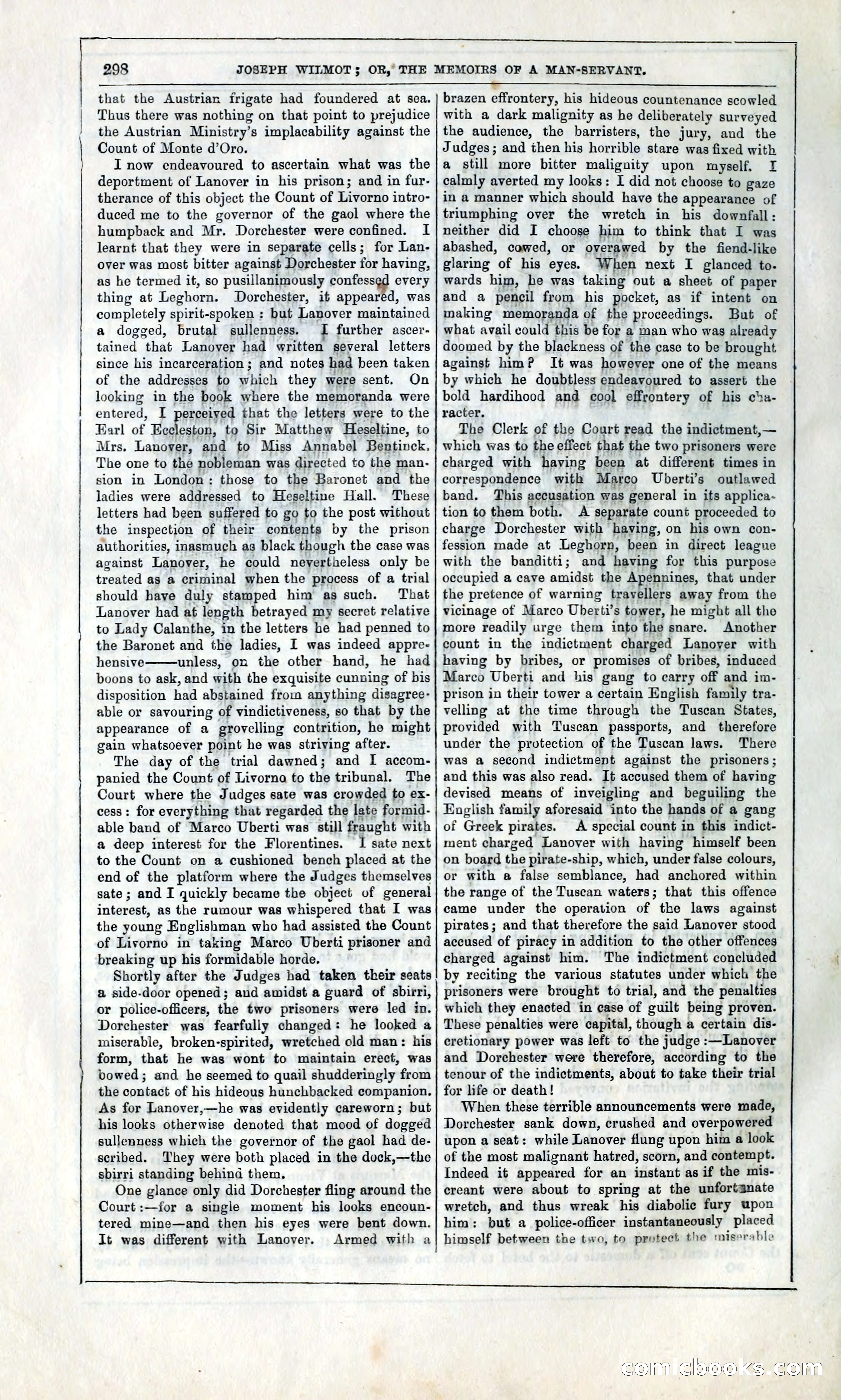
A restored page from Penny Dreadfuls, 1854. Page through the whole issue in the reader above.
📄 Transcribed text from this page (OCR, searchable)
Machine-transcribed from the original scan — historical spelling and the odd misread are preserved.
ree 298 JOSEPH WILMOT; OR, THE MEMOIRS OF A MAN-SERVANT. se A En OE ae that the Austrian frigate had foundered at sea. Thus there was nothing on that point to prejudice the Austrian Ministry’s implacability against the Count of Monte d’Oro. I now endeavoured to ascertain what was the deportment of Lanover in his prison; and in fur- therance of this object the Count of Livorno intro- duced me to the governor of the gaol where the humpback and Mr. Dorchester were confined. I learnt that they were in separate cells; for Lan- over was most bitter against Dorchester for having, as he termed it, so pusillanimously confessed every thing at Leghorn. Dorchester, if appeared, was completely spirit-spoken : but Lanover maintained a dogged, brutal sullenness. further ascer- tained that Lanoyer had written several letters since his incarceration; and notes had been taken of the addresses to which they were sent. On looking in the book where the memoranda were entered, I perceiyed that the letters were to the Earl of Hodes to Sir Matthew Heseltine, to Mrs. Lanover, and to Miss Annabel Bentinck. The one to the nobleman was directed to the man- sion in London: those to the Baronet and the ladies were addressed to Heseltine Hall. These letters had been suffered to go to the post without the inspection of their contents by the prison authorities, inasmuch as black though the case was against Lanover, he could nevertheless only be treated as a criminal when the process of a trial should have duly stamped him as such. That Lanover had at length betrayed my secret relative to Lady Calanthe, in the letters he had penned to the Baronet and the ladies, I was indeed appre- hensive unless, on the other hand, he had boons to ask, and with the exquisite cunning of bis disposition had abstained from anything disagree- able or savouring of vindictiveness, so that by the appearance of a grovelling contrition, he might gain whatsoever point he was striving after. The day of the trial dawned; and I accom- panied the Count of Livorna to the tribunal. The Court where the Judges sate was crowded to ex- cess: for everything that regarded the late formid- able band of Marco Uberti was still fraught with a deep interest for the Florentines. I sate next to the Count on a cushioned bench placed at the end of the platform where the Judges themselves sate; and I quickly became the object of general interest, as the rumour was whispered that I was the young Englishman who had assisted the Count of Livorno in taking Marco Uberti prisoner and breaking up his formidable horde. Shortly after the Judges had taken their seats a side-door opened; aud amidst a guard of sbirri, or police-officers, the two prisoners were led in. Dorchester was fearfully changed: he looked a miserable, broken-spirited, wretched old man: his form, that he was wont to maintain erect, was vowed; and he seemed to quail shudderingly from the contact of his hideous hunchbacked companion. As for Lanover,—he was evidently careworn; but his looks otherwise denoted that mood of dogged sullenness which the governor of the gaol had de- scribed. They were both placed in the dock,—the sbirri standing behind them. One glance only did Dorchester fling around the Court :—for a single moment his looks encoun- tered mine—and then his eyes were bent down. It was different with Lanover. Armed with a brazen effrontery, his hideous countenance scowled with a dark malignity as he deliberately surveyed the audience, the barristers, the jury, and the Judges; and then his horrible stare was fixed with a still more bitter malignity upon myself. I calmly averted my looks: I did not choose to gaze in a manner which should have the appearance of triumphing over the wretch in his downfall: neither did I choose him to think that I was abashed, cowed, or overawed by the fiend-like glaring of his eyes. When next I glanced to. wards him, he was taking out a sheet of paper and a pencil from his pocket, as if intent on making memoranda of the proceedings. But of what avail could this be for a man who was already doomed by the blackness of the case to be brought against himP It was however one of the means by which he doubtless endeavoured to assert the bold hardihood and cool effrontery of his cha- racter. The Clerk of the Court read the indictment,— which was to the effect that the two prisoners were charged with having been at different times in correspondence with Marco Uberti’s outlawed band. This accusation was general in its applica- tion to them both. A separate count proceeded to charge Dorchester with haying, on his own con- fession made at Leghorn, been in direct league with the banditti; and having for this purpose occupied a cave amidst the Apennines, that under the pretence of warning travellers away from the vicinage of Marco Uberti’s tower, he might all the more readily urge them into the snare. Another count in the indictment charged Lanoyer with having by bribes, or promises of bribes, induced Marco Uberti and his gang to carry off and im- prison in their tower a certain English family tra- velling at the time through the Tuscan States, provided with Tuscan passports, and therefore under the protection of the Tuscan laws. There was a second indictment against the prisoners; and this was also read. It accused them of having devised means of inveigling and beguiling the English family aforesaid into the hands of a gang of Greek pirates. A special count in this indict- ment charged Lanover with having himself been on board the pirate-ship, which, under false colours, or with a false semblance, had anchored within the range of the Tuscan waters; that this offence came under the operation of the laws against pirates; and that therefore the said Lanover stood accused of piracy in addition to the other offences charged against him. The indictment concluded by reciting the various statutes under which the prisoners were brought to trial, and the penalties which they enacted in case of guilt being proven. These penalties were capital, though a certain dis- cretionary power was left to the judge :—Lanover ~ and Dorchester were therefore, according to the tenour of the indictments, about to take their trial for life or death! When these terrible announcements were made, Dorchester sank down, crushed and overpowered upon a seat: while Lanover flung upon him a look of the most malignant hatred, scorn, and contempt. Indeed it appeared for an instant as if the mis- creant were about to spring at the unfortanate wretch, and thus wreak his diabolic fury upon him: but a police-officer instantaneously placed himself between the two, to protect the miserable DOO) SHalEO