
Penny Dreadfuls, 1854 · page 306 of 399
Joseph Wilmot, or, The Memoirs of a Man-Servant — page 306: what you’re looking at
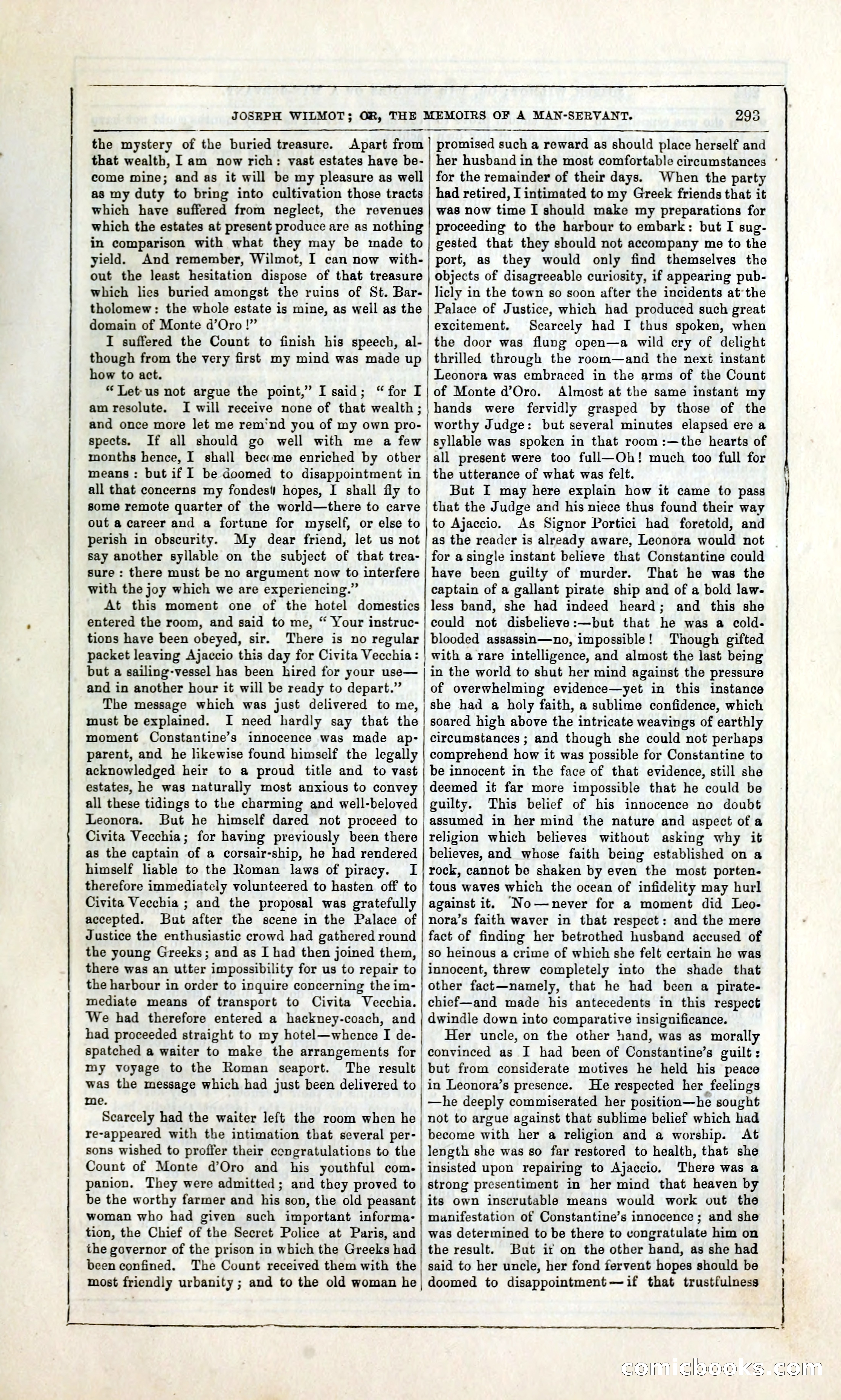
A restored page from Penny Dreadfuls, 1854. Page through the whole issue in the reader above.
📄 Transcribed text from this page (OCR, searchable)
Machine-transcribed from the original scan — historical spelling and the odd misread are preserved.
JOSEPH WILMOT; OR, THE MEMOIRS OF A MAN-SERVANT. 295 the mystery of the buried treasure. Apart from that wealth, Iam now rich: vast estates have be- come mine; and as it will be my pleasure as well as my duty to bring into cultivation those tracts which have suffered from neglect, the revenues which the estates at present produce are as nothing in comparison with what they may be made to yield. And remember, Wilmot, I can now with- out the least hesitation dispose of that treasure which lies buried amongst the ruins of St. Bar- tholomew: the whole estate is mine, as well as the domain of Monte d’Oro!” I suffered the Count to finish his speech, al- though from the very first my mind was made up how to act. “'Let-us not argue the point,’ I said; “for I am resolute. I will receive none of that wealth; and once more let me rem’nd you of my own pro- spects. If all should go well with me a few months hence, I shall becime enriched by other means: but if 1 be doomed to disappointment in all that concerns my fondest) hopes, I shall fly to | | ' promised such a reward as should place herself and her husband in the most comfortable circumstances ° for the remainder of their days. When the party had retired, I intimated to my Greek friends that it was now time I should make my preparations for proceeding to the harbour to embark: but I sug- gested that they should not accompany me to the port, as they would only find themselves the objects of disagreeable curiosity, if appearing pub- licly in the town so soon after the incidents at the Palace of Justice, which had produced such great excitement. Scarcely had I thus spoken, when the door was flung open—a wild cry of delight thrilled through the room—and the next instant Leonora was embraced in the arms of the Count of Monte d’Oro. Almost at the same instant my hands were fervidly grasped by those of the worthy Judge: but several minutes elapsed ere a syllable was spoken in that room :—the hearts of all present were too full—Oh! much too full for the utterance of what was felt. But I may here explain how it came to pass some remote quarter of the world—there to carve | that the Judge and his niece thus found their way out a career and a fortune for myself, or else to perish in obscurity. My dear friend, let us not | | to Ajaccio. As Signor Portici had foretold, and as the reader is already aware, Leonora would not say another syllable on the subject of that trea- | for asingle instant believe that Constantine could sure : there must be no argument now to interfere with the joy which we are experiencing.” At this moment one of the hotel domestics entered the room, and said to me, “ Your instruc- tions have been obeyed, sir. There is no regular packet leaving Ajaccio this day for Civita Vecchia: but a sailing-vessel has been hired for your use— and in another hour it will be ready to depart.” The message which was just delivered to me, must be explained. I need hardly say that the moment Constantine’s innocence was made ap- parent, and he likewise found himself the legally acknowledged heir to a proud title and to vast estates, he was naturally most anxious to convey all these tidings to the charming and well-beloved Leonora. But he himself dared not proceed to Civita Vecchia; for having previously been there as the captain of a corsair-ship, he had rendered himself liable to the Roman laws of piracy. I therefore immediately volunteered to hasten off to Civita Vecchia ; and the proposal was gratefully accepted. But after the scene in the Palace of Justice the enthusiastic crowd had gathered round the young Greeks; and as I had then joined them, there was an utter impossibility for us to repair to the harbour in order to inquire concerning the im- mediate means of transport to Civita Vecchia. We had therefore entered a hackney-coach, and had proceeded straight to my hotel—whence I de- spatched a waiter to make the arrangements for my voyage to the Roman seaport. The result was the message which had just been delivered to me. Scarcely had the waiter left the room when he re-appeared with the intimation that several per- sons wished to proffer their congratulations to the Count of Monte d’Oro and his youthful com- panion. They were admitted; and they proved to be the worthy farmer and his son, the old peasant woman who had given such important informa- tion, the Chief of the Secret Police at Paris, and the governor of the prison in which the Greeks had been confined. The Count received them with the have been guilty of murder. That he was the captain of a gallant pirate ship and of a bold law- less band, she had indeed heard; and this she could not disbelieve:—but that he was a cold- blooded assassin—no, impossible! Though gifted with a rare intelligence, and almost the last being in the world to shut her mind against the pressure of overwhelming evidence—yet in this instance she had a holy faith, a sublime confidence, which soared high above the intricate weavings of earthly circumstances ; and though she could not perhaps comprehend how it was possible for Constantine to be innocent in the face of that evidence, still she deemed it far more impossible that he could be guilty. This belief of his innocence no doubt assumed in her mind the nature and aspect of a religion which believes without asking why it believes, and whose faith being established on a rock, cannot be shaken by even the most porten- tous waves which the ocean of infidelity may hurl against it. NNo—never for a moment did Leo- nora’s faith waver in that respect: and the mere fact of finding her betrothed husband accused of so heinous a crime of which she felt certain he was innocent, threw completely into the shade that other fact—namely, that he had been a pirate- chief—and made his antecedents in this respect dwindle down into comparative insignificance. Her uncle, on the other hand, was as morally convinced as I had been of Constantine’s guilt: but from considerate motives he held his peace in Leonora’s presence. He respected her feelings —he deeply commiserated her position—he sought not to argue against that sublime belief which had become with her a religion and a worship. At length she was so far restored to health, that she insisted upon repairing to Ajaccio. There was a strong presentiment in her mind that heaven by its own inscrutable means would work out the manifestation of Constantine’s innocence ; and she was determined to be there to vongratulate him on the result. But it on the other hand, as she had said to her uncle, her fond fervent hopes should be most friendly urbanity ; and to the old woman he} doomed to disappointment—if that trustfulness DOOKS