
Penny Dreadfuls, 1854 · page 290 of 399
Joseph Wilmot, or, The Memoirs of a Man-Servant — page 290: what you’re looking at
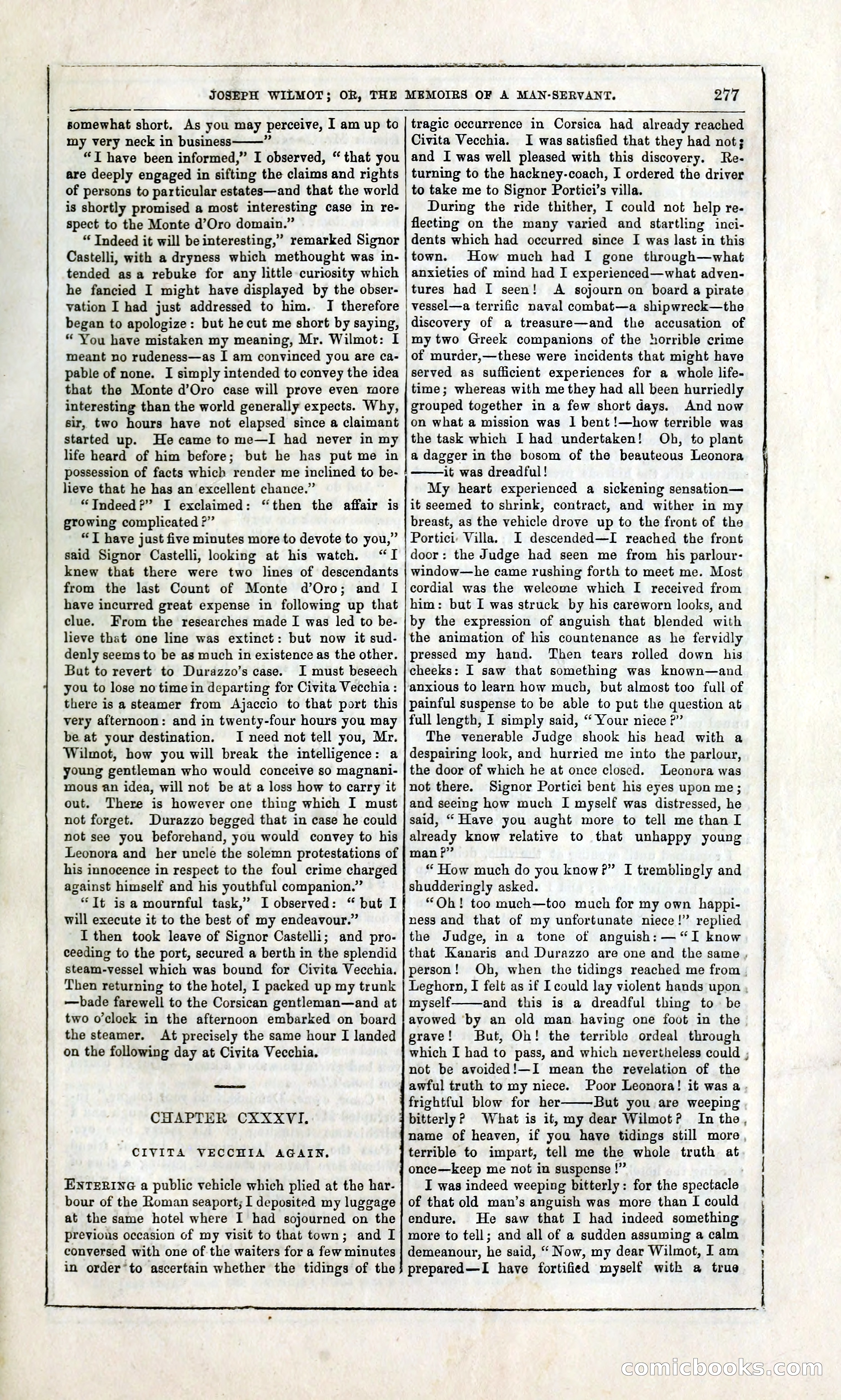
A restored page from Penny Dreadfuls, 1854. Page through the whole issue in the reader above.
📄 Transcribed text from this page (OCR, searchable)
Machine-transcribed from the original scan — historical spelling and the odd misread are preserved.
— JOSEPH WILMOT; OR, THE MEMOIRS OF A MAN-SERVANT. somewhat short. As you may perceive, I am up to 3) my very neck in business “T have been informed,” I observed, “ that you are deeply engaged in sifting the claims and rights of persons to particular estates—and that the world is shortly promised a most interesting case in re- spect to the Monte d’Oro domain.” “ Indeed it will be interesting,’ remarked Signor Castelli, with a dryness which methought was in- tended asa rebuke for any little curiosity which he fancied I might have displayed by the obser- vation I had just addressed to him. JI therefore began to apologize: but hecut me short by saying, “You have mistaken my meaning, Mr. Wilmot: I meant no rudeness—as I am convinced you are ca- pable of none. I simply intended to convey the idea that the Monte d’Oro case will prove even more interesting than the world generally expects. Why, sir, two hours have not elapsed since a claimant started up. He came to me—I had never in my life heard of him before; but he has put me in possession of facts which render me inclined to be- lieve that he has an excellent chance.” “Indeed?” I exclaimed: “then the affair is growing complicated ?” “T have just five minutes more to devote to you,” said Signor Castelli, looking at his watch. “I knew that there were two lines of descendants from the last Count of Monte d’Oro; and I have incurred great expense in following up that clue. From the researches made I was led to be- lieve that one line was extinct: but now it sud- denly seems to be as much in existence as the other. But to revert to Durazzo’s case. I must beseech you to lose no time in departing for Civita Vecchia : there is a steamer from Ajaccio to that port this very afternoon: and in twenty-four hours you may be at your destination. I need not tell you, Mr. Wilmot, how you will break the intelligence: a young gentleman who would conceive so magnani- mous an idea, will not be at a loss how to carry it out. There is however one thing which I must not forget. Durazzo begged that in case he could not see you beforehand, you would convey to his Leonora and her uncle the solemn protestations of his innocence in respect to the foul crime charged against himself and his youthful companion.” “It is a mournful task,” I observed: “ but I will execute it to the best of my endeavour.” I then took leave of Signor Castelli; and pro- ceeding to the port, secured a berth in the splendid steam-vessel which was bound for Civita Vecchia. Then returning to the hotel, I packed up my trunk —bade farewell to the Corsican gentleman—and at two o’clock in the afternoon embarked on board the steamer. At precisely the same hour I landed on the following day at Civita Vecchia. CHAPTER CXXXVI. CIVITA VECCHIA AGAIN. ENTERING a public vehicle which plied at the har- bour of the Roman seaport; I deposited my luggage at the same hotel where I had sojourned on the previous occasion of my visit to that town; and I conversed with one of the waiters for a few minutes in order*to ascertain whether the tidings of the tragic occurrence in Corsica had already reached Civita Vecchia. I was satisfied that they had not; and I was well pleased with this discovery. Re- turning to the hackney-coach, I ordered the driver to take me to Signor Portici’s villa. During the ride thither, I could not help re- flecting on the many varied and startling inci- dents which had occurred since I was last in this town. How much had I gone through—what anxieties of mind had I experienced—what adven- tures had I seen! A sojourn on board a pirate vessel—a terrific naval combat—a shipwreck—the discovery of a treasure—and the accusation of my two Greek companions of the horrible crime of murder,—these were incidents that might have served as sufficient experiences for a whole life- time; whereas with me they had all been hurriedly erouped together in a few short days. And now on what a mission was | bent !—how terrible was the task which I had undertaken! Oh, to plant a dagger in the bosom of the beauteous Leonora it was dreadful! My heart experienced a sickening sensation— it seemed to shrink, contract, and wither in my breast, as the vehicle drove up to the front of the Portici: Villa. I descended—I reached the front door: the Judge had seen me from his parlour: window—he came rushing forth to meet me. Most cordial was the weleome which I received from him: but I was struck by his careworn looks, and by the expression of anguish that blended with the animation of his countenance as he fervidly pressed my hand. Then tears rolled down his cheeks: I saw that something was known—and anxious to learn how much, but almost too full of painful suspense to be able to put the question at full length, I simply said, “ Your niece ?” The venerable Judge shook his head with a despairing look, and hurried me into the parlour, the door of which he at once closed. Leonora was not there. Signor Portici bent his eyes upon me; and seeing how much I myself was distressed, he said, “ Have you aught more to tell me than I already know relative to that unhappy young man ?” “ How much do you know?” I tremblingly and shudderingly asked. “Oh! too much—too much for my own happi- ness and that of my unfortunate niece!” replied the Judge, in a tone of anguish: —“I know that Kanaris and Durazzo are one and the same, person! Oh, when the tidings reached me from . Leghorn, I felt as if I could lay violent hands upon , myself and this is a dreadful thing to be avowed ‘by an old man having one foot in the grave! But, Oh! the terrible ordeal through which I had to pass, and which nevertheless could , not be avoided!—I mean the revelation of the awful truth to my niece. Poor Leonora! it was a frightful blow for her But you are weeping bitterly? What is it, my dear Wilmot? In the, name of heaven, if you have tidings still more, terrible to impart, tell me the whole truth at once—keep me not in suspense !” I was indeed weeping bitterly: for the spectacle of that old man’s anguish was more than I could endure. He saw that I had indeed something more to tell; and all of a sudden assuming a calm demeanour, he said, “ Now, my dear Wilmot, I am prepared—I have fortified myself with @ true ’ OOO) S co iin