
Penny Dreadfuls, 1854 · page 284 of 399
Joseph Wilmot, or, The Memoirs of a Man-Servant — page 284: what you’re looking at
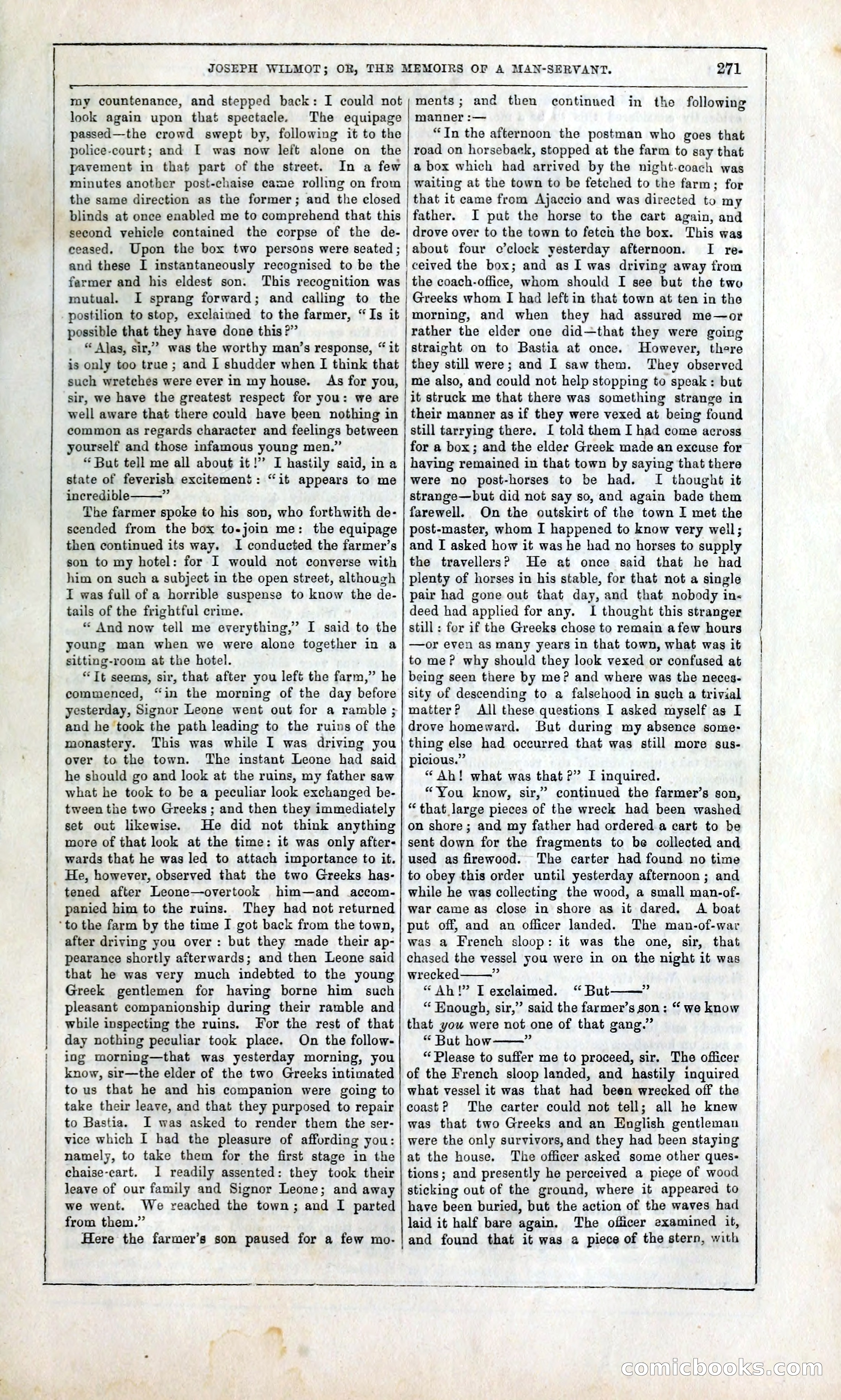
A restored page from Penny Dreadfuls, 1854. Page through the whole issue in the reader above.
📄 Transcribed text from this page (OCR, searchable)
Machine-transcribed from the original scan — historical spelling and the odd misread are preserved.
Tt 271 my countenance, and stepped back: I could not look again upon that spectacle. The equipage passed—the crowd swept by, following it to the police-court; and I was now left alone on the pavement in that part of the street. In a few minutes another post-chaise came rolling on from the same direction as the former; and the closed blinds at once enabled me to comprehend that this second vehicle contained the corpse of the de- ceased. Upon the box two persons were seated ; and these I instantaneously recognised to be the farmer and his eldest son. This recognition was mutual. I sprang forward; and calling to the postilion to stop, exclaimed to the farmer, “Is it possible that they have done this?” “ Alas, sir,’ was the worthy man’s response, “ it is only too true ; and | shudder when I think that such wretches were ever in my house. As for you, sir, we have the greatest respect for you: we are well aware that there could have been nothing in common as regards character and feelings between yourself and those infamous young men.” “ But tell me all about it!” I hastily said, in a state of feverish excitement: “it appears to me incredible d The farmer spoke to his son, who forthwith de- scended from the box to-join me: the equipage then continued its way. I conducted the farmer’s son to my hotel: for I would not converse with him on such a subject in the open street, although I was full of a horrible suspense to know the de- tails of the frightful crime. “ And now tell me everything,’ I said to the young man when we were alone together in a sitting-room at the hotel. “Tt seems, sir, that after you left the farm,” he commenced, “in the morning of the day before yesterday, Signor Leone went out for a ramble ; and he took the path leading to the ruins of the monastery. This was while I was driving you over to the town. The instant Leone had said he should go and look at the ruins, my father saw what he took to be a peculiar look exchanged be- tween the two Greeks ; and then they immediately set out likewise. He did not think anything more of that look at the time: it was only after- wards that he was led to attach importance to it. _ He, however, observed that the two Greeks has- tened after Leone—overtook him—and accom- panied him to the ruins. They had not returned ‘to the farm by the time I got back from the town, after driving you over: but they made their ap- pearance shortly afterwards; and then Leone said that he was very much indebted to the young Greek gentlemen for having borne him such pleasant companionship during their ramble and while inspecting the ruins. For the rest of that day nothing peculiar took place. On the follow- ing morning—that was yesterday morning, you know, sir—the elder of the two Greeks intimated to us that he and his companion were going to take their leave, and that they purposed to repair to Bastia. I was asked to render them the ser- vice which I had the pleasure of affording you: namely, to take them for the first stage in the chaise-cart. 1 readily assented: they took their leave of our family and Signor Leone; and away we went. We reached the town; and I parted from them.” Here the farmer’s son paused for a few mo- ments; and then continued in the following manner :— “In the afternoon the postman who goes that road on horseback, stopped at the farm to say that a box which had arrived by the night-coach was waiting at the town to be fetched to the farm; for that it came from Ajaccio and was directed to my father. I put the horse to the cart again, and drove over to the town to fetch the box. This was about four oc’clock yesterday afternoon. I re. ceived the box; and as I was driving away from the coach-office, whom should I see but the two Greeks whom I had left in that town at ten in the morning, and when they had assured me—or rather the elder one did—that they were going straight on to Bastia at once. However, there they still were; and I saw them. They observed me also, and could not help stopping to speak: but it struck me that there was something strange in their manner as if they were vexed at being found still tarrying there. I told them I had come across for a box; and the elder Greek made an excuse for having remained in that town by saying that there were no post-horses to be had. I thought it strange—but did not say so, and again bade them farewell. On the outskirt of the town I met the post-master, whom I happened to know very well; and I asked how it was he had no horses to supply the travellers? He at once said that he had plenty of horses in his stable, for that not a single pair had gone out that day, and that nobody in- deed had applied for any. I thought this stranger still : for if the Greeks chose to remain afew hours —or even as many years in that town, what was it to me? why should they look vexed or confused at being seen there by me? and where was the neces- sity of descending to a falsehood in such a trivial matter? All these questions I asked myself as I drove homeward. But during my absence some: thing else had occurred that was still more sus- picious.” “ Ah! what was that?” I inquired. “You know, sir,” continued the farmer’s son, “that large pieces of the wreck had been washed on shore; and my father had ordered a cart to be sent down for the fragments to be collected and used as firewood. The carter had found no time to obey this order until yesterday afternoon ; and while he was collecting the wood, a small man-of- war came as close in shore as if dared. A boat put off, and an officer landed. The man-of-war was a French sloop: it was the one, sir, that chased the vessel you were in on the night it was wrecked i “Ah!” Texclaimed. “But 4 “ Enough, sir,” said the farmer’s son: “ we know that you were not one of that gang.” “ But how 2 ‘Please to suffer me to proceed, sir. The officer of the French sloop landed, and hastily inquired what vessel it was that had been wrecked off the coastP The carter could not tell; all he knew was that two Greeks and an English gentleman were the only survivors, and they had been staying at the house. The officer askea some other ques- tions; and presently he perceived a piece of wood sticking out of the ground, where it appeared to have been buried, but the action of the waves had laid it half bare again, The officer examined it, and found that it was a piece of the stern, with SE SES SE VP On oat ee ae LR ae en JOSEPH WILMOT; OR, THE MEMOIRS OF A MAN-SERVANT. 0 - RS se NE ELOOQO) SS co