
Penny Dreadfuls, 1854 · page 269 of 399
Joseph Wilmot, or, The Memoirs of a Man-Servant — page 269: what you’re looking at
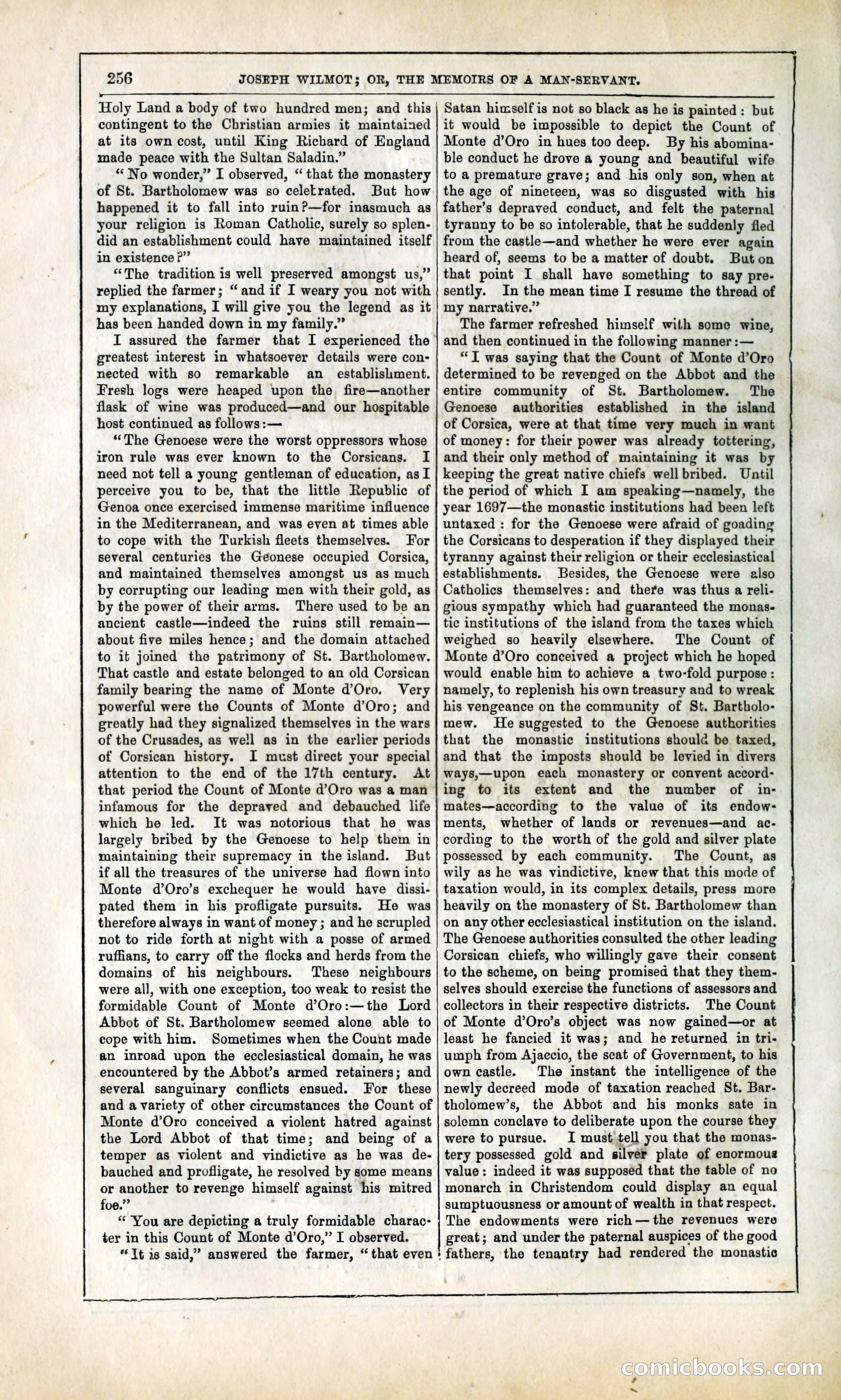
A restored page from Penny Dreadfuls, 1854. Page through the whole issue in the reader above.
📄 Transcribed text from this page (OCR, searchable)
Machine-transcribed from the original scan — historical spelling and the odd misread are preserved.
256 Holy Land a body of two hundred men; and this contingent to the Christian armies it maintained at its own cost, until King Richard of England made peace with the Sultan Saladin.” ** No wonder,” I observed, “ that the monastery of St. Bartholomew was so celetrated. But how happened it to fall into ruinP—for inasmuch as your religion is Roman Catholic, surely so splen- did an establishment could have maintained itself in existence ?P” ‘The tradition is well preserved amongst us,” replied the farmer; “and if I weary you not with my explanations, I will give you the legend as it has been handed down in my family.” I assured the farmer that I experienced the greatest interest in whatsoever details were con- nected with so remarkable an_ establishment. Fresh logs were heaped upon the fire—another flask of wine was produced—and our hospitable host continued as follows :— “‘The Genoese were the worst oppressors whose iron rule was ever known to the Corsicans. I need not tell a young gentleman of education, as I perceive you to be, that the little Republic of Genoa once exercised immense maritime influence in the Mediterranean, and was even at times able to cope with the Turkish fleets themselves. For several centuries the Geonese occupied Corsica, and maintained themselves amongst us as much by corrupting our leading men with their gold, as by the power of their arms. There used to be an ancient castle—indeed the ruins still remain— about five miles hence; and the domain attached to it joined the patrimony of St. Bartholomew. That castle and estate belonged to an old Corsican family bearing the name of Monte d’Oro. Very powerful were the Counts of Monte d’Oro; and greatly had they signalized themselves in the wars of the Crusades, as well as in the earlier periods of Corsican history. I must direct your special attention to the end of the 17th century. At that period the Count of Monte d’Oro was a man infamous for the depraved and debauched life which be led. It was notorious that he was largely bribed by the Genoese to help them in maintaining their supremacy in the island. But if all the treasures of the universe had flown into Monte d’Oro’s exchequer he would have dissi- pated them in his profligate pursuits. He was therefore always in want of money ; and he scrupled not to ride forth at night with a posse of armed ruffians, to carry off the flocks and herds from the domains of his neighbours. These neighbours were all, with one exception, too weak to resist the formidable Count of Monte d’Oro:—the Lord Abbot of St. Bartholomew seemed alone able to cope with him. Sometimes when the Count made an inroad upon the ecclesiastical domain, he was encountered by the Abbot’s armed retainers; and several sanguinary conflicts ensued. For these and a variety of other circumstances the Count of Monte d’Oro conceived a violent hatred against the Lord Abbot of that time; and being of a temper as violent and vindictive as he was de- bauched and profligate, he resolved by some means or another to revenge himself against his mitred foe.” : “ You are depicting a truly formidable charac- ter in this Count of Monte d’Oro,” I observed. JOSEPH WILMOT; OR, THE MEMOIRS OF A MAN-SERVANT. Satan himself is not so black as he is painted: but it would be impossible to depict the Count of Monte d’Oro in hues too deep. By his abomina- ble conduct he drove a young and beautiful wife to a premature grave; and his only son, when at the age of nineteen, was so disgusted with his father’s depraved conduct, and felt the paternal tyranny to be so intolerable, that he suddenly fled from the castle—and whether he were ever again heard of, seems to be a matter of doubt. Buton that point I shall have something to say pre- sently. In the mean time I resume the thread of my narrative.” The farmer refreshed himself with some wine, and then continued in the following manner :— “I was saying that the Count of Monte d’Oro determined to be revenged on the Abbot and the . entire community of St. Bartholomew. The Genoese authorities established in the island of Corsica, were at that time very much in want of money: for their power was already tottering, and their only method of maintaining it was by keeping the great native chiefs well bribed. Until the period of which I am speaking—namely, the year 1697—the monastic institutions had been left untaxed : for the Genoese were afraid of goading the Corsicans to desperation if they displayed their tyranny against their religion or their ecclesiastical establishments. Besides, the Genoese were also Catholics themselves: and there was thus a reli- gious sympathy which had guaranteed the monas- tic institutions of the island from the taxes which weighed so heavily elsewhere. The Count of Monte d’Oro conceived a project which he hoped would enable him to achieve a two-fold purpose : namely, to replenish his own treasury and to wreak his vengeance on the community of St. Bartholo- mew. He suggested to the Genoese authorities that the monastic institutions shoulda be taxed, and that the imposts should be levied in divers ways,—upon each monastery or convent accord- ing to its extent and the number of in- mates—according to the value of its endow- ments, whether of lands or revenues—and ac- cording to the worth of the gold and silver plate possessed by each community. The Count, as wily as he was vindictive, knew that this mode of taxation would, in its complex details, press more heavily on the monastery of St. Bartholomew than on any other ecclesiastical institution on the island. The Genoese authorities consulted the other leading Corsican chiefs, who willingly gave their consent to the scheme, on being promised that they them- selves should exercise the functions of assessors and collectors in their respective districts. The Count of Monte d’Oro’s object was now gained—or at least he fancied it was; and he returned in tri- umph from Ajaccio, the seat of Government, to his own castle. The instant the intelligence of the newly decreed mode of taxation reached St. Bar- tholomew’s, the Abbot and his monks sate in solemn conclave to deliberate upon the course they were to pursue. I must tell you that the monas- tery possessed gold and silver plate of enormous value: indeed it was supposed that the table of no monarch in Christendom could display an equal sumptuousness or amount of wealth in that respect. The endowments were rich—the revenues were great; and under the paternal auspices of the good Tt is said,” answered the farmer, “that even: fathers, the tenantry had rendered the monastic Gs a I IS TE ELNOOLKS (E(0) coim