
Penny Dreadfuls, 1854 · page 256 of 399
Joseph Wilmot, or, The Memoirs of a Man-Servant — page 256: what you’re looking at
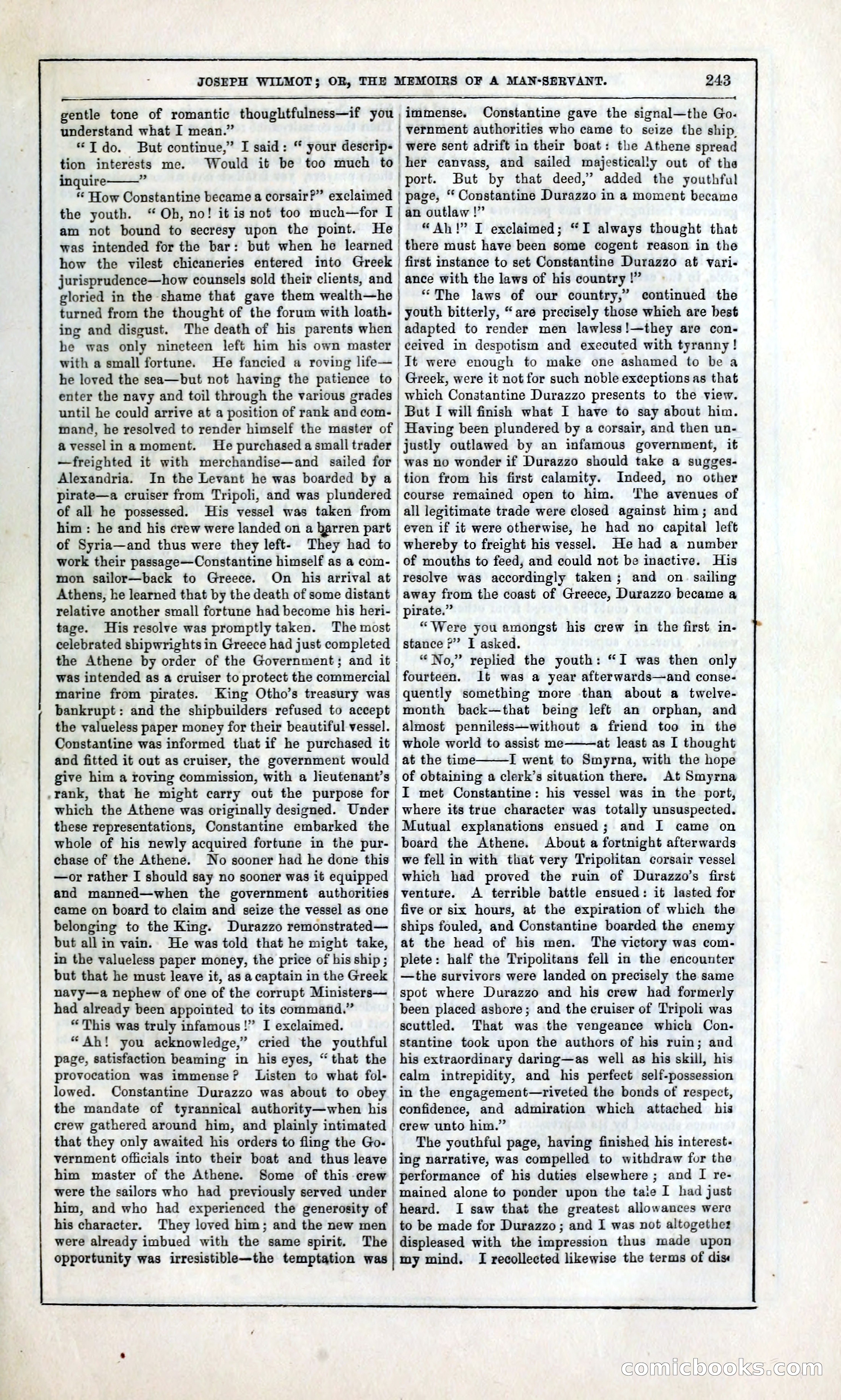
A restored page from Penny Dreadfuls, 1854. Page through the whole issue in the reader above.
📄 Transcribed text from this page (OCR, searchable)
Machine-transcribed from the original scan — historical spelling and the odd misread are preserved.
JOSEPH WILMOT; OR, THE MEMOIRS OF A MAN-SERVANT. gentle tone of romantic thougltfulness—if you understand what I mean.” “Ido. But continue,” I said: “ your descrip- tion interests me. Would it be too much to inquire P | port. 243 immense. Constantine gave the signal—the Go. vernment authorities who came to seize the ship. were sent adrift in their boat: the Athene spread her canvass, and sailed majestically out of the But by that deed,’ added the youthful How Constantine became a corsair?” exclaimed | page, ‘ Constantine Durazzo in a moment became the youth. am not bound to secresy upon the point. He “ Oh, no! itis nof too much—for I | an outlaw!” “Ah!” I exclaimed; “I always thought that was intended for the bar: but when he learned | there must have been some cogent reason in the how the vilest chicaneries entered into Greek | first instance to set Constantine Durazzo at vari- jurisprudence—how counsels sold their clients, and | ance with the laws of his country !” gloried in the shame that gave them wealth—he turned from the thought of the forum with loath- ing and disgust. he was only nineteen left him his own master with a small fortune. He fancied a roving life— “The laws of our country,’ continued the youth bitterly, “are precisely those which are best The death of his parents when | adapted to render men lawless!—they are con- ceived in despotism and executed with tyranny ! It were enough to make one ashamed to bea he loved the sea—but not having the patience to | Greek, were it not for such noble exceptions as that enter the navy and toil through the various grades | which Conatantine Durazzo presents to the view. until he could arrive at a position of rank and com- | But I will finish what I have to say about him. mand, he resolved to render himself the master of | Having been plundered by a corsair, and then un- a vessel in a moment. He purchased a small trader | justly outlawed by an infamous government, it —freighted it with merchandise—and sailed for | was no wonder if Durazzo should take a sugges- Alexandria. pirate—a cruiser from Tripoli, and was plundered | course remained open to him. of all he possessed. His vessel was taken from In the Levant he was boarded by a | tion from his first calamity. Indeed, no other The avenues of all legitimate trade were closed against him; and him : he and his crew were landed on a barren part | even if it were otherwise, he had no capital left of Syria—and thus were they left- They had to work their passage—Constantine himself as a com- mon sailor—back to Greece. On his arrival at whereby to freight his vessel. He had a number of mouths to feed, and could not be inactive. His resolve was accordingly taken; and on sailing Athens, he learned that by the death of some distant | away from the coast of Greece, Durazzo became a tage. His resolve was promptly taken. The most celebrated shipwrights in Greece had just completed the Athene by order of the Government; and it was intended as a cruiser to protect the commercial | fourteen. marine from pirates. King Otho’s treasury was bankrupt: and the shipbuilders refused to accept the valueless paper money for their beautiful vessel. Constantine was informed that if he purchased it and fitted it out as cruiser, the government would give him a roving commission, with a lieufenant’s .rank, that he might carry out the purpose for which the Athene was originally designed. Under these representations, Constantine embarked the whole of his newly acquired fortune in the pur- chase of the Athene. No sooner had he done this —or rather I should say no sooner was it equipped and manned—when the government authorities came on board to claim and seize the vessel as one belonging to the King. Durazzo remonstrated— but allin vain. He was told that he might take, in the valueless paper money, the price of his ship ; but that he must leave it, as a captain in the Greek relative another small fortune had become his heri- | pirate.” “Were you amongst his crew in the first in- stance ?” I asked. “No,” replied the youth: “I was then only lt was a year afterwards—and conse- quently something more than about a twelve- month back—that being left an orphan, and almost penniless~—without a friend too in the whole world to assist me at least as I thought at the time I went to Smyrna, with the hope of obtaining a clerk’s situation there. At Smyrna I met Constantine: his vessel was in the port, where its true character was totally unsuspected. Mutual explanations ensued; and I came on board the Athene. About a fortnight afterwards we fell in with that very Tripolitan corsair vessel which had proved the ruin of Durazzo’s first venture. A terrible battle ensued: it lasted for five or six hours, at the expiration of which the ships fouled, and Constantine boarded the enemy at the head of his men. The victory was com- plete: half the Tripolitans fell in the encounter —the survivors were landed on precisely the same navy—a nephew of one of the corrupt Ministers~ | spot where Durazzo and his crew had formerly had already been appointed to its command.” “This was truly infamous!” I exclaimed. | been placed ashore; and the cruiser of Tripoli was | scuttled. That was the vengeance which Con- “Ah! you acknowledge,” cried the youthful | stantine took upon the authors of his ruin; and page, satisfaction beaming in his eyes, “that the | his extraordinary daring—as well as his skill, his provocation was immense? Listen to what fol- | calm intrepidity, and his perfect self-possession lowed. Constantine Durazzo was about to obey the mandate of tyrannical authority—when his crew gathered around him, and plainly intimated that they only awaited his orders to fling the Go- vernment officials into their boat and thus leave him master of the Athene. Some of this crew were the sailors who had previously served under him, and who had experienced the generosity of heard. his character. were already imbued with the same spirit. They loved him; and the new men The opportunity was irresistible—the temptation was in the engagement—riveted the bonds of respect, confidence, and admiration which attached his crew unto him.” The youthful page, having finished his interest- ing narrative, was compelled to withdraw for the performance of his duties elsewhere; and I re- mained alone to ponder upon the taie I had just I saw that the greatest allowances were to be made for Durazzo ; and I was not altogethez displeased with the impression thus made upon my mind. [I recollected likewise the terms of dis Glyoo S (C@)