
Penny Dreadfuls, 1854 · page 245 of 399
Joseph Wilmot, or, The Memoirs of a Man-Servant — page 245: what you’re looking at
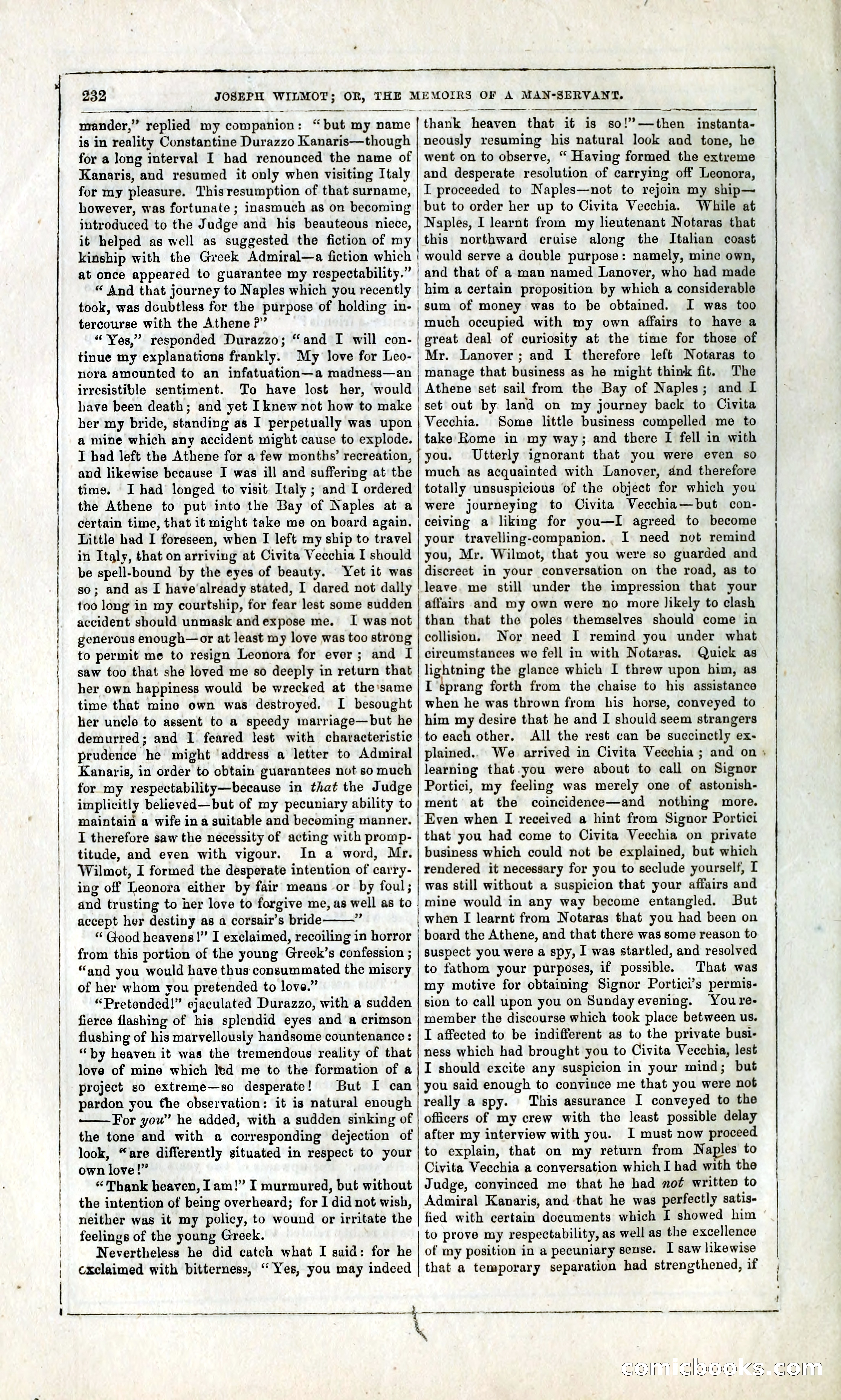
A restored page from Penny Dreadfuls, 1854. Page through the whole issue in the reader above.
📄 Transcribed text from this page (OCR, searchable)
Machine-transcribed from the original scan — historical spelling and the odd misread are preserved.
232 mander,” replied my companion: “but my name is in reality Constantine Durazzo Kanaris—though for a long interval I had renounced the name of Kanaris, and resumed it only when visiting Italy for my pleasure. This resumption of that surname, however, was fortunate ; inasmuch as on becoming introduced to the Judge and his beauteous niece, it helped as well as suggested the fiction of my kinship with the Greek Admiral—a fiction which at once appeared to guarantee my respectability.” “ And that journey to Naples which you recently took, was dcubtless for the purpose of holding in- tercourse with the Athene P” “Yes,” responded Durazzo; “and I will con- tinue my explanations frankly. My love for Leo- nora amounted to an infatuation—a madness—an irresistible sentiment. To have lost her, would have been death; and yet I knew not how to make her my bride, standing as I perpetually was upon a mine which any accident might cause to explode. I had left the Athene for a few months’ recreation, and likewise because I was ill and suffering at the time. I had longed to visit Italy; and I ordered the Athene to put into the Bay of Naples at a certain time, that it might take me on board again. Little had I foreseen, when I left my ship to travel in Italy, that on arriving at Civita Vecchia I should be spell-bound by the eyes of beauty. Yet it was so; and as I have already stated, I dared not dally too long in my courtship, for fear lest some sudden accident should unmask and expose me. I was not generous enough—or at least my love was too strong to permit me to resign Leonora for ever; and I saw too that she loved me so deeply in return that her own happiness would be wrecked at the'same time that mine own was destroyed. I besought her uncle to assent to a speedy marriage—but he demurred; and I feared lest with characteristic prudence he might ‘address a letter to Admiral Kanaris, in order to obtain guarantees not so much for my respectability—because in that the Judge implicitly believed—but of my pecuniary ability to maintain a wife ina suitable and becoming manner. I therefore saw the necessity of acting with promp- titude, and even with vigour. In a word, Mr. Wilmot, I formed the desperate intention of carry- ing off Leonora either by fair means or by foul; and trusting to her love to forgive me, as well as to accept her destiny as a corsair’s bride ? “ Good heavens!” I exclaimed, recoiling 1n horror from this portion of the young Greek’s confession ; “and you would have thus consummated the misery of her whom you pretended to love.” “Pretended!” ejaculated Durazzo, with a sudden fierce flashing of his splendid eyes and a crimson flushing of his marvellously handsome countenance : “by heaven it was the tremendous reality of that love of mine which led me to the formation of a project so extreme—so desperate! But I can pardon you the observation: it is natural enough ——For you” he added, with a sudden sinking of the tone and with a corresponding dejection of look, “are differently situated in respect to your own love!” “Thank heaven, Iam!” I murmured, but without the intention of being overheard; for I did not wish, neither was it my policy, to wound or irritate the feelings of the young Greek. Nevertheless he did catch what I said: for he inn ee ae JOSEPH WILMOT; OR, THE MEMOIRS OF A MAN-SERVANT. _——— — + * thank heaven that it is so!”—then instanta- neously resuming his natural look and tone, he went on to observe, “ Having formed the extreme and desperate resolution of carrying off Leonora, I proceeded to Naples—not to rejoin my ship— but to order her up to Civita Vecchia. While at Naples, I learnt from my lieutenant Notaras that this northward cruise along the Italian coast would serve a double purpose: namely, mine own, and that of a man named Lanover, who had made him a certain proposition by which a considerable sum of money was to be obtained. I was too much occupied with my own affairs to have a great deal of curiosity at the time for those of Mr. Lanover ; and I therefore left Notaras to manage that business as he might think fit. The Athene set sail from the Bay of Naples; and I set out by land on my journey back to Civita Vecchia. Some little business compelled me to take Rome in my way; and there I fell in with you. Utterly ignorant that you were even s0 much as acquainted with Lanover, dnd therefore totally unsuspicious of the object for which you were journeying to Civita Vecchia—but con- ceiving a liking for you—I agreed to become your travelling-companion. I need not remind you, Mr. Wilmot, that you were so guarded and discreet in your conversation on the road, as to leave. me still under the impression that your affairs and my own were no more Jikely to clash than that the poles themselves should come in collision. Nor need I remind you under what circumstances we fell in with Notaras. Quick as lightning the glance which I threw upon him, as I sprang forth from the chaise to his assistance when he was thrown from his horse, conveyed to him my desire that he and I should seem strangers to each other. All the rest can be succinctly ex- plained.. We arrived in Civita Vecchia ; and on : learning that.you were about to call on Signor Portici, my feeling was merely one of astonish- ment at the coincidence—and nothing more. Even when I received a hint from Signor Portici that you had come to Civita Vecchia on private business which could not be explained, but which rendered it necessary for you to seclude yourself, I was still without a suspicion that your affairs and mine would in any way become entangled. But when I learnt from Notaras that you had been on board the Athene, and that there was some reason to suspect you were a spy, I was startled, and resolved to fathom your purposes, if possible. That was my motive for obtaining Signor Portici’s permis- sion to call upon you on Sundayevening. Youre- member the discourse which took place between us. I affected to be indifferent as to the private busi- ness which had brought you to Civita Vecchia, lest I should excite any suspicion in your mind; but you said enough to convince me that you were not really a spy. This assurance I conveyed to the officers of my crew with the least possible delay after my interview with you. I must now proceed to explain, that on my return from Naples to Civita Vecchia a conversation which I had with the Judge, convinced me that he had not written to Admiral Kanaris, and that he was perfectly satis- fied with certain documents which I showed him © to prove my respectability, as well as the excellence of my position in a pecuniary sense. I saw likewise exclaimed with bitterness, “Yes, you may indeed | that a temporary separation had strengthened, if GIOaks (C(O)