
Penny Dreadfuls, 1854 · page 237 of 399
Joseph Wilmot, or, The Memoirs of a Man-Servant — page 237: what you’re looking at
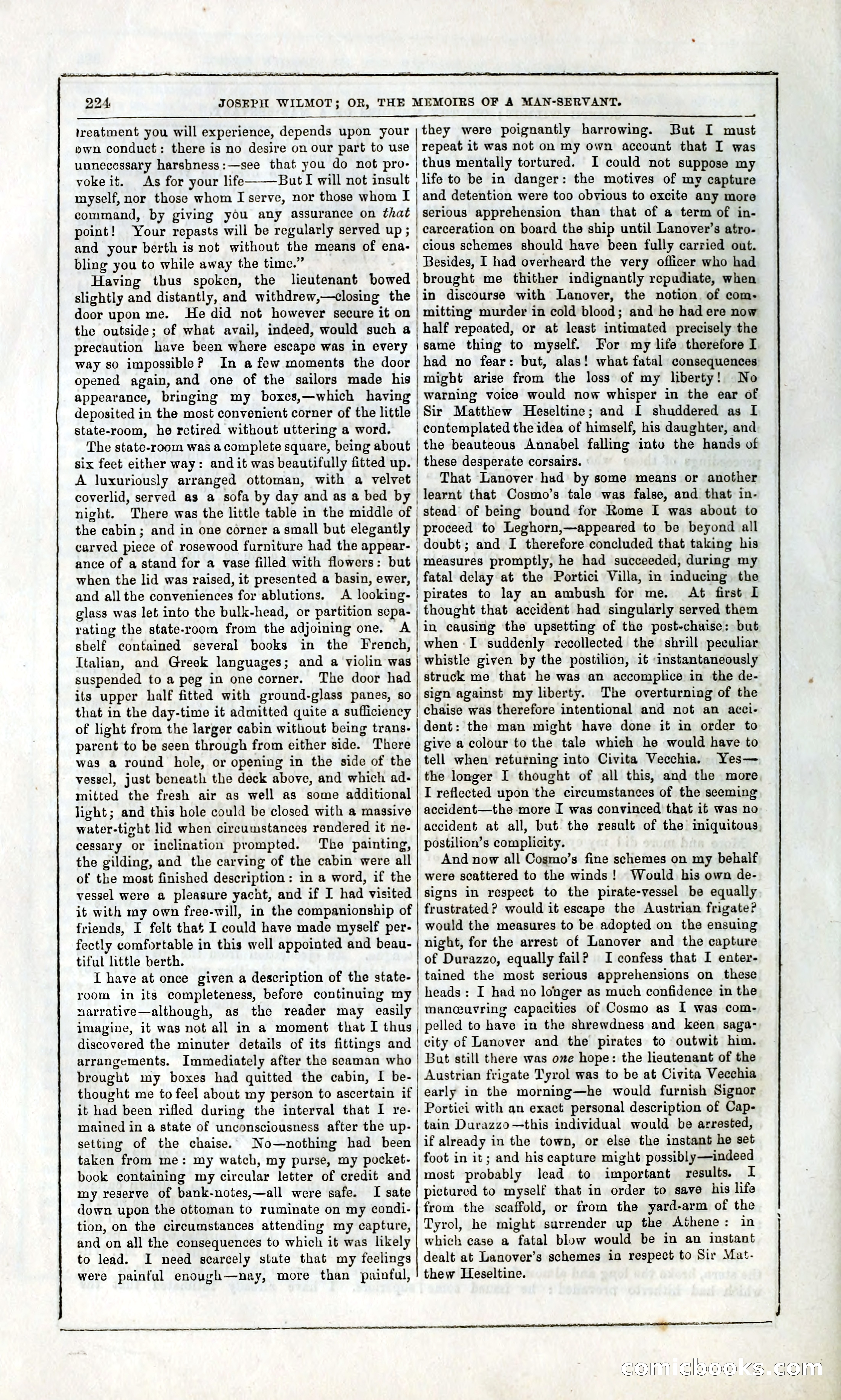
A restored page from Penny Dreadfuls, 1854. Page through the whole issue in the reader above.
📄 Transcribed text from this page (OCR, searchable)
Machine-transcribed from the original scan — historical spelling and the odd misread are preserved.
treatment you will experience, depends upon your own conduct: there is no desire on our part to use unnecessary harshness:—see that you do not pro- voke it. As for your life But I will not insult myself, nor those whom I serve, nor those whom I command, by giving yOu any assurance on that point! Your repasts will be regularly served up ; and your berth is not without the means of ena- bling you to while away the time.” : Having thus spoken, the lieutenant bowed slightly and distantly, and withdrew,—closing the door upon me. He did not however secure it on the outside; of what avail, indeed, would such a precaution have been where escape was in every way so impossible? In afew moments the door opened again, and one of the sailors made his appearance, bringing my boxes,—which having deposited in the most convenient corner of the little state-room, he retired without uttering a word. The state-room was a complete square, being about six feet either way: andit was beautifully fitted up. A luxuriously arranged ottoman, with a velvet coverlid, served as a sofa by day and as a bed by night. There was the little table in the middle of the cabin; and in one corner a small but elegantly carved piece of rosewood furniture had the appear- ance of a stand for a vase filled with flowers: but when the lid was raised, it presented a basin, ewer, and all the conveniences for ablutions. A looking- glass was let into the bulk-head, or partition sepa- rating the state-room from the adjoining one. A shelf contained several books in the French, Italian, and Greek languages; and a violin was suspended to a peg in one corner. The door had its upper half fitted with ground-glass panes, so that in the day-time it admitted quite a sufficiency of light from the larger cabin without being trans- parent to be seen through from either side. There was a round hole, or opening in the side of the vessel, just beneath the deck above, and which ad- mitted the fresh air as well as some additional light; and this hole could be closed with a massive water-tight lid when circumstances rendered it ne- cessary or inclination prompted. The painting, the gilding, and the carving of the cabin were all of the most finished description: in a word, if the vessel were a pleasure yacht, and if I had visited it with my own free-will, in the companionship of friends, I felt that I could have made myself per- fectly comfortable in this well appointed and beau- tiful little berth. I have at once given a description of the state- room in its completeness, before continuing my narrative—although, as the reader may easily imagine, it was not all in a moment that I thus discovered the minuter details of its fittings and arrangements. Immediately after the seaman who brought my boxes had quitted the cabin, I be- thought me to feel about my person to ascertain if it had been rifled during the interval that I re- mained in a state of unconsciousness after the up- setting of the chaise. No—nothing had been taken from me: my watch, my purse, my pocket- book containing my circular letter of credit and my reserve of bank-notes,—all were safe. I sate down upon the ottoman to ruminate on my condi- tion, on the circumstances attending my capture, and on all the consequences to which it was likely to lead. I need scarcely state that my feelings were painful enough—nay, more than painful, Caan c nc ee cremeeenntinnnetnnInnse ee i ee JOSEPH WILMOT; OR, THE MEMOIRS OF A MAN-SERVANT. they were poignantly harrowing. But I must repeat it was not on my own account that I was thus mentally tortured. I could not suppose my life to be in danger: the motives of my capture and detention were too obvious to excite any more serious apprehension than that of a term of in- carceration on board the ship until Lanover’s atro- cious schemes should have been fully carried out. Besides, I had overheard the very officer who had brought me thither indignantly repudiate, when in discourse with Lanover, the notion of com- mitting murder in cold blood; and he had ere now half repeated, or at least intimated precisely the same thing to myself. For my life thorefore I had no fear: but, alas! what fatal consequences might arise from the loss of my liberty! No warning voice would now whisper in the ear of Sir Matthew Heseltine; and I shuddered as IL contemplated the idea of himself, his daughter, and the beauteous Annabel falling into the hands of these desperate corsairs. That Lanover had by some means or another learnt that Cosmo’s tale was false, and that in- stead of being bound for Rome I was about to proceed to Leghorn,—appeared to be beyond all doubt; and I therefore concluded that taking his measures promptly, he had succeeded, during my fatal delay at the Portici Villa, in inducing the pirates to lay an ambush for me. At first I thought that accident had singularly served them in causing the upsetting of the post-chaise: but when :I suddenly recollected the shrill peculiar whistle given by the postilion, it ‘instantaneously struck me that he was an accomplice in the de- sign against my liberty. The overturning of the chaise was therefore intentional and not an acci- dent: the man might have done it in order to give a colour to the tale which he would have to tell when returning into Civita Vecchia. Yes— the longer I thought of all this, and the more I reflected upon the circumstances of the seeming accident—the more I was convinced that it was no accident at all, but the result of the iniquitous postilion’s complicity. And now all Cosmo’s fine schemes on my behalf were scattered to the winds! Would his own de- signs in respect to the pirate-vessel be equally frustrated ? would it escape the Austrian frigate? would the measures to be adopted on the ensuing night, for the arrest of Lanover and the capture of Durazzo, equally fail? I confess that I enter- tained the most serious apprehensions on these heads: I had no longer as much confidence in the manceuvring capacities of Cosmo as I was com- pelled to have in the shrewdness and keen saga- city of Lanover and the pirates to outwit him. But still there was one hope: the lieutenant of the Austrian frigate Tyrol was to be at Civita Vecchia early in the morning—he would furnish Signor Portici with an exact personal description of Cap- tain Durazzo—this individual would be arrested, if already in the town, or else the instant he set foot in it; and his capture might possibly—indeed most probably lead to important results. I pictured to myself that in order to save his life from the scaffold, or from the yard-arm of the Tyrol, he might surrender up the Athene: in which case a fatal blow would be in an instant dealt at Lanover’s schemes in respect to Sir Mat- thew Heseltine. @ J COmicboooks.Gom