
Penny Dreadfuls, 1854 · page 235 of 399
Joseph Wilmot, or, The Memoirs of a Man-Servant — page 235: what you’re looking at
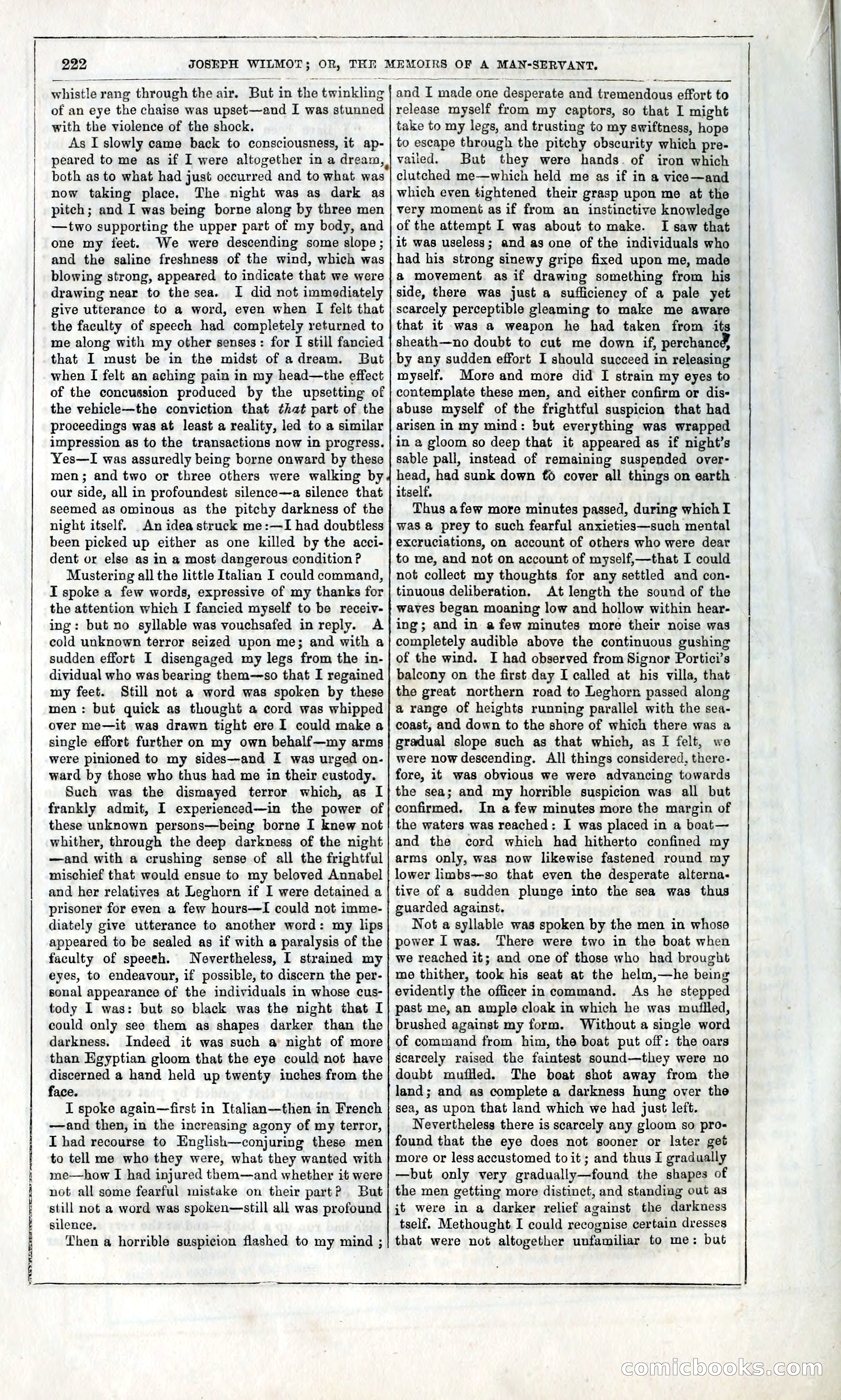
A restored page from Penny Dreadfuls, 1854. Page through the whole issue in the reader above.
📄 Transcribed text from this page (OCR, searchable)
Machine-transcribed from the original scan — historical spelling and the odd misread are preserved.
cs whistle rang through the air. But in the twinkling PONS er Cee eee 222 mn ee eS CO JOSEPH WILMOT; OR, THE MEMOIRS OF A MAN-SERVANT. of an eye the chaise was upset—and I was stunned with the violence of the shock. As I slowly came back to consciousness, it ap- peared to me as if I were altogether in a dream, both as to what had just occurred and to what was now taking place. The night was as dark as pitch; and I was being borne along by three men —two supporting the upper part of my body, and one my feet. We were descending some slope ; and the saline freshness of the wind, which was blowing strong, appeared to indicate that we were drawing near to the sea. I did not immediately give utterance to a word, even when [I felt that the faculty of speech had completely returned to me along with my other senses: for I still fancied that I must be in the midst of adream. But when I felt an aching pain in my head—the effect of the concussion produced by the upsetting of the vehicle—the conviction that ¢hat part of the proceedings was at least a reality, led to a similar impression as to the transactions now in progress. Yes—I was assuredly being borne onward by these men; and two or three others were walking by our side, all in profoundest silence—a silence that seemed as ominous as the pitchy darkness of the night itself. An idea struck me:—I had doubtless been picked up either as one killed by the acci- dent or else as in a most dangerous condition? Mustering all the little Italian I could command, T spoke a few words, expressive of my thanks for the attention which I fancied myself to be receiv- ing: but no syllable was vouchsafed in reply. A cold unknown terror seized upon me; and with a sudden effort I disengaged my legs from the in- dividual who was bearing them—so that I regained my feet. Still not a word was spoken by these men: but quick as thought a cord was whipped over me—it was drawn tight ere I could make a single effort further on my own behalf—my arms were pinioned to my sides—and I was urged on- ward by those who thus had me in their custody. Such was the dismayed terror which, as I frankly admit, I experienced—in the power of these unknown persons—being borne I knew not whither, through the deep darkness of the night —and with a crushing sense of all the frightful mischief that would ensue to my beloved Annabel and her relatives at Leghorn if I were detained a prisoner for even a few hours—I could not imme- diately give utterance to another word: my lips appeared to be sealed as if with a paralysis of the faculty of speeeh. Nevertheless, I strained my eyes, to endeavour, if possible, to discern the per- sonal appearance of the individuals in whose cus- tody I was: but so black was the night that I could only see them as shapes darker than the darkness. Indeed it was such a night of more than Egyptian gloom that the eye could not have discerned a hand held up twenty inches from the face. I spoke again—first in Italian—then in French —and then, in the increasing agony of my terror, I had recourse to Hnglish—conjuring these men to tell me who they were, what they wanted with me—how I had injured them—and whether it were not all some fearful mistake on their part? But still not a word was spoken—still all was profound silence, Then a horrible suspicion flashed to my mind ; and I made one desperate and tremendous effort to release myself from my captors, so that I might take to my legs, and trusting to my swiftness, hope to escape through the pitchy obscurity which pre- vaiied. But they were hands. of iron which clutched me—which held me as if in a vice—and which even tightened their grasp upon me at the very moment as if from an instinctive knowledge of the attempt I was about to make. I saw that it was useless; and as one of the individuals who had his strong sinewy gripe fixed upon me, made a movement as if drawing something from his side, there was just a sufficiency of a pale yet scarcely perceptible gleaming to make me aware that it was a weapon he had taken from its sheath—no doubt to cut me down if, perchancé, by any sudden effort I should succeed in releasing myself. More and more did I strain my eyes to contemplate these men, and either confirm or dis- abuse myself of the frightful suspicion that had arisen in my mind: but everything was wrapped in 2 gloom so deep that it appeared as if night’s sable pall, instead of remaining suspended over- head, had sunk down f6 cover all things on earth. itself, Thus afew more minutes passed, during which I was a prey to such fearful anxieties—such mental excruciations, on account of others who were dear to me, and not on account of myself,—that I could not collect my thoughts for any settled and con- tinuous deliberation. At length the sound of the waves began moaning low and hollow within hear- ing; and in afew minutes more their noise was completely audible above the continuous gushing of the wind. I had observed from Signor Portici’s balcony on the first day I called at his villa, that the great northern road to Leghorn passed along a range of heights running parallel with the sea- coast, and down to the shore of which there was a gradual slope such as that which, as I felt, we were now descending. All things considered, there- fore, it was obvious we were advancing towards the sea; and my horrible suspicion was all but confirmed. In a few minutes more the margin of the waters was reached: I was placed in a boat— and the cord which had hitherto confined my arms only, was now likewise fastened round my lower limbs~—so that even the desperate alterna- tive of a sudden plunge into the sea was thus guarded against. Not a syllable was spoken by the men in whose power I was. There were two in the boat when we reached it; and one of those who had brought me thither, took his seat at the helm,—he being evidently the officer in command. As he stepped past me, an ample cloak in which he was mutiled, brushed against my form. Without a single word of command from him, the boat put off: the oars scarcely raised the faintest sound—they were no doubt mufiled. The boat shot away from the land; and as complete a darkness hung over the sea, as upon that land which we had just left. Nevertheless there is scarcely any gloom so pro- found that the eye does not sooner or later get more or less accustomed to it; and thus I gradually —but only very gradually—found the shapes of the men getting more distinct, and standing out as jt were in a darker relief against the darkness tself. Methought I could recognise certain dresses that were not altogether unfamiliar to me: but ElOOO <S (Cc)