
Penny Dreadfuls, 1854 · page 223 of 399
Joseph Wilmot, or, The Memoirs of a Man-Servant — page 223: what you’re looking at
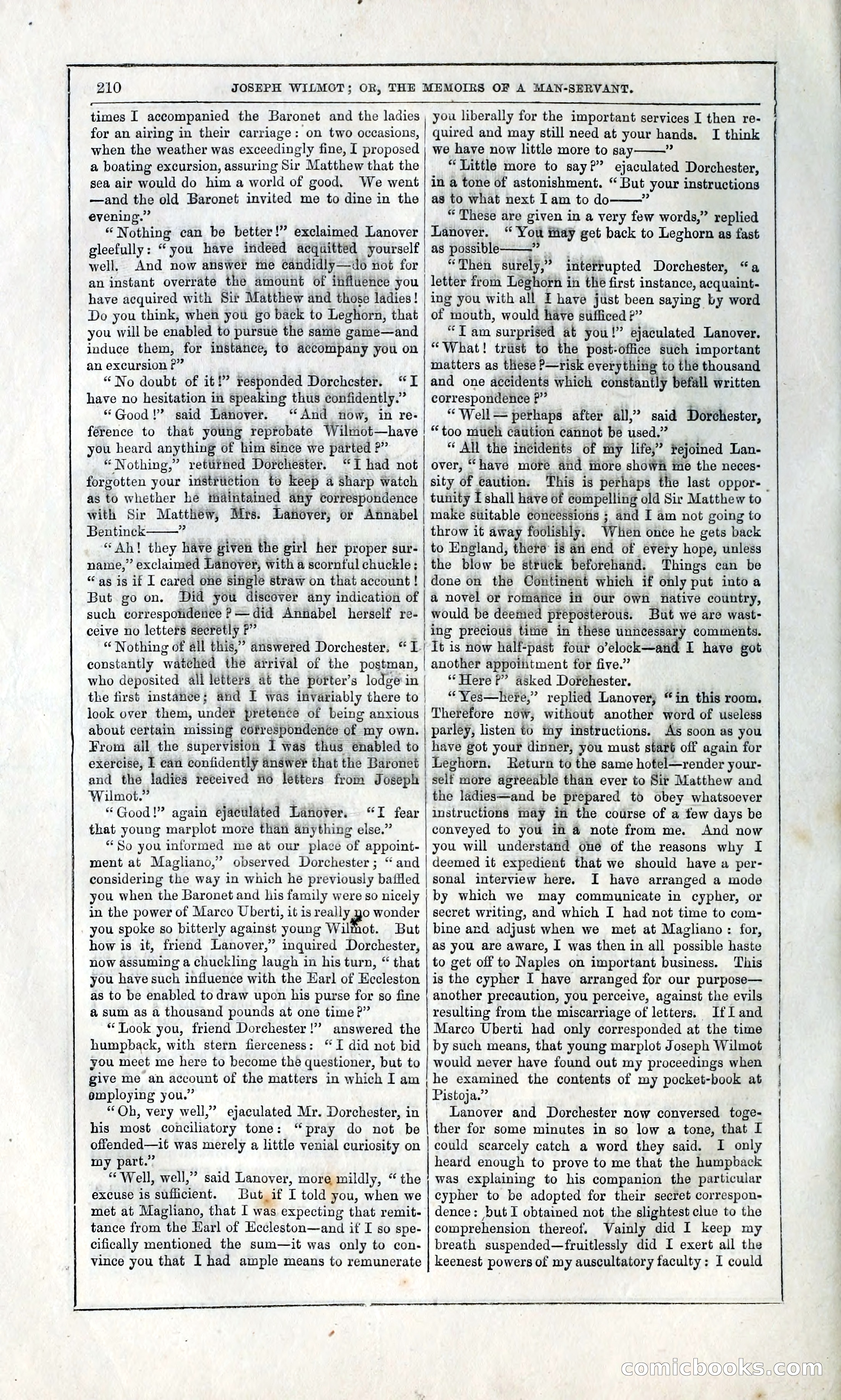
A restored page from Penny Dreadfuls, 1854. Page through the whole issue in the reader above.
📄 Transcribed text from this page (OCR, searchable)
Machine-transcribed from the original scan — historical spelling and the odd misread are preserved.
210 times I accompanied the Baronet and the ladies for an airing in their carriage: on two occasions, when the weather was exceedingly fine, I proposed a boating excursion, assuring Sir Matthew that the sea air would do him a world of good. We went —and the old Baronet invited me to dine in the evening.” “ Nothing can be better!’ exclaimed Lanover gleefully: “you have indeed acquitted yourself well. And now atiswer me ¢andidly—do not for an instant overrate the amount of influence you have acquired with Sit Matthew and those ladies! Do you think, when you go back to Leghorn, that you will be enabled to pursue the same game—and induce them, for instance, to accompany you on an excursion ?” “No doubt of it!” responded Dorchester. “I have no hesitation in speaking thus confidently.” “Good! said Lanover. “And now, in re- férence to that young reprobate Wilmot—have you heard anything of him since we parted ?” “ Nothing,” returned Dorchester. “I had not forgotten your instruction to keep a sharp watch as to whether he maintained any correspondence with Sir Matthew, Mrs. Lanover,; or Annabel Bentinck i “Ah! they have given the girl her proper sur- name,” exclaimed Lanover, with a scornful chuckle: “as is if I cared one single straw on that account! But go on. Did you discover any indication of such correspotidence ?—did Annabel herself re- ceive no letters secretly Fr” “ Nothing of all this,” answered Dorchester. “ L| constantly watched the atrival of the postman, | who deposited all letters at the porter’s lodge in | the first instance; and I was ifvariably there to | look over them, undet pretenée of being anxious | about certain missing cofrespondenée of my own. From all the supervision I was thus enabled to exercise, I can confidently answer that the Baronet | and the ladies received no letters from Joseph | Wilmot.” “Good!” again ejaculated Lanover. “I fear that young marplot more than anything else.” “So you informed me at our place of appoint- ment at Magliano,”’ observed Dorchester; “and considering the way in which he previously baffled you when the Baronet and his family were so nicely in the power of Marco Uberti, it is really yo wonder you spoke so bitterly against young Wilmot. But how is it, friend Lanover,” inquired Dorchester, now assuming a chuckling laugh in his turn, “ that you have such influence with the Harl of Eccleston as to be enabled to draw upon his purse for so fine a sum as a thousand pounds at one time?” ‘Look you, friend Dorchester !”” answered the humpback, with stern fierceness: “I did not bid you meet me here to become the questioner, but to JOSEPH WILMOT; OR, THE MEMOIRS OF A MAN-SERVANT. you liberally for the important services I then re- quired and may still need at your hands. I think we have now little more to say ° “Little more to say?” ejaculated Dorchester, in a tone of astonishment. “ But your instructions as to what next Iam to do 33 “ These are given in a very few words,” replied Lanover. “ You iiay get back to Leghorn as fast as possible Pty te “Then surely,” interrupted Dorchester, “a letter from Leghorn in the first instance, acquaint- ing you with all E have just been saying by word of mouth, would have stifficed P” “Tam surprised at you!” ejaculated Lanover. “What! trust to the post-office such important matters as these P—risk everything to the thousand and one accidents which constantly befall written correspondence P” | “ Well— perhaps after all,” said Dorchester, “too mueh caution cannot be used.” “ All the incidents of my life,’ rejoined Lan- over, “have more and more shown me the neces- sity of caution: This is perhaps the last oppor. _ tunity I shall have of compelling old Sir Matthew to make suitable concessions ; and I am not going to throw it away foolishly. When once he gets back to England, there is an end of every hope, unless the blow be sttuck beforehand: Things can be done on the Continent which if only put intoa a novel or romance in our own native country, would be deemed preposterous. But we are wast- | ing precious time in these unncessary comments. It is now half-past four o’elock—and I have got another appoiiitment for five.” ‘Here ?” asked Dorchester. “Yes—here,” replied Lanover; “in this room. Therefore now, without another word of useless parley, listen to thy instructions. As soon as you have got your dinner, you must start off again for Leghorn. Return to the same hotel—render your- self more agreeable than ever to Sit Matthew and the ladies—and be prepared to obey whatsoever instructions may in the course of a few days be conveyed to you in @ note from me. And now you will understand one of the reasons why I deemed it expedient that we should have a per- sonal interview here. I have arranged a mode by which we may communicate in cypher, or secret writing, and which I had not time to com- bine ard adjust when we met at Magliano: for, as you are aware, I was then in all possible haste to get off to Naples on important business. This is the cypher I have arranged for our purpose— another precaution, you perceive, against the evils resulting from the miscarriage of letters. If and Marco Uberti had only corresponded at the time by such means, that young marplot Joseph Wilmot would never have found out my proceedings when give me an account of the matters in which I am | he examined the contents of my pocket-book at employing you.” “Oh, very well,” ejaculated Mr. Dorchester, in his most conciliatory tone: “pray do not be Pistoja.” Lanover and Dorchester now conversed toge- ther for some minutes in so low a tone, that L offended—it was merely a little venial curiosity on | could scarcely catch a word they said. I only my part.” heard enough to prove to me that the humpback “Well, well,” said Lanover, more mildly, “the | was explaining to his companion the particular excuse is sufficient. But if I told you, when we met at Magliano, that I was expecting that remit- tance from the Harl of Eccleston—and if I so spe- cifically mentioned the sum—it was only to con- vince you that I had ample means to remunerate cypher to be adopted for their secret correspon- dence: but I obtained not the slightest clue to the comprehension thereof. Vainly did I keep my breath suspended—fruitlessly did I exert all the keenest powers of my auscultatory faculty: I could ee ee anes 6 ————— eee DOOKS (Cc)