
Penny Dreadfuls, 1854 · page 218 of 399
Joseph Wilmot, or, The Memoirs of a Man-Servant — page 218: what you’re looking at
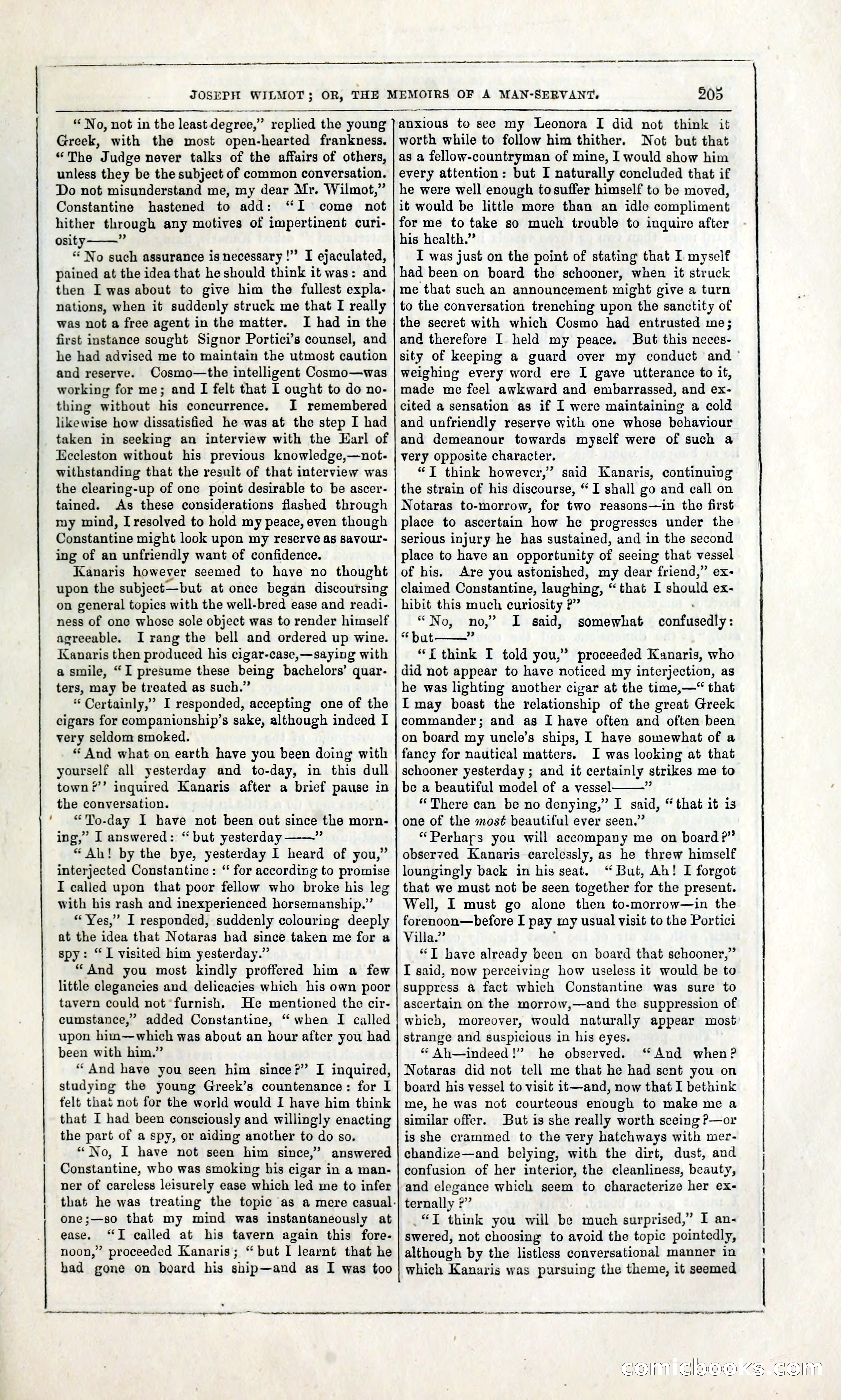
A restored page from Penny Dreadfuls, 1854. Page through the whole issue in the reader above.
📄 Transcribed text from this page (OCR, searchable)
Machine-transcribed from the original scan — historical spelling and the odd misread are preserved.
7 a ee eee nhl JOSEPH WILMOT; OR, THE MEMOIRS OF A MAN-SERVANT. ? * No, not in the least degree,” replied the young Greek, with the most open-hearted frankness. “The Judge never talks of the affairs of others, unless they be the subject of common conversation. Do not misunderstand me, my dear Mr. Wilmot,” Constantine hastened to add: “1 come not hither through any motives of impertinent curi- osity 2 “ No such assurance is necessary !”’ I ejaculated, pained at the idea that he should think it was: and then I was about to give him the fullest expla- nations, when it suddenly struck me that I really was not a free agent in the matter. I had in the first instance sought Signor Portici’s counsel, and he had advised me to maintain the utmost caution and reserve. Cosmo—the intelligent Cosmo—was working for me; and I felt that I ought to do no- thing without his concurrence. I remembered likewise how dissatisfied he was at the step I had taken in seeking an interview with the Earl of Eccleston without his previous knowledge,—not- withstanding that the result of that interview was the clearing-up of one point desirable to be ascer- tained. As these considerations flashed through my mind, I resolved to hold my peace, even though Constantine might look upon my reserve as sayour- ing of an unfriendly want of confidence. Kanaris however seemed to have no thought upon the subject—but at once began discoursing on general topics with the well-bred ease and readi- ness of one whose sole object was to render himself agreeable. I rang the bell and ordered up wine. Kanaris then produced his cigar-case,—saying with a smile, “I presume these being bachelors’ quar- ters, may be treated as such.” Certainly,’ I responded, accepting one of the cigars for companionship’s sake, although indeed I very seldom smoked. * And what on earth have you been doing with yourself all yesterday and to-day, in this dull town?’ inquired Kanaris after a brief pause in the conversation. “To-day I have not been out since the morn- ing,” I answered: “ but yesterday ——” “Ah! by the bye, yesterday I heard of you,” interjected Constantine: “ for according to promise I called upon that poor fellow who broke his leg with his rash and inexperienced horsemanship.” “Yes,” I responded, suddenly colouring deeply at the idea that Notaras had since taken me for a spy: “I visited him yesterday.” “And you most kindly proffered him a few little elegancies and delicacies which his own poor tavern could not furnish, He mentioned the cir- cumstance,” added Constantine, “when I called upon him—which was about an hour after you had been with him.” “And have you seen him since?” I inquired, studying the young Greek’s countenance: for I felt that not for the world would I have him think that I had been consciously and willingly enacting the part of a spy, or aiding another to do so. “No, I have not seen him since,” answered Constantine, who was smoking his cigar in a man- ner of careless leisurely ease which led me to infer that he was treating the topic as a mere casual: one;—so that my mind was instantaneously at ease. “I called at his tavern again this fore- noon,” proceeded Kanaris; “but I learnt that he had gone on board his ship—and as I was too ee Gee 205 anxious to see my Leonora I did not think it worth while to follow him thither. Not but that as a fellow-countryman of mine, I would show him every attention: but I naturally concluded that if he were well enough tosuffer himself to be moved, it would be little more than an idle compliment for me to take so much trouble to inquire after his health.” I was just on the point of stating that I myself had been on board the schooner, when it struck me that such an announcement might give a turn to the conversation trenching upon the sanctity of the secret with which Cosmo had entrusted me; and therefore I held my peace. But this neces- sity of keeping a guard over my conduct and ' weighing every word ere I gave utterance to if, made me feel awkward and embarrassed, and ex- cited a sensation as if I were maintaining a cold and unfriendly reserve with one whose behaviour and demeanour towards myself were of such a very opposite character. “IT think however,” said Kanaris, continuing the strain of his discourse, “I shall go and call on Notaras to-morrow, for two reasons—in the first place to ascertain how he progresses under the serious injury he has sustained, and in the second place to have an opportunity of seeing that vessel of his. Are you astonished, my dear friend,” ex- claimed Constantine, laughing, “that I should ex- hibit this much curiosity ?” “No, no,’ I said, somewhat confusedly: “ but——” “JT think I told you,’ proceeded Kanaris, who did not appear to have noticed my interjection, as he was lighting another cigar at the time,—“ that I may boast the relationship of the great Greek commander; and as I have often and often been on board my uncle’s ships, I have somewhat of a fancy for nautical matters. I was looking at that schooner yesterday ; and it certainly strikes me to be a beautiful model of a vessel ss “‘There can be no denying,” I said, “that it is one of the most beautiful ever seen.” “Perhars you will accompany me on board?” observed Kanaris carelessly, as he threw himself loungingly back in his seat. “But, Ah! I forgot that we must not be seen together for the present. Well, I must go alone then to-morrow—in the forenoon—before I pay my usual visit to the Portici Villa.” “T have already been on board that schooner,” I said, now perceiving how useless it would be to suppress a fact which Constantine was sure to ascertain on the morrow,—and the suppression of which, moreover, would naturally appear most strange and suspicious in his eyes. ** Ah—indeed!” he observed. ‘‘And when? Notaras did not tell me that he had sent you on board his vessel to visit it—and, now that I bethink me, he was not courteous enough to make me a similar offer. But is she really worth seeing P—or is she crammed to the very hatchways with mer- chandize—and belying, with the dirt, dust, and confusion of her interior, the cleanliness, beauty, and elegance which seem to characterize her ex- ternally ?” “I think you will be much surprised,’ I an- swered, not choosing to avoid the topic pointedly, although by the listless conversational manner in which Kanaris was pursuing the theme, it seemed DR ears Chess eaters ee Ce ar LE TENE mor DOO) ‘S (CO)