
Penny Dreadfuls, 1854 · page 211 of 399
Joseph Wilmot, or, The Memoirs of a Man-Servant — page 211: what you’re looking at
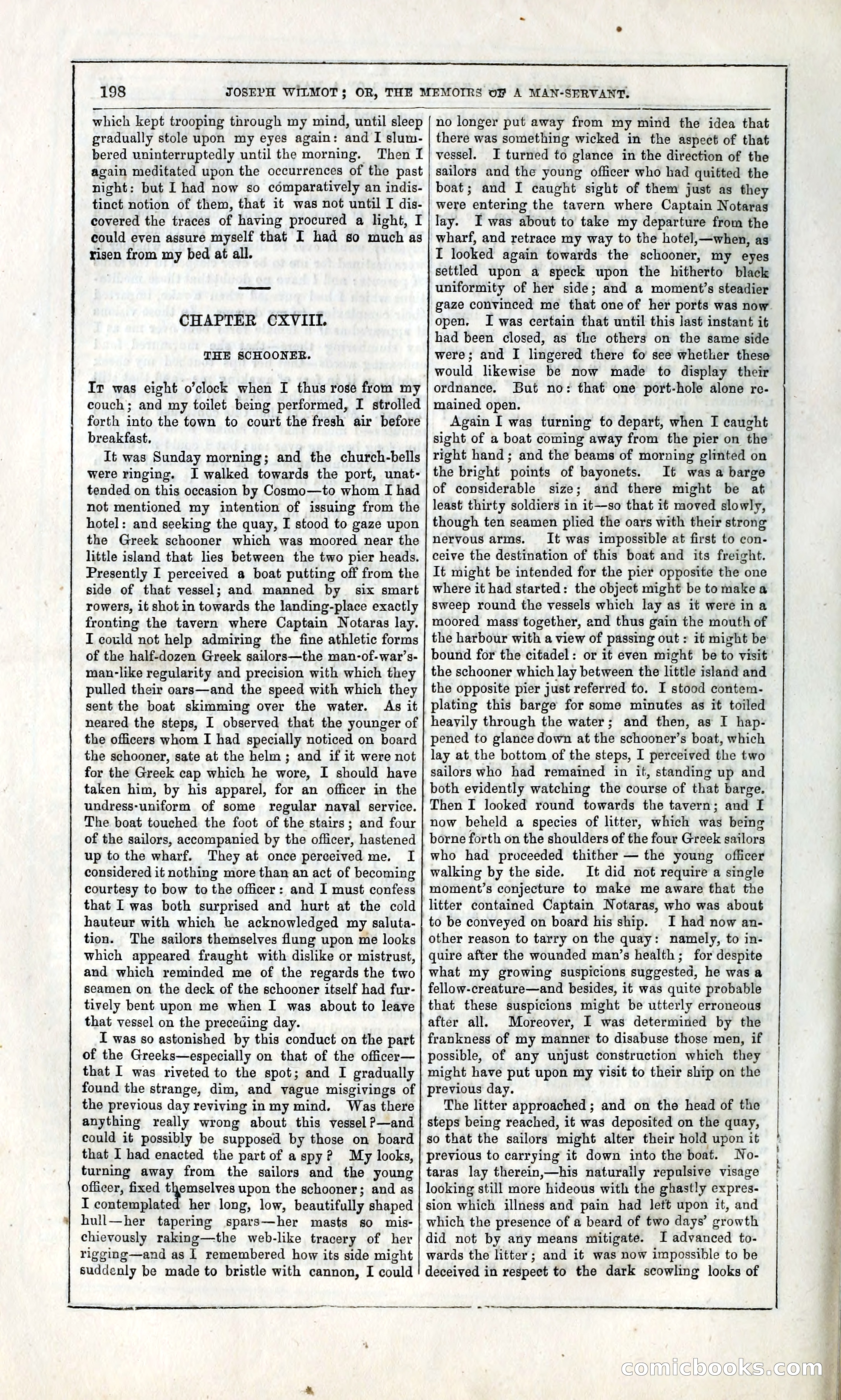
A restored page from Penny Dreadfuls, 1854. Page through the whole issue in the reader above.
📄 Transcribed text from this page (OCR, searchable)
Machine-transcribed from the original scan — historical spelling and the odd misread are preserved.
a JOSEPH WILMOT; OR, THE MEMOIRS oF A MAN-SERVANT. 198 which kept trooping through my mind, until sleep gradually stole upon my eyes again: and I slum- bered uninterruptedly until the morning. Then I again meditated upon the occurrences of the past night: but I had now so comparatively an indis- tinct notion of them, that it was not until I dis- covered the traces of having procured a light, I could even assure myself that I had so much as risen from my bed at all. CHAPTER CXVIII. THE SCHOONER. It was eight o’clock when I thus rose from my couch; and my toilet being performed, I strolled forth into the town to court the fresh air before breakfast, It was Sunday morning; and the church-bells were ringing. J walked towards the port, unat- tended on this occasion by Cosmo—to whom I had not mentioned my intention of issuing from the hotel: and seeking the quay, I stood to gaze upon the Greek schooner which was moored near the little island that lies between the two pier heads. Presently I perceived a boat putting off from the side of that vessel; and manned by six smart rowers, it shot in towards the landing-place exactly fronting the tavern where Captain Notaras lay. I could not help admiring the fine athletic forms of the half-dozen Greek sailors—the man-of-war’s- man-like regularity and precision with which they pulled their oars—and the speed with which they sent the boat skimming over the water. As it neared the steps, I observed that the younger of the officers whom I had specially noticed on board the schooner, sate at the helm; and if it were not for the Greek cap which he wore, I should have taken him, by his apparel, for an officer in the undress-uniform of some regular naval service. The boat touched the foot of the stairs; and four of the sailors, accompanied by the officer, hastened up to the wharf. They at once perceived me. I considered it nothing more than an act of becoming courtesy to bow to the officer: and I must confess that I was both surprised and hurt at the cold hauteur with which he acknowledged my saluta- tion. The sailors themselves flung upon me looks which appeared fraught with dislike or mistrust, and which reminded me of the regards the two seamen on the deck of the schooner itself had fur- tively bent upon me when I was about to leave that vessel on the preceding day. I was so astonished by this conduct on the part of the Greeks—especially on that of the officer— that I was riveted to the spot; and I gradually found the strange, dim, and vague misgivings of the previous day reviving in my mind. Was there anything really wrong about this vessel P—and could it possibly be supposed by those on board that I had enacted the partof aspy? My looks, turning away from the sailors and the young officer, fixed themselves upon the schooner; and as I contemplated her long, low, beautifully shaped 4) hull—her tapering spars—her masts so mis- chievously raking—the web-like tracery of her rigging—and as 1 remembered how its side might suddenly be made to bristle with cannon, I could ets 1, eT i A GE Tn no longer put away from my mind the idea that there was something wicked in the aspect of that vessel. I turned to glance in the direction of the sailors and the young officer who had quitted the boat; and I caught sight of them just as they were entering the tavern where Captain Notaras lay. I was about to take my departure from the wharf, and retrace my way to the hotel,—when, as I looked again towards the schooner, my eyes settled upon a speck upon the hitherto black uniformity of her side; and a moment’s steadier gaze convinced me that one of her ports was now. open. I was certain that until this last instant it had been closed, as the others on the same side were; and I lingered there to see whether these would likewise be now made to display their ordnance. But no: that one port-hole alone re- mained open. Again I was turning to depart, when I caucht sight of a boat coming away from the pier on the’ right hand; and the beams of morning glinted on the bright points of bayonets. It was a barge of considerable size; and there might be at least thirty soldiers in it—so that if moved slowly, though ten seamen plied the oars with their strong nervous arms. It was impossible at first to con- ceive the destination of this boat and its freight. It might be intended for the pier opposite the one where it had started: the object might be tomake a Sweep round the vessels which lay as it were in a moored mass together, and thus gain the mouth of the harbour with a view of passing out : it might be bound for the citadel: or it even might be to visit the schooner which lay between the little island and the opposite pier just referred to. I stood contem- plating this barge for some minutes as it toiled heayily through the water; and then, as I hap- pened to glance down at the schooner’s boat, which lay at the bottom of the steps, I perceived the two sailors who had remained in it, standing up and both evidently watching the course of that barge. Then I looked round towards the tavern; and I now beheld a species of litter, which was being borne forth on the shoulders of the four Greek sailors who had proceeded thither — the young officer walking by the side. It did not require a single moment’s conjecture to make me aware that the litter contained Captain Notaras, who was about to be conveyed on board his ship. _ I had now an- other reason to tarry on the quay: namely, to in- quire after the wounded man’s health; for despite what my growing suspicions suggested, he was a fellow-creature—and besides, it was quite probable that these suspicions might be utterly erroneous after all. Moreover, I was determined by the frankness of my manner to disabuse those men, if possible, of any unjust construction which they might have put upon my visit to their ship on the previous day. The litter approached ; and on the head of the steps being reached, it was deposited on the quay, so that the sailors might alter their hold upon it previous to carrying it down into the boat. No- taras lay therein,—his naturaily repulsive visage looking still more hideous with the ghastly expres- sion which illness and pain had lett upon it, and which the presence of a beard of two days’ growth did not by any means mitigate. I advanced to- wards the litter; and if was now impossible to be deceived in respect to the dark scowling looks of ———— pee ee gr GDooks (CO)