
Penny Dreadfuls, 1854 · page 21 of 399
Joseph Wilmot, or, The Memoirs of a Man-Servant — page 21: what you’re looking at
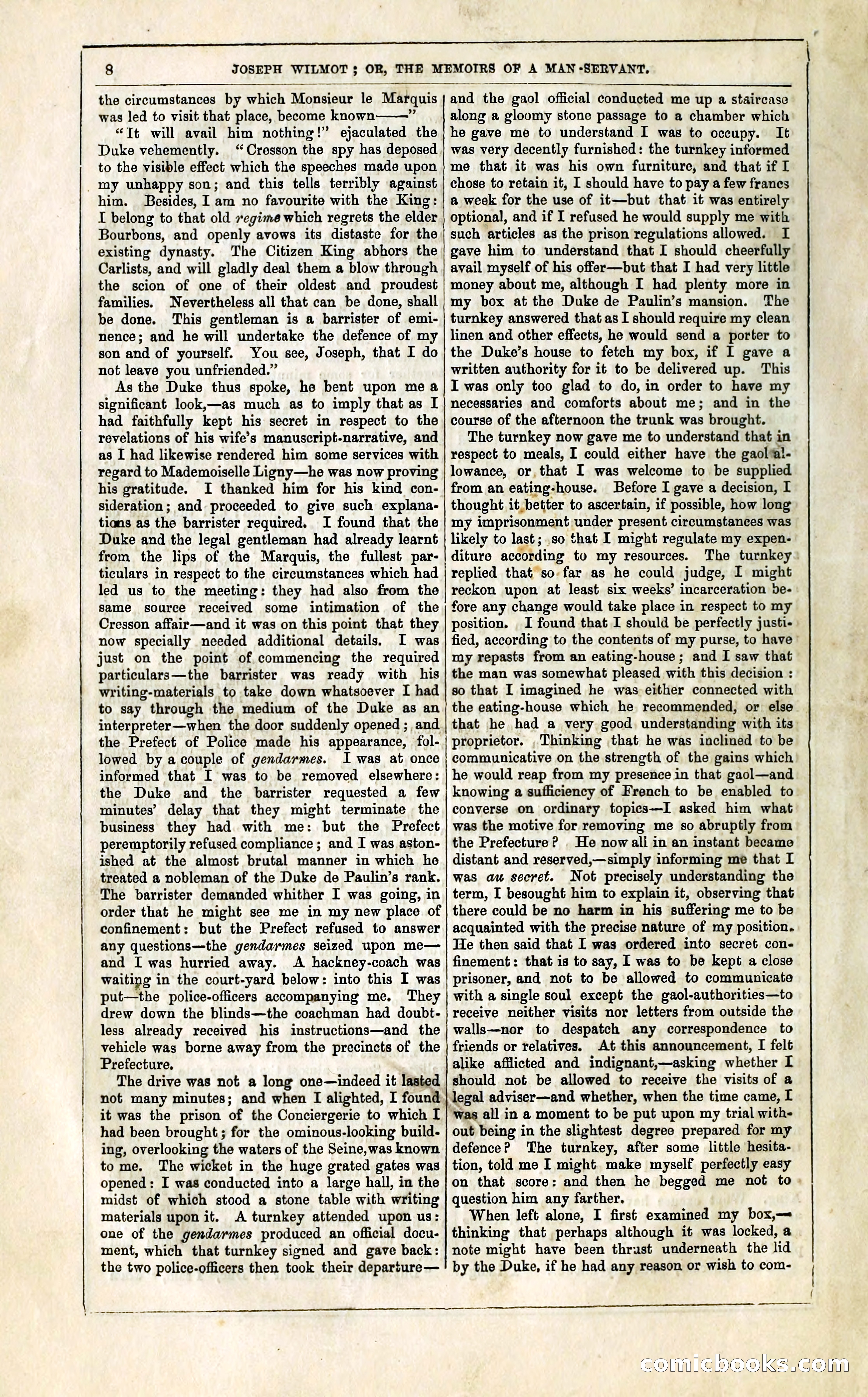
A restored page from Penny Dreadfuls, 1854. Page through the whole issue in the reader above.
📄 Transcribed text from this page (OCR, searchable)
Machine-transcribed from the original scan — historical spelling and the odd misread are preserved.
8 the circumstances by which Monsieur le Marquis +P] was led to visit that place, become known “Tt will avail him nothing!” ejaculated the Duke vehemently. ‘Cresson the spy has deposed to the visible effect which the speeches made upon _ may unhappy son; and this tells terribly against him. Besides, I am no favourite with the King: I belong to that old regime which regrets the elder Bourbons, and openly avows its distaste for the existing dynasty. The Citizen King abhors the Carlists, and will gladly deal them a blow through the scion of one of their oldest and proudest families. Nevertheless all that can be done, shall be done. This gentleman is a barrister of emi- nence; and he will undertake the defence of my son and of yourself. You see, Joseph, that I do not leave you unfriended.” As the Duke thus spoke, he bent upon mea significant look,—as much as to imply that as I had faithfully kept his secret in respect to the revelations of his wife’s manuscript-narrative, and as I had likewise rendered him some services with regard to Mademoiselle Ligny—he was now proving his gratitude. I thanked him for his kind con- sideration; and proceeded to give such explana- tions as the barrister required. I found that the Duke and the legal gentleman had already learnt from the lips of the Marquis, the fullest par- ticulars in respect to the circumstances which had led us to the meeting: they had also from the same source received some intimation of the Cresson affair—and it was on this point that they now specially needed additional details. I was just on the point of. commencing the required particulars—the barrister was ready with his writing-materials to take down whatsoever I had to say throuch the medium of the Duke as an interpreter—when the door suddenly opened ; and the Prefect of Police made his appearance, fol- lowed by accouple of gendarmes. I was at once informed that I was to be removed elsewhere: the Duke and the barrister requested a few minutes’ delay that they might terminate the business they had with me: but the Prefect peremptorily refused compliance; and I was aston- ished at the almost brutal manner in which he treated a nobleman of the Duke de Paulin’s rank. The barrister demanded whither I was going, in order that he might see me in my new place of confinement: but the Prefect refused to answer any questions—the gendarmes seized upon me— and I was hurried away. A hackney-coach was waiting in the court-yard below: into this I was put—the police-officers accompanying me. They drew down the blinds—the coachman had doubt- less already received his instructions—and the vehicle was borne away from the precincts of the Prefecture. The drive was not a long one—indeed it lasted | not many minutes; and when I alighted, I found it was the prison of the Conciergerie to which 1 had been brought; for the ominous-looking build- ing, overlooking the waters of the Seine,was known | to me. The wicket in the huge grated gates was opened: I was conducted into a large hall, in the midst of which stood a stone table with writing materials upon it. A turnkey attended upon us: one of the gendarmes produced an official docu- ment, which that turnkey signed and gave back: the two police-officers then took their departure— ee ee JOSEPH WILMOT: OR, THE MEMOIRS OF A MAN-SERVANT, and the gaol official conducted me up a staircase along a gloomy stone passage to a chamber which he gave me to understand I was to occupy. It was very decently furnished: the turnkey informed me that it was his own furniture, and that if I chose to retain it, I should have to pay a few franes a week for the use of it—but that it was entirely optional, and if I refused he would supply me with such articles as the prison regulations allowed. I gave him to understand that I should cheerfully avail myself of his offer—but that I had very little money about me, although I had plenty more in my box at the Duke de Paulin’s mansion. The turnkey answered that as I should require my clean linen and other effects, he would send a porter to the Duke’s house to fetch my box, if I gave a written authority for 1t to be delivered up. This I was only too glad to do, in order to have my necessaries and comforts about me; and in the course of the afternoon the trunk was brought. The turnkey now gave me to understand that in respect to meals, I could either have the gaolal- lowance, or, that I was welcome to be supplied from an eating-house. Before I gave a decision, I thought it better to ascertain, if possible, how long my imprisonment under present circumstances was likely to last; .so that I might regulate my expen- diture acsbhding tu my resources. replied that so-far as he could judge, I might reckon upon at least six weeks’ incarceration be- fore any change would take place in respect to my position, I found that I should be perfectly justi- The turnkey» fied, according to the contents of my purse, to have’ my repasts from an eating-house; and I saw that the man was somewhat pleased with this decision : so that I imagined he was either connected with the eating-house which he recommended, or else — that he had a very good understanding with its proprietor. , Thinking that he was inclined to be communicative on the strength of the gains which he would reap from my presence in that gaol—and knowing a sufficiency of French to be enabled to converse on ordinary topics—I asked him what was the motive for removing me so abruptly from the Prefecture? . He nowali in an instant became distant and reserved,—simply informing me that I was au secret. Not precisely understanding the term, I besought him to explain it, observing that there could be no harm in his suffering me to be acquainted with the precise nature of my position. He then said that I was ordered into secret con- finement: that is to say, I was to be kept a close prisoner, and not to be allowed to communicate with a single soul except the gaol-authorities—to receive neither visits nor letters from outside the walls—nor to despatch any correspondence to friends or relatives. At this announcement, I felt alike afflicted and indignant,—asking whether I should not be allowed to receive the visits of a legal adviser—and whether, when the time came, I “was all in a moment to be put upon my trial with- out being in the slightest degree prepared for my defence? ‘The turnkey, after some little hesita- tion, told me I might make myself perfectly easy on that score: and then he begged me not to» question him any farther. When left alone, I first examined my box,— thinking that perhaps although it was locked, a note might have been thrust underneath the lid by the Duke, if he had any reason or wish to com- ( —_—---- (e(0) 0)(6\(6) SS (E(0) Af