
Penny Dreadfuls, 1854 · page 201 of 399
Joseph Wilmot, or, The Memoirs of a Man-Servant — page 201: what you’re looking at
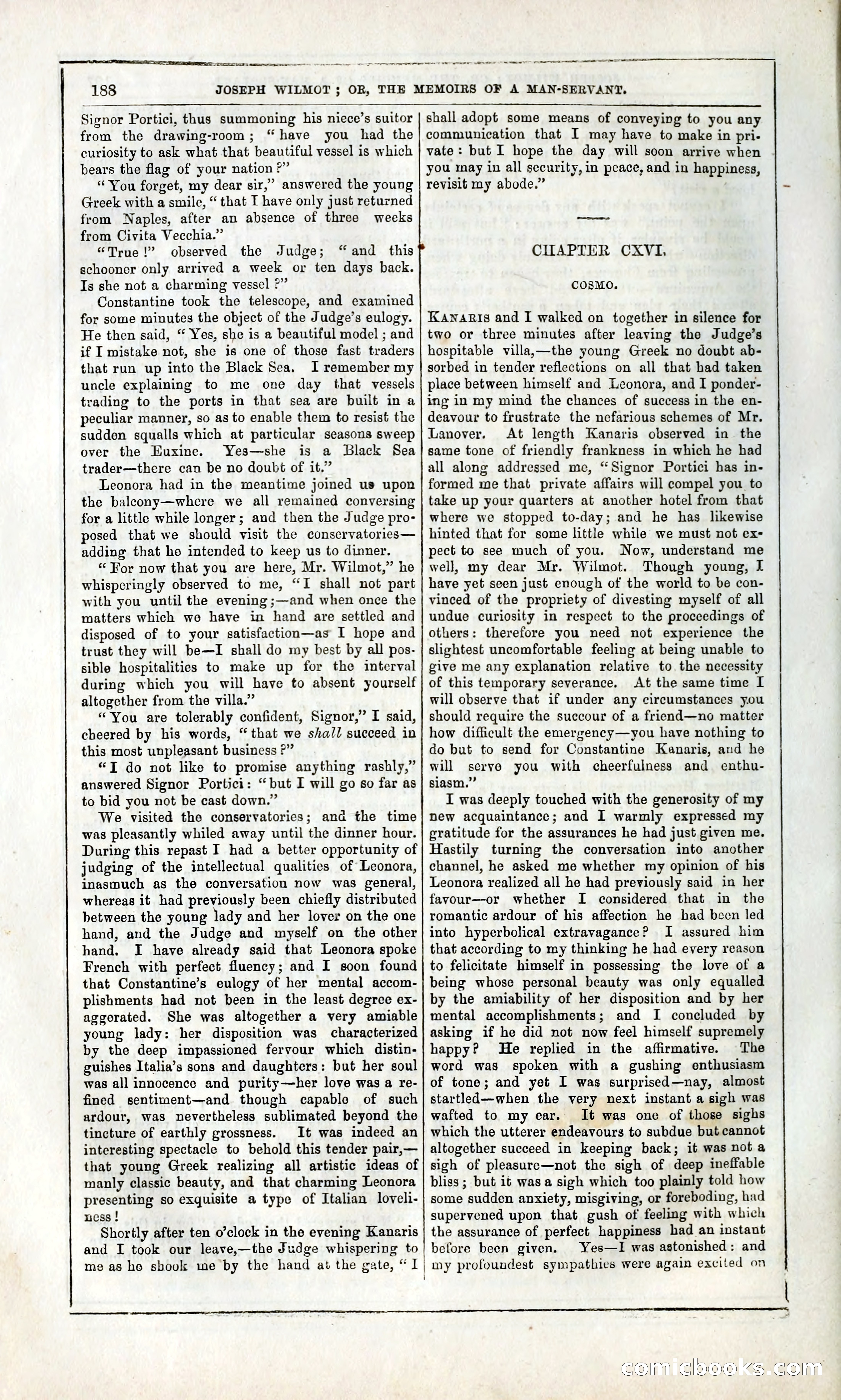
A restored page from Penny Dreadfuls, 1854. Page through the whole issue in the reader above.
📄 Transcribed text from this page (OCR, searchable)
Machine-transcribed from the original scan — historical spelling and the odd misread are preserved.
Cr ES te bs ee — 188 Signor Portici, thus summoning his niece’s suitor from the drawing-room; “have you had the curiosity to ask what that beautiful vessel is which bears the flag of your nation ?” “You forget, my dear sir,” answered the young Greek with a smile, “ that I have only just returned from Naples, after an absence of three weeks from Civita Vecchia.” “True !? observed the Judge; “and this schooner only arrived a week or ten days back. Is she not a charming vessel ?” Constantine took the telescope, and examined for some minutes the object of the Judge’s eulogy. He then said, “ Yes, she is a beautiful model ; and if I mistake not, she is one of those fast traders that run up into the Black Sea. I remember my uncle explaining to me one day that vessels trading to the ports in that sea are built in a peculiar manner, so as to enable them to resist the sudden squalls which at particular seasons sweep over the Euxine. Yes—she is a Black Sea trader—there can be no doubt of it.” Leonora had in the meantime joined us upon the balcony—where we all remained conversing for a little while longer; and then the Judge pro- posed that we should visit the conservatories— adding that he intended to keep us to dinner. “For now that you are here, Mr. Wilmot,” he whisperingly observed to me, “I shall not part with you until the evening ;—and when once the matters which we have in hand are settled and disposed of to your satisfaction—as I hope and trust they will be—I shall do my best by all pos- sible hospitalities to make up for the interval during which you will have to absent yourself altogether from the villa.” “You are tolerably confident, Signor,” I said, cheered by his words, “ that we shall succeed in this most unpleasant business ?” “JT do not like to promise anything rashly,” answered Signor Portici: “but I will go so far as to bid you not be cast down.” We visited the conservatories; ana the time was pleasantly whiled away until the dinner hour. During this repast I had a better opportunity of judging of the intellectual qualities of Leonora, inasmuch as the conversation now was general, whereas it had previously been chiefly distributed between the young lady and her lover on the one hand, and the Judge and myself on the other hand. I have already said that Leonora spoke French with perfect fluency; and I soon found that Constantine’s eulogy of her mental accom- plishments had not been in the least degree ex- aggerated. She was altogether a very amiable young lady: her disposition was characterized by the deep impassioned fervour which distin- guishes Italia’s sons and daughters: but her soul was all innocence and purity—her love was a re- fined sentiment—and though capable of such ardour, was nevertheless sublimated beyond the tincture of earthly grossness. It was indeed an interesting spectacle to behold this tender pair,— that young Greek realizing all artistic ideas of manly classic beauty, and that charming Leonora presenting so exquisite a type of Italian loveli- uess ! Shortly after ten o’clock in the evening Kanaris and I took our leave,—the Judge whispering to me as he shook me by the hand at the gate, “I | er ee See Ser eee Gar “"- -_—_s->) eer en ee ee Se we JOSEPH WILMOT; OR, THE MEMOIRS OF A MAN-SERVANT. shall adopt some means of conveying to you any communication that I may have to make in pri- vate: but I hope the day will soon arrive when . you may in all security, in peace, and in happiness, revisit my abode.” —_—_——_ CHAPTER CXVI, COSMO. KANARIS and I walked on together in silence for two or three minutes after leaving the Judge’s hospitable villa,—the young Greek no doubt ab- sorbed in tender reflections on all that had taken place between himself and Leonora, and I ponder- ing in my mind the chances of success in the en- deavour to frustrate the nefarious schemes of Mr. Lanover. At length Kanaris observed in the same tone of friendly frankness in which he had all along addressed me, “Signor Portici has in- formed me that private affairs will compel you to take up your quarters at another hotel from that where we stopped to-day; and he has likewise hinted that for some little while we must not ex- pect to see much of you. Now, understand me well, my dear Mr. Wilmot. Though young, J have yet seen just enough of the world to be con- vinced of the propriety of divesting myself of all undue curiosity in respect to the proceedings of others: therefore you need not experience the slightest uncomfortable feeling at being unable to give me any explanation relative to the necessity of this temporary severance. At the same time I will observe that if under any circumstances you should require the succour of a friend—no matter how difficult the emergency—you have nothing to do but to send for Constantine Kanaris, and he will serye you with cheerfulness and enthu- siasm.” I was deeply touched with the generosity of my new acquaintance; and I warmly expressed my gratitude for the assurances he had just given me. Hastily turning the conversation into another channel, he asked me whether my opinion of his Leonora realized all he had previously said in her favour—or whether I considered that in the romantic ardour of his affection he had been led into hyperbolical extravagance? JI assured him that according to my thinking he had every reason to felicitate himself in possessing the love of a being whose personal beauty was only equalled by the amiability of her disposition and by her mental accomplishments; and I concluded by asking if he did not now feel himself supremely happy? He replied in the affirmative. The word was spoken with a gushing enthusiasm of tone; and yet LI was surprised—nay, almost startled—when the very next instant a sigh was wafted to my ear. It was one of those sighs which the utterer endeavours to subdue but cannot altogether succeed in keeping back; it was not a sigh of pleasure—not the sigh of deep ineffable bliss; but it was a sigh which too plainly told how some sudden anxiety, misgiving, or foreboding, had supervened upon that gush of feeling with which the assurance of perfect happiness had an instaut before been given. Yes—I was astonished: and my profoundest sympathies were again excited on | eee er ee A EL CL IL NE OOO) <S (CE)