
Penny Dreadfuls, 1854 · page 193 of 399
Joseph Wilmot, or, The Memoirs of a Man-Servant — page 193: what you’re looking at
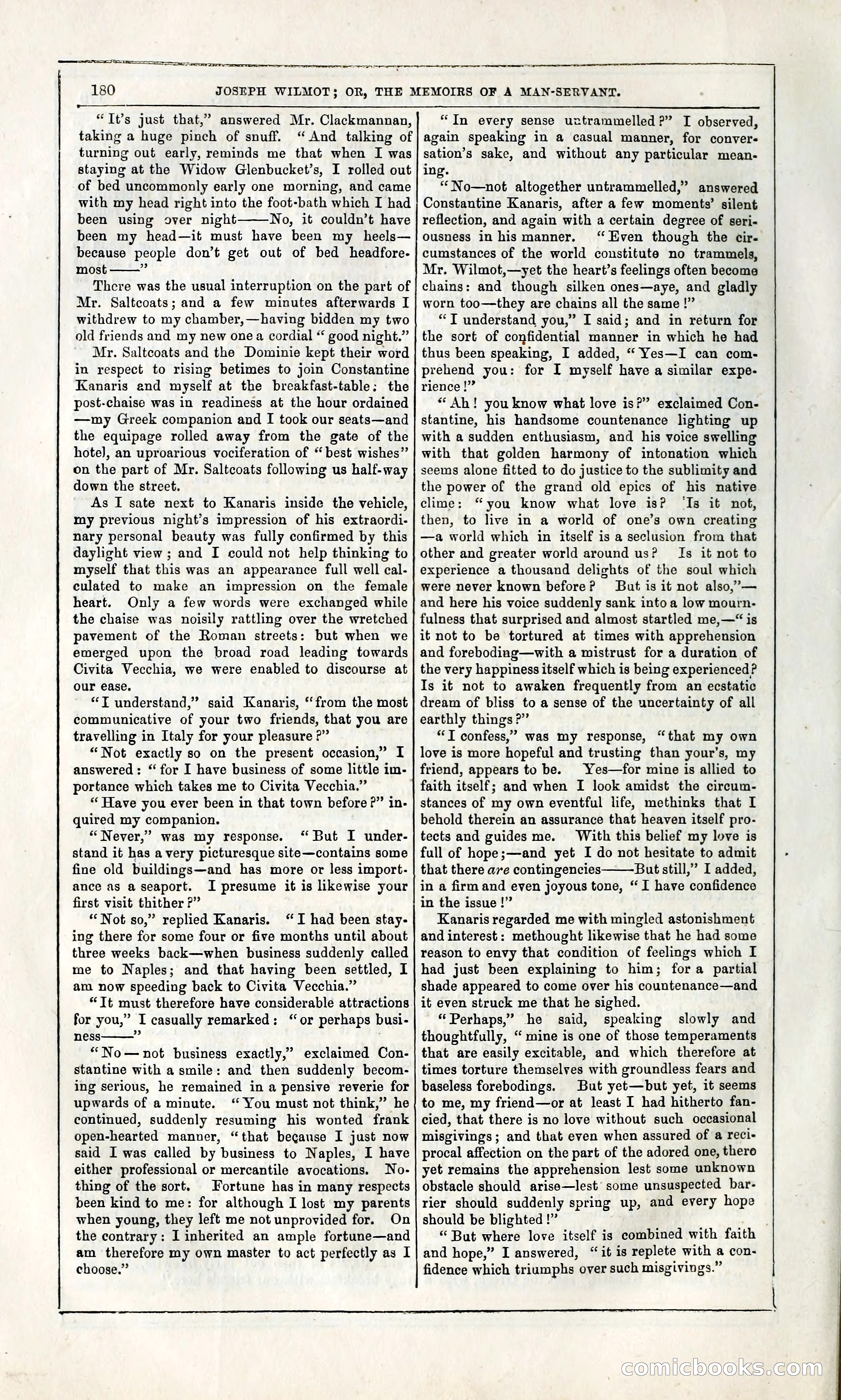
A restored page from Penny Dreadfuls, 1854. Page through the whole issue in the reader above.
📄 Transcribed text from this page (OCR, searchable)
Machine-transcribed from the original scan — historical spelling and the odd misread are preserved.
oer We) ee eee . — 180 JOSEPH WILMOT; OR, THE MEMOIRS OF A MAN-SERVANT. “It’s just that,” answered Mr. Clackmannan, taking a huge pinch of snuff. “ And talking of turning out early, reminds me that when I was staying at the Widow Glenbucket’s, I rolled out of bed uncommonly early one morning, and came with my head right into the foot-bath which I had been using over night No, it couldn’t have been my head—it must have been my heels— because people don’t get out of bed headfore- most od There was the usual interruption on the part of Mr. Saltcoats; and a few minutes afterwards I withdrew to my chamber, —having bidden my two old friends and my new one a cordial “ good night.” Mr. Saltcoats and the Dominie kept their word in respect to rising betimes to join Constantine Kanaris and myself at the breakfast-table: the post-chaise was in readiness at the hour ordained —my Greek companion and I took our seats—and the equipage rolled away from the gate of the hote), an uproarious vociferation of “best wishes” on the part of Mr. Saltcoats following us half-way down the street. As I sate next to Kanaris inside the vehicle, my previous night’s impression of his extraordi- nary personal beauty was fully confirmed by this daylight view ; and I could not help thinking to myself that this was an appearance full well cal- culated to make an impression on the female heart. Only a few words were exchanged while the chaise was noisily rattling over the wretched pavement of the Roman streets: but when we emerged upon the broad road leading towards Civita Vecchia, we were enabled to discourse at our ease. “T understand,” said Kanaris, ‘‘from the most communicative of your two friends, that you are travelling in Italy for your pleasure ?” “Not exactly so on the present occasion,” I answered: “ for I have business of some little im-. portance which takes me to Civita Vecchia.” “Have you ever been in that town before ?” in- quired my companion. ‘Never,’ was my response. “ But I under- stand it has a very picturesque site—contains some fine old buildings—and has more or less import- ance as a seaport. I presume it is likewise your first visit thither P” ‘Not so,” replied Kanaris. “I had been stay- ing there for some four or five months until about three weeks back—when business suddenly called me to Naples; and that having been settled, I am now speeding back to Civita Vecchia.” “Tt must therefore have considerable attractions for you,” I casually remarked: “or perhaps busi- ness x | “No—not business exactly,” exclaimed Con- stantine with a smile: and then suddenly becom- ing serious, he remained in a pensive reverie for upwards of a minute. ‘ You must not think,” he continued, suddenly resuming his wonted frank open-hearted manner, “that because I just now said I was called by business to Naples, I have either professional or mercantile avocations. No- thing of the sort. Fortune has in many respects been kind to me: for although I lost my parents when young, they left me not unprovided for. On the contrary: I inherited an ample fortune—and am therefore my own master to act perfectly as I choose.” “In every sense uxctrammelled ?” I observed, again speaking in a casual manner, for conver- sation’s sake, and without any particular mean- ing. “No—not altogether untrammelled,” answered Constantine Kanaris, after a few moments’ silent reflection, and again with a certain degree of seri- ousness in his manner. “Even though the cir. cumstances of the world constitute no trammels, Mr. Wilmot,—yet the heart’s feelings often become chains: and though silken ones—aye, and gladly worn too—they are chains all the same !” *T understand you,” I said; and in return for the sort of confidential manner in which he had thus been speaking, I added, “ Yes—I can com- prehend you: for I myself have a similar expe- rience !” “Ah! you know what love is?” exclaimed Con- stantine, his handsome countenance lighting up with a sudden enthusiasm, and his voice swelling with that golden harmony of intonation which seems alone fitted to do justice to the sublimity and the power of the grand old epics of his native clime: “you know what love is? ‘Is it not, then, to live in a world of one’s own creating —a world which in itself is a seclusion from that other and greater world around us? Is it not to experience a thousand delights of the soul which were never known before? JBut is it not also,’— and here his voice suddenly sank into a low mourn- fulness that surprised and almost startled me,—“ is it not to be tortured at times with apprehension and forebodiag—with a mistrust for a duration of the very happiness itself which is being experienced? Is it not to awaken frequently from an ecstatic dream of bliss to a sense of the uncertainty of all earthly things ?” “IT confess,” was my response, “that my own love is more hopeful and trusting than your’s, my friend, appears to be. Yes—for mine is allied to faith itself; and when I look amidst the circum- stances of my own eventful life, methinks that I behold therein an assurance that heaven itself pro- tects and guides me. With this belief my love is full of hope;—and yet I do not hesitate to admit that there ave contingencies But still,” I added, in a firm and even joyous tone, “I have confidence in the issue !” Kanaris regarded me with mingled astonishment and interest: methought likewise that he had some reason to envy that condition of feelings which I had just been explaining to him; fora partial shade appeared to come over his countenance—and it even struck me that he sighed. “Perhaps,” he said, speaking slowly and thoughtfully, “ mine is one of those temperaments that are easily excitable, and which therefore at times torture themselves with groundless fears and baseless forebodings. But yet—but yet, it seems to me, my friend—or at least I had hitherto fan- cied, that there is no love without such occasional misgivings; and that even when assured of a reci- procal affection on the part of the adored one, there yet remains the apprehension lest some unknown obstacle should arise—lest’ some unsuspected bar- rier should suddenly spring up, and every hope should be blighted !” “ But where love itself is combined with faith | and hope,” I answered, “it is replete with a con- fidence which triumphs over such misgivings.” CoOmicooolks (C@) im