
Penny Dreadfuls, 1854 · page 188 of 399
Joseph Wilmot, or, The Memoirs of a Man-Servant — page 188: what you’re looking at
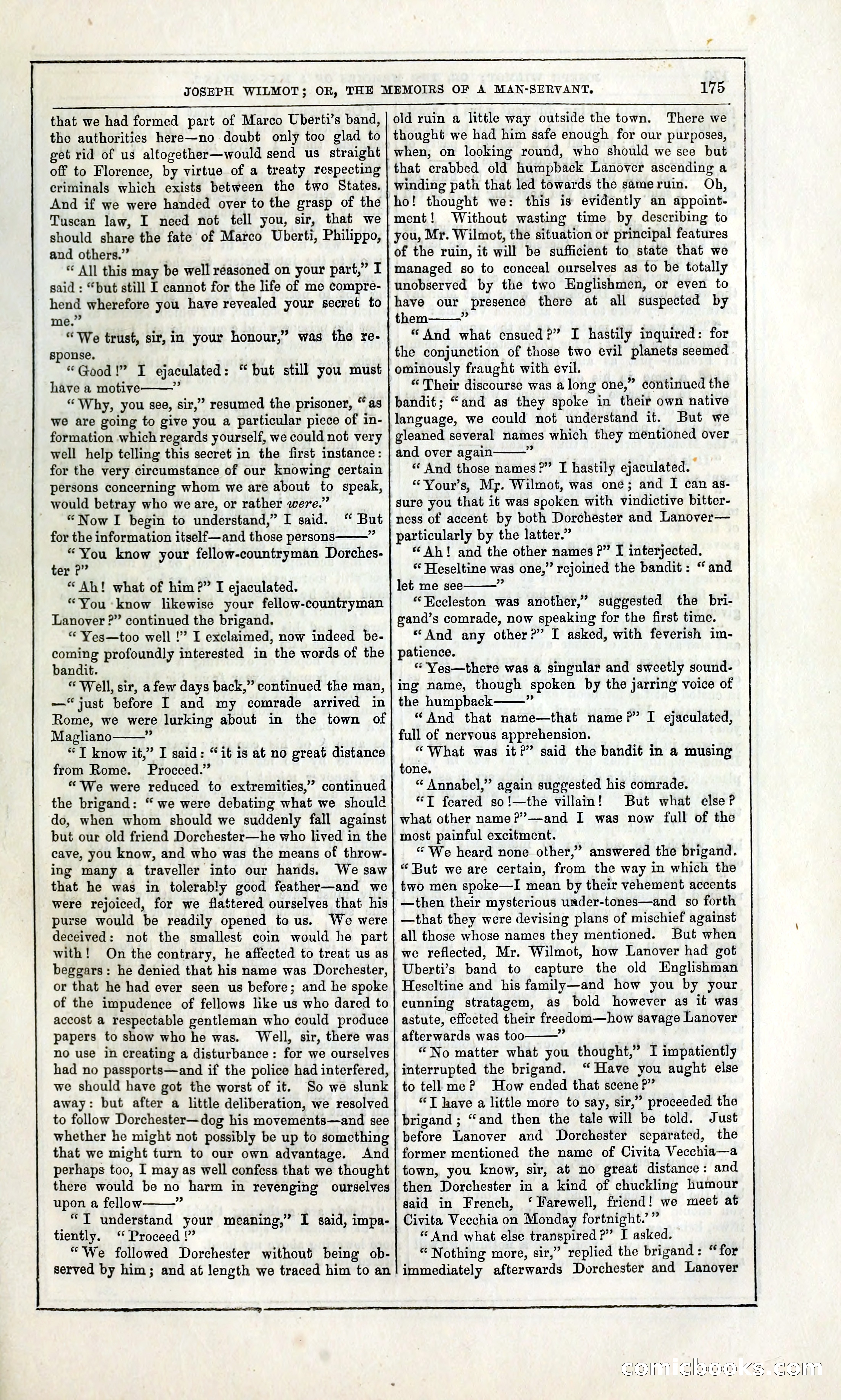
A restored page from Penny Dreadfuls, 1854. Page through the whole issue in the reader above.
📄 Transcribed text from this page (OCR, searchable)
Machine-transcribed from the original scan — historical spelling and the odd misread are preserved.
x aT JOSEPH WILMOT; OR, THE MEMOIRS OF A MAN-SERVANT. that we had formed part of Marco Uberti’s band, the authorities here—no doubt only too glad to get rid of us altogether—would send us straight off to Florence, by virtue of a treaty respecting criminals which exists between the two States. And if we were handed over to the grasp of the Tuscan law, I need not tell you, sir, that we should share the fate of Marco Uberti, Philippo, and others.” All this may be well reasoned on your part,” I said : “but still I cannot for the life of me compre- hend wherefore you have revealed your secret to me.” “We trust, sir, in your honour,’ was the re- sponse. “Good!” I ejaculated: “but still you must have a motive a “Why, you see, sir,” resumed the prisoner, “as we are going to give you a particular piece of in- formation which regards yourself, we could not very well help telling this secret in the first instance: for the very circumstance of our knowing certain persons concerning whom we are about to speak, would betray who we are, or rather were.” “Now I begin to understand,” I said. for the information itself—and those persons “You know your fellow-countryman Dorches- ter P” “Ah! what of him?” I ejaculated. “You ‘know likewise your fellow-countryman Lanover ?” continued the brigand. “ Yes—too well !” I exclaimed, now indeed be- coming profoundly interested in the words of the bandit. “ Well, sir, afew days back,” continued the man, —“ just before I and my comrade arrived in Rome, we were lurking about in the town of Magliano re “T know it,” I said: “it is at no great distance from Rome. Proceed.” “We were reduced to extremities,” continued the brigand: “ we were debating what we should do, when whom should we suddenly fall against but our old friend Dorchester—he who lived in the cave, you know, and who was the means of throw- ing many a traveller into our hands. We saw that he was in tolerably good feather—and we were rejoiced, for we flattered ourselves that his purse would be readily opened tous. We were deceived: not the smallest coin would he part with! On the contrary, he affected to treat us as beggars: he denied that his name was Dorchester, or that he had ever seen us before; and he spoke of the impudence of fellows like us who dared to accost a respectable gentleman who could produce papers to show who he was. Well, sir, there was no use in creating a disturbance : for we ourselves had no passports—and if the police had interfered, we should have got the worst of it. So we slunk away: but after a little deliberation, we resolved to follow Dorchester—dog his movements—and see whether he might not possibly be up to something that we might turn to our own advantage. And perhaps too, I may as well confess that we thought there would be no harm in reyenging ourselves upon a fellow % “I understand your meaning,” I said, impa- tiently. ‘Proceed !” “We followed Dorchester without being ob- ¢ But 92 served by him; and at length we traced him to an old ruin a little way outside the town. thought we had him safe enough for our purposes, when, on looking round, who should we see but winding path that led towards the same ruin. ho! thought we: this is evidently an appoint- ment ! you, Mr. Wilmot, the situation or principal features of the ruin, it will be sufficient to state that we managed so to conceal ourselves as to be totally unobserved by the two Englishmen, or even to have our presence there at all suspected by let me see 175 There we that crabbed old humpback Lanover ascending a Oh, Without wasting time by describing to >> them “And what ensued?” I hastily inquired: for the conjunction of those two evil planets seemed ominously fraught with evil. “Their discourse was a long one,” continued the bandit; “and as they spoke in their own native language, we could not understand it. gleaned several names which they mentioned over and over again But we 29 “ And those names?” I hastily ejaculated. “Your’s, My. Wilmot, was one; and I can as- sure you that it was spoken with vindictive bitter- ness of accent by both Dorchester and Lanover— particularly by the latter.” «Ah! and the other names ?” I interjected. “ Heseltine was one,” rejoined the bandit: “ and 29 ‘‘Eccleston was another,” suggested the bri- gand’s comrade, now speaking for the first time. “And any other?” I asked, with feverish im- patience. * Yes—there was a singular and sweetly sound- ing name, though spoken by the jarring voice of the humpback ¥ “And that name—that name?” I ejaculated, full of nervous apprehension. “What was it?” said the bandit in a musing tone. “ Annabel,” again suggested his comrade. “T feared so!—the villain! But what elseP what other name P”—and I was now full of the most painful excitment. “ We heard none other,” answered the brigand. “But we are certain, from the way in which the two men spoke—I mean by their vehement accents —then their mysterious uxder-tones—and so forth —that they were devising plans of mischief against all those whose names they mentioned. But when we reflected, Mr. Wilmot, how Lanover had got Uberti’s band to capture the old Englishman Heseltine and his family—and how you by your cunning stratagem, as bold however as it was astute, effected their freedom—how savage Lanover afterwards was too “ “No matter what you thought,’ I impatiently interrupted the brigand. “Have you aught else to tell me? How ended that scene P” “T have a little more to say, sir,” proceeded the brigand ; “and then the tale will be told. Just before Lanover and Dorchester separated, the former mentioned the name of Civita Vecchia—a town, you know, sir, at no great distance: and then Dorchester in a kind of chuckling humour said in French, ‘Farewell, friend! we meet at Civita Vecchia on Monday fortnight.’ ” “ And what else transpired ?” I asked. © Nothing more, sir,” replied the brigand: “for immediately afterwards Dorchester and Lanover ELOO@ SS (CO)