
Penny Dreadfuls, 1854 · page 186 of 399
Joseph Wilmot, or, The Memoirs of a Man-Servant — page 186: what you’re looking at
A restored page from Penny Dreadfuls, 1854. Page through the whole issue in the reader above.
📄 Transcribed text from this page (OCR, searchable)
Machine-transcribed from the original scan — historical spelling and the odd misread are preserved.
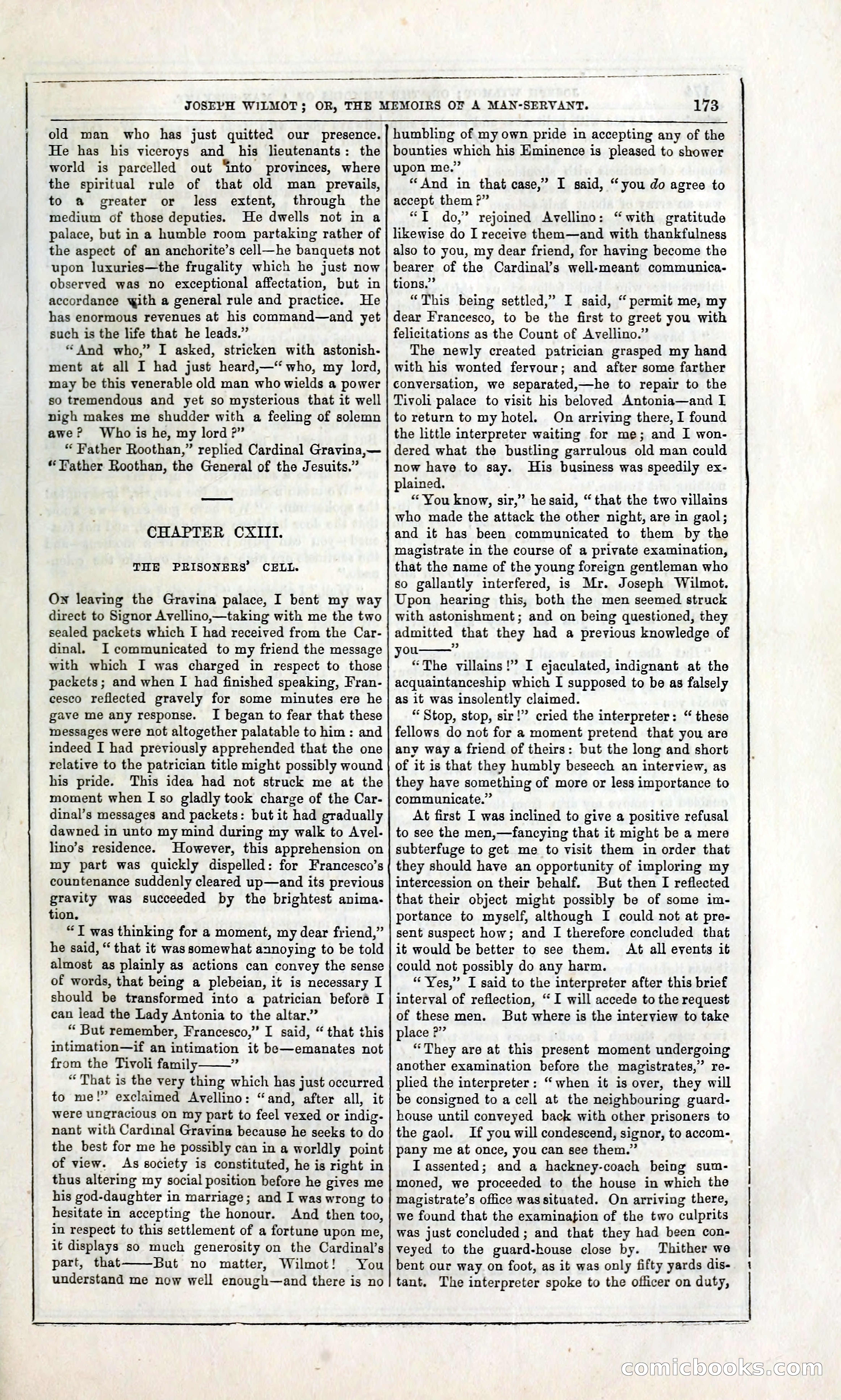
ee -_—_— — —— SS + hC Cr - - ee er JOSEPH WILMOT; OR, THE MEMOIRS OF A MAN-SERVANT. 173 old man who has just quitteé our presence. He has his viceroys and his lieutenants: the world is parcelled out “into provinces, where the spiritual rule of that old man prevails, to a greater or less extent, through the medium of those deputies. He dwells not in a palace, but in a humble room partaking rather of the aspect of an anchorite’s cell—he banquets not upon luxuries—the frugality which he just now observed was no exceptional affectation, but in accordance with a general rule and practice. He has enormous revenues at his command—and yet such is the life that he leads.” * And who,” I asked, stricken with astonish- ment at all I had just heard,— who, my lord, may be this venerable old man who wields a power so tremendous and yet so mysterious that it well nigh makes me shudder with a feeling of solemn awe? Who is he, my lord ?” “ Father Roothan,” replied Cardinal Gravina,— *Tather Roothan, the General of the Jesuits.” CHAPTER CXIII. THE PEISONERS’ CELL. Ow leaving the Gravina palace, I bent my way direct to Signor Avellino,—taking with me the two sealed packets which I had received from the Car- dinal. I communicated to my friend the message with which I was charged in respect to those packets; and when I had finished speaking, Fran- cesco reflected gravely for some minutes ere he gave me any response. [I began to fear that these messages were not altogether palatable to him: and indeed I had previously apprehended that the one relative to the patrician title might possibly wound his pride. This idea had not struck me at the moment when I so gladly took charge of the Car- dinal’s messages and packets: but it had gradually dawned in unto my mind during my walk to Avel- lino’s residence. However, this apprehension on my part was quickly dispelled: for Francesco’s countenance suddenly cleared up—and its previous gravity was succeeded by the brightest anima- tion. “T was thinking for a moment, my dear friend,” he said, “ that it was somewhat annoying to be told almost as plainly as actions can convey the sense of words, that being a plebeian, it is necessary I should be transformed into a patrician beforé I can lead the Lady Antonia to the altar.” “ But remember, Francesco,” I said, “ that this intimation—if an intimation it be—emanates not from the Tivoli family i. “That is the very thing which has just occurred to me!” exclaimed Avellino: “and, after all, it were ungracious on my part to feel vexed or indig- nant with Cardinal Gravina because he seeks to do the best for me he possibly can in a worldly point of view. As society is constituted, he is right in thus altering my social position before he gives me his god-daughter in marriage; and I was wrong to hesitate in accepting the honour. And then too, in respect to this settlement of a fortune upon me, it displays so much generosity on the Cardinal’s part, that But no matter, Wilmot! You understand me now well enough—and there is no humbling of my own pride in accepting any of the bounties which his Eminence is pleased to shower upon me.” “And in that case,” I said, “you do agree to accept them ?” “I do,’ rejoined Avellino: “with gratitude likewise do I receive them—and with thankfulness also to you, my dear friend, for having become the bearer of the Cardinal’s well-meant communica- tions.” “This being settled,” I said, ‘ permit me, my dear Francesco, to be the first to greet you with felicitations as the Count of Avellino.” The newly created patrician grasped my hand with his wonted fervour; and after some farther conversation, we separated,—he to repair to the Tivoli palace to visit his beloved Antonia—and I to return to my hotel. On arriving there, I found the little interpreter waiting for me; and I won- dered what the bustling garrulous old man could now have to say. His business was speedily ex- plained. “You know, sir,” he said, “ that the two villains who made the attack the other night, are in gaol; and it has been communicated to them by the magistrate in the course of a private examination, that the name of the young foreign gentleman who so gallantly interfered, is Mr. Joseph Wilmot. Upon hearing this, both the men seemed struck with astonishment; and on being questioned, they admitted that they had a previous knowledge of ou 33 “The villains!” I ejaculated, indignant at the acquaintanceship which I supposed to be as falsely as it was insolently claimed. “Stop, stop, sir!” cried the interpreter: “ these fellows do not for a moment pretend that you are any way a friend of theirs: but the long and short of it is that they humbly beseech an interview, as they have something of more or less importance to communicate.” At first I was inclined to give a positive refusal to see the men,—fancying that it might be a mere subterfuge to get me to visit them in order that they should have an opportunity of imploring my intercession on their behalf. But then I reflected that their object might possibly be of some im- portance to myself, although I could not at pre- sent suspect how; and I therefore concluded that it would be better to see them. At all events it could not possibly do any harm. “Yes,” I said to the interpreter after this brief interval of reflection, “I will accede to the request of these men. But where is the interview to take place ?”” “They are at this present moment undergoing another examination before the magistrates,” re- plied the interpreter: “when it is over, they will be consigned to a cell at the neighbouring guard- house until conveyed back with other prisoners to the gaol. pany me at once, you can see them.” I assented; and a hackney-coach being sum- moned, we proceeded to the house in which the magistrate’s office wassituated. On arriving there, we found that the examination of the two culprits was just concluded ; and that they had been con- veyed to the guard-house close by. Thither we bent our way on foot, as it was only fifty yards dis- tant. The interpreter spoke to the officer on duty, If you will condescend, signor, to accom- ElONOO (CO AA