
Penny Dreadfuls, 1854 · page 181 of 399
Joseph Wilmot, or, The Memoirs of a Man-Servant — page 181: what you’re looking at
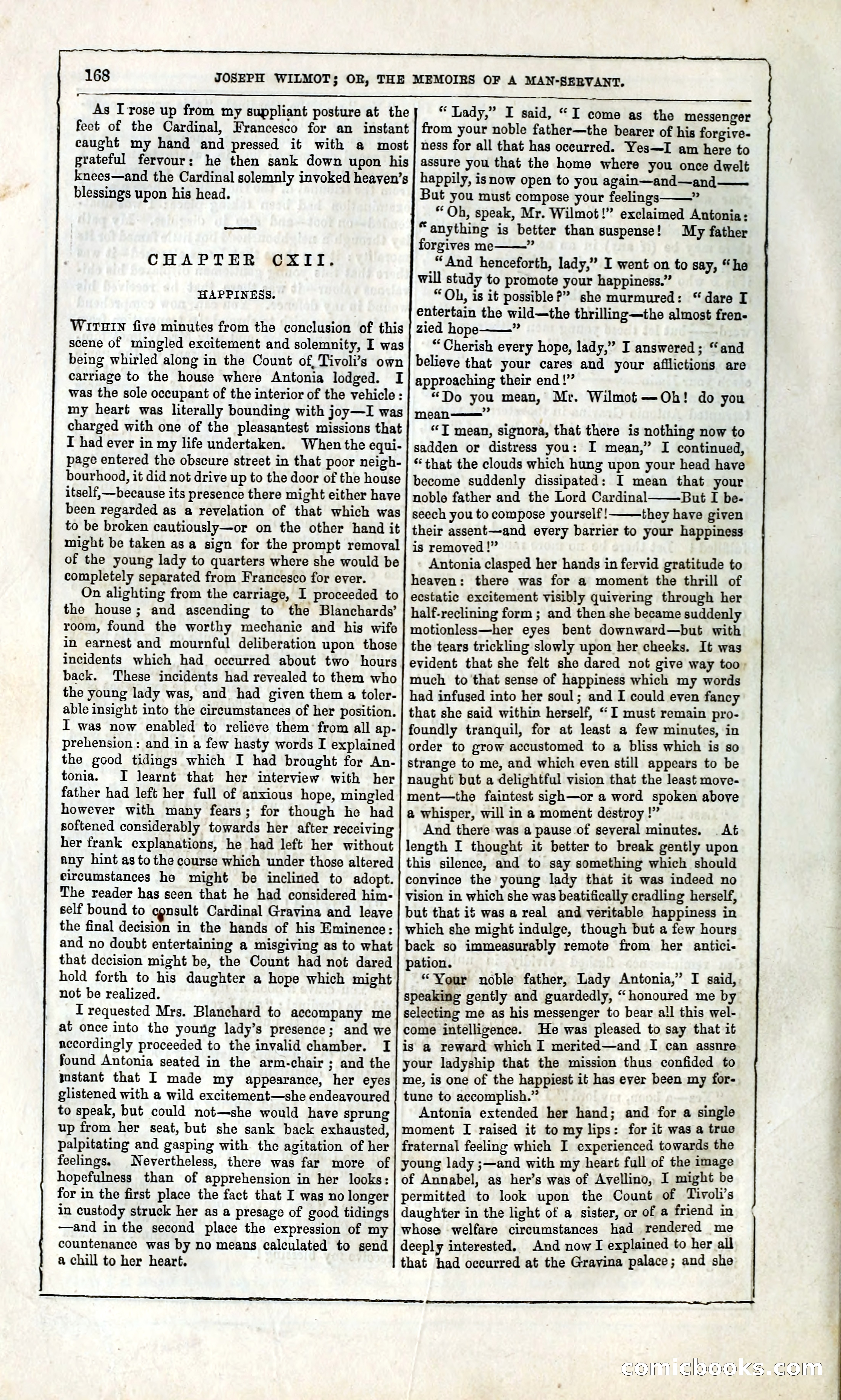
A restored page from Penny Dreadfuls, 1854. Page through the whole issue in the reader above.
📄 Transcribed text from this page (OCR, searchable)
Machine-transcribed from the original scan — historical spelling and the odd misread are preserved.
168 As I rose up from my suppliant posture at the feet of the Cardinal, Francesco for an instant caught my hand and pressed it with a most prateful fervour: he then sank down upon his knees—and the Cardinal solemnly invoked heayen’s blessings upon his head. CHAPTER CXII. HAPPINESS. WITHIN five minutes from the conclusion of this scene of mingled excitement and solemnity, I was being whirled along in the Count of. Tivoli’s own carriage to the house where Antonia lodged. I was the sole occupant of the interior of the vehicle : my heart was literally bounding with joy—I was charged with one of the pleasantest missions that I had ever in my life undertaken. "When the equi- page entered the obscure street in that poor neigh- bourhood, it did not drive up to the door of the house itself,—because its presence there might either have been regarded as a revelation of that which was to be broken cautiously—or on the other hand it might be taken asa sign for the prompt removal of the young lady to quarters where she would be completely separated from Francesco for ever. On alighting from the carriage, I proceeded to the house; and ascending to the Blanchards’ room, found the worthy mechanic and his wife in earnest and mournful deliberation upon those incidents which had occurred about two hours back. These incidents had revealed to them who the young lady was, and had given them a toler- able insight into the circumstances of her position. I was now enabled to relieve them from all ap- prehension : and in a few hasty words I explained the good tidings which I had brought for An- tonia. JI learnt that her interview with her father had left her full of anxious hope, mingled however with many fears; for though he had softened considerably towards her after receiving her frank explanations, he had left her without any hint as to the course which under those altered circumstances he might be inclined to adopt. The reader has seen that he had considered him- self bound to cpnsult Cardinal Gravina and leave the final decision in the hands of his Eminence: and no doubt entertaining a misgiving as to what that decision might be, the Count had not dared hold forth to his daughter a hope which might not be realized. I requested Mrs. Blanchard to accompany me at once into the yourg lady’s presence; and we accordingly proceeded to the invalid chamber. I found Antonia seated in the arm-chair ; and the tustant that I made my appearance, her eyes glistened with a wild excitement—she endeavoured to speak, but could not—she would have sprung up from her seat, but she sank back exhausted, palpitating and gasping with. the agitation of her feelings. Nevertheless, there was far more of hopefulness than of apprehension in her looks: for in the first place the fact that I was no longer in custody struck her as a presage of good tidings —and in the second place the expression of my countenance was by no means calculated to send a chill to her heart. eS tS eeseneeeeteee—e JOSEPH WILMOT; OR, THE MEMOIRS OF A MAN-SERVANT. “ Lady,” I said, “I come as the messenger from your noble father—the bearer of his forgive- ness for all that has occurred. Yes—I am here to assure you that the home where you once dwelt happily, is now open to you again—and—and—— But you must compose your feelings » “Oh, speak, Mr. Wilmot!” exclaimed Antonia: “anything is better than suspense! My father forgives me 1g “And henceforth, lady,” I went on to say, “he will study to promote your happiness.” “Oh, is it possible?” she murmured: “dare I entertain the wild—the thrilling—the almost fren- zied hope i “Cherish every hope, lady,” I answered; “and believe that your cares and your afflictions are approaching their end!” “Do you mean, Mr. Wilmot —Oh! do you 2? mean—— “T mean, signora, that there is nothing now to sadden or distress you: I mean,” I continued, “that the clouds which hung upon your head have become suddenly dissipated: I mean that your noble father and the Lord Cardinal But I be- seech you to compose yourself! they have given their assent—and every barrier to your happiness is removed!” Antonia clasped her hands in fervid gratitude to heaven: there was for a moment the thrill of ecstatic excitement visibly quivering through her half-reclining form ; and then she became suddenly motionless—her eyes bent downward—but with the tears trickling slowly upon her cheeks. It was evident that she felt she dared not give way too: much to that sense of happiness which my words had infused into her soul; and I could even fancy that she said within herself, “I must remain pro- foundly tranquil, for at least a few minutes, in order to grow accustomed to a bliss which is so strange to me, and which even still appears to be naught but a delightful vision that the least move- ment—the faintest sigh—or a word spoken above @ whisper, will in a moment destroy !” And there was a pause of several minutes. At length I thought it better to break gently upon this silence, and to say something which should convince the young lady that it was indeed no vision in which she was beatifically cradling herself, but that if was a real and veritable happiness in which she might indulge, though but a few hours back so immeasurably remote from her antici- pation. “Your noble father, Lady Antonia,’ I said, speaking gently and guardedly, “honoured me by selecting me as his messenger to bear all this wel- come intelligence. He was pleased to say that it is a reward which I merited—and I can assnre your ladyship that the mission thus confided to me, is one of the happiest it has ever been my for- tune to accomplish.” Antonia extended her hand; and for a single moment I raised it to my lips: for it was a true fraternal feeling which I experienced towards the young lady ;—and with my heart full of the image of Annabel, as her’s was of Avellino, I might be permitted to look upon the Count of Tivoli’s daughter in the light of a sister, or of a friend in whose welfare circumstances had rendered me deeply interested, And now I explained to her all that had occurred at the Gravina palace; and she Glyoo cS (c@)