
Penny Dreadfuls, 1854 · page 18 of 399
Joseph Wilmot, or, The Memoirs of a Man-Servant — page 18: what you’re looking at
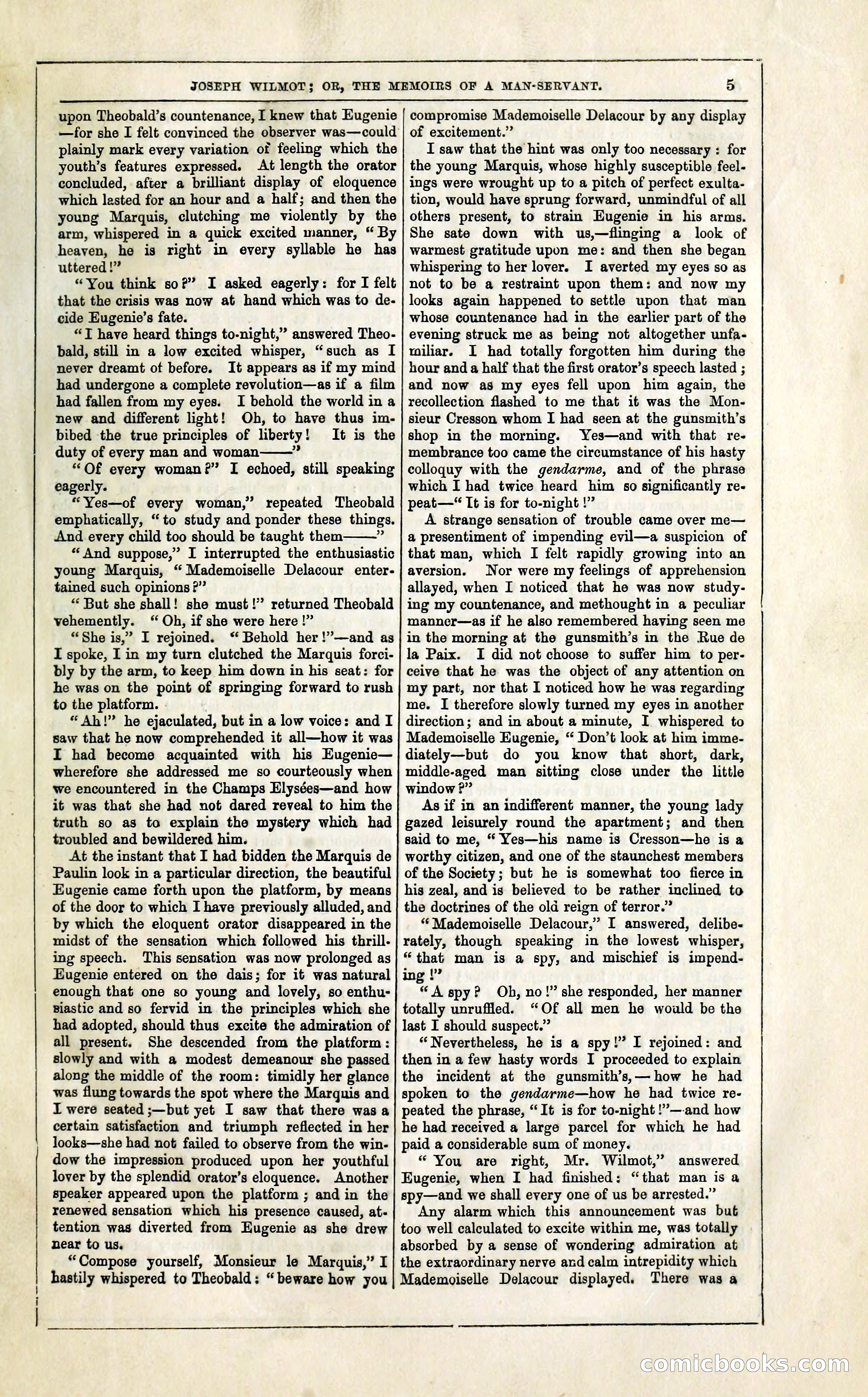
A restored page from Penny Dreadfuls, 1854. Page through the whole issue in the reader above.
📄 Transcribed text from this page (OCR, searchable)
Machine-transcribed from the original scan — historical spelling and the odd misread are preserved.
JOSEPH WILMOT; OR, THE MEMOIRS OF A MAN-SERVANT. 5 upon Theobald’s countenance, I knew that Eugenie —for she I felt convinced the observer was—could | plainly mark every variation of feeling which the youth’s features expressed. At length the orator concluded, after a brilliant display of eloquence which lested for an hour and a half; and then the young Marquis, clutching me violently by the arm, whispered in a quick excited manner, “ By heaven, he is right in every syllable he has uttered !” “You think so?” I asked eagerly: for I felt that the crisis was now at hand which was to de- cide Eugenie’s fate. “T have heard things to-night,” answered Theo- bald, still in a low excited whisper, “such as I never dreamt of before. It appears as if my mind had undergone a complete revolution—as if a film had fallen from my eyes. I behold the world in a new and different light! Oh, to have thus im- bibed the true principles of liberty! It is the duty of every man and woman ? “Of every woman?” I echoed, still speaking eagerly. ““Yes—of every woman,’ repeated Theobald emphatically, “to study and ponder these things. | And every child too should be taught them fi “And suppose,” I interrupted the enthusiastic young Marquis, “ Mademoiselle Delacour enter- tained such opinions ?” “* But she shall! she must!’ returned Theobald vehemently. “Oh, if she were here !” “She is,” I rejoined. ‘‘ Behold her !’—and as I spoke, I in my turn clutched the Marquis forci- bly by the arm, to keep him down in his seat: for he was on the point of springing forward to rush to the platform. . “Ah!” he ejaculated, but in a low voice: and I saw that he now comprehended it all—how it was I had become acquainted with his Eugenie— wherefore she addressed me so courteously when we encountered in the Champs Elysées—and how it was that she had not dared reveal to him the truth so as to explain the mystery which had troubled and bewildered him. At the instant that I had bidden the Marquis de Paulin look in a particular direction, the beautiful Eugenie came forth upon the platform, by means of the door to which I have previously alluded, and by which the eloquent orator disappeared in the midst of the sensation which followed his thrill- ing speech. This sensation was now prolonged as Eugenie entered on the dais; for it was natural enough that one so young and lovely, so enthu- Biastic and so fervid in the principles which she had adopted, should thus excite the admiration of all present. She descended from the platform: slowly and with a modest demeanour she passed along the middle of the room: timidly her glance was flung towards the spot where the Marquis and I were seated ;—but yet I saw that there was a certain satisfaction and triumph reflected in her looks—she had not failed to observe from the win- dow the impression produced upon her youthful lover by the splendid orator’s eloquence. Another speaker appeared upon the platform ; and in the renewed sensation which his presence caused, at- tention was diverted from Eugenie as she drew near to us. “Compose yourself, Monsieur le Marquis,” I hastily whispered to Theobald: “beware how you compromise Mademoiselle Delacour by any display of excitement.” I saw that the hint was only too necessary : for the young Marquis, whose highly susceptible feel- ings were wrought up to a pitch of perfect exulta- tion, would have sprung forward, unmindful of all others present, to strain Eugenie in his arms. She sate down with us,—flinging a look of warmest gratitude upon me: and then she began whispering to her lover. I averted my eyes so as not to be a restraint upon them: and now my looks again happened to settle upon that man whose countenance had in the earlier part of the evening struck me as being not altogether unfa- riliar. I had totally forgotten him during the hour and a half that the first orator’s speech lasted ; and now as my eyes fell upon him again, the recollection flashed to me that it was the Mon- sieur Cresson whom I had seen at the gunsmith’s shop in the morning. Yes—and with that re- membrance too came the circumstance of his hasty colloquy with the gendarme, and of the phrase which I had twice heard him so significantly re- peat—*“ It is for to-night !” A strange sensation of trouble came over me— a presentiment of impending evil—a suspicion of that man, which I felt rapidly growing into an aversion. Nor were my feelings of apprehension allayed, when I noticed that he was now study- ing my countenance, and methought in a peculiar manner—as if he also remembered having seen me in the morning at the gunsmith’s in the Rue de la Paix. I did not choose to suffer him to per- ceive that he was the object of any attention on my part, nor that I noticed how he was regarding me. I therefore slowly turned my eyes in another direction; and in about a minute, I whispered to Mademoiselle Eugenie, “ Don’t look at him imme- diately—but do you know that short, dark, middle-aged man sitting close under the little window ?” As if in an indifferent manner, the young lady gazed leisurely round the apartment; and then said to me, * Yes—his name is Cresson—he is a worthy citizen, and one of the staunchest members of the Society; but he is somewhat too fierce in his zeal, and is believed to be rather inclined to the doctrines of the old reign of terror.” ‘* Mademoiselle Delacour,” I answered, delibe- rately, though speaking in the lowest whisper, “that man is a spy, and mischief is impend- ing Na “A spy? Oh, no!” she responded, her manner totally unrufled. “Of all men he would be the last I should suspect.” “‘ Nevertheless, he is a spy!’ I rejoined: and then in a few hasty words I proceeded to explain the incident at the gunsmith’s,—how he had spoken to the gendarme—how he had twice re- peated the phrase, “It is for to-night !”’—-and how he had received a large parcel for which he had paid a considerable sum of money. “ You are right, Mr. Wilmot,’ answered Eugenie, when I had finished: “that man is a spy—and we shall every one of us be arrested.” Any alarm which this announcement was but too well calculated to excite within me, was totally absorbed by a sense of wondering admiration at the extraordinary nerve and calm intrepidity which Mademoiselle Delacour displayed. There was a eee eee (E() 6)(6\(0) <S) (C(@)