
Penny Dreadfuls, 1854 · page 172 of 399
Joseph Wilmot, or, The Memoirs of a Man-Servant — page 172: what you’re looking at
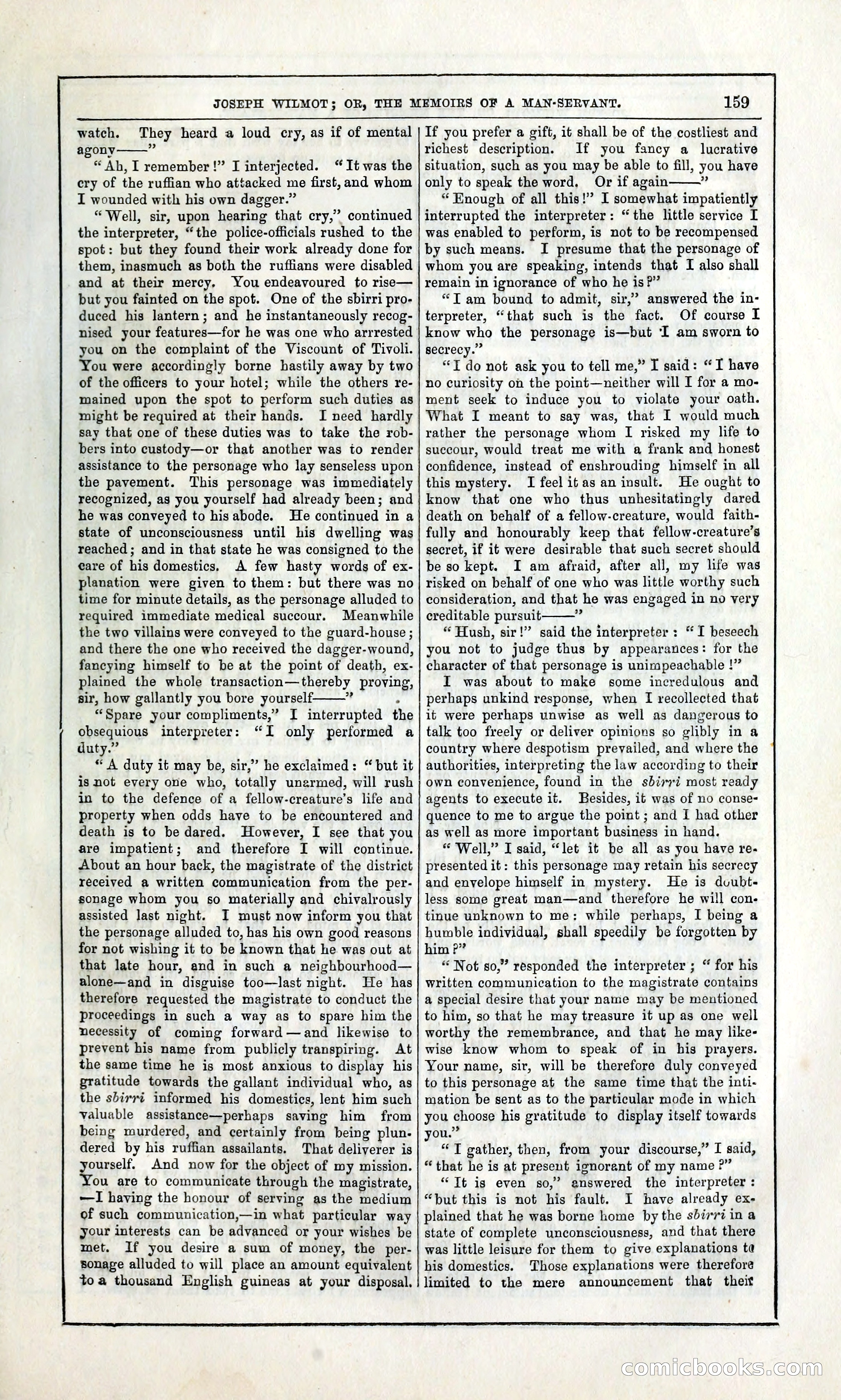
A restored page from Penny Dreadfuls, 1854. Page through the whole issue in the reader above.
📄 Transcribed text from this page (OCR, searchable)
Machine-transcribed from the original scan — historical spelling and the odd misread are preserved.
JOSEPH WILMOT; OR, THE MEMOIRS OF A MAN-SERVANT. 159 They heard a loud cry, as if of mental 99 watch. agony “Ah, I remember!” I interjected. “It was the ery of the ruffian who attacked me first, and whom I wounded with his own dagger.” “Well, sir, upon hearing that cry,” continued the interpreter, “the police-officials rushed to the spot: but they found their work already done for them, inasmuch as both the ruffians were disabled and at their mercy, You endeavoured to rise— but you fainted on the spot. One of the sbirri pro- duced his lantern; and he instantaneously recog- nised your features—for he was one who arrrested you on the complaint of the Viscount of Tivoli. You were accordingly borne hastily away by two of the officers to your hotel; while the others re- mained upon the spot to perform such duties as might be required at their hands. I need hardly say that one of these duties was to take the rob- bers into custody—or that another was to render assistance to the personage who lay senseless upon the pavement. This personage was immediately recognized, as you yourself had already been; and he was conveyed to hisabode. He continued in a state of unconsciousness until his dwelling was reached ; and in that state he was consigned to the care of his domestics, A few hasty words of ex- planation were given to them: but there was no time for minute details, as the personage alluded to required immediate medical succour. Meanwhile the two villains were conveyed to the guard-house ; and there the one who received the dagger-wound, fancying himself to be at the point of death, ex- plained the whole transaction—thereby proving, sir, how gallantly you bore yourself: a” ° “Spare your compliments,’ I interrupted the obsequious interpreter: “I only performed a duty.” “A duty it may be, sir,” he exclaimed: “ but it is not every one who, totally unermed, will rush in to the defence of a fellow-creature’s life and property when odds have to be encountered and death is to be dared. However, I see that you are impatient; and therefore I will continue. About an hour back, the magistrate of the district received a written communication from the per- sonage whom you so materially and chivalrously assisted last night. I must now inform you that the personage alluded to, has his own good reasons for not wishing it to be known that he was out at that late hour, and in such a neighbourhood— alone—and in disguise too—last night. He has therefore requested the magistrate to conduct the proceedings in such a way as to spare him the necessity of coming forward —and likewise to prevent his name from publicly transpiring. At the same time he is most anxious to display his gratitude towards the gallant individual who, as the sbirri informed his domestics, lent him such valuable assistance—perhaps saving him from being murdered, and certainly from being plun- dered by his ruffian assailants. That deliverer is yourself. And now for the object of my mission. You are to communicate through the magistrate, —I having the honour of serving as the medium of such communication,—in what particular way your interests can be advanced or your wishes be met. If you desire a sum of money, the per- sonage alluded to will place an amount equivalent toa thousand English guineas at your disposal. If you prefer a gift, it shall be of the costliest and richest description. If you fancy a _ lucrative situation, such as you may be able to fill, you have only to speak the word, Or if again 7 “ Enough of all this!” I somewhat impatiently interrupted the interpreter: “the little service I was enabled to perform, is not to be recompensed by such means. I presume that the personage of whom you are speaking, intends that I also shall remain in ignorance of who he is?” “Tam bound to admit, sir,” answered the in- terpreter, “that such is the fact. Of course L know who the personage is—but ‘IL am sworn to secrecy.” | “TI do not ask you to tell me,” I said: “I have no curiosity on the point—uneither will I for a mo- ment seek to induce you to violate your oath. What I meant to say was, that I would much rather the personage whom I risked my life to suecour, would treat me with a frank and honest confidence, instead of enshrouding himself in all this mystery. I feelitas an insult. He ought to know that one who thus unhesitatingly dared death on behalf of a fellow-creature, would faith- fully and honourably keep that fellow-creature’s secret, if it were desirable that such secret should be so kept. I am afraid, after all, my life was risked on behalf of one who was little worthy such consideration, and that he was engaged in no very ereditable pursuit 7 “ Hush, sir!” said the interpreter: “I beseech you not to judge thus by appearances: for the character of that personage is unimpeachable !” I was about to make some incredulous and perhaps unkind response, when I recollected that it were perhaps unwise as well as dangerous to talk too freely or deliver opinions so glibly in a country where despotism prevailed, and where the authorities, interpreting the law according to their own convenience, found in the sbirvi most ready agents to execute it. Besides, it was of no conse- quence to me to argue the point ; and I had other as well as more important business in hand. « Well,” I said, “let it be all as you have re- presented it: this personage may retain his secrecy and envelope himself in mystery. He is duubt- less some great man—and therefore he will con- tinue unknown to me: while perhaps, I being a humble individual, shall speedily be forgotten by him ?” “ Not so,” responded the interpreter ; “ for his written communication to the magistrate contains a special desire that your name may be mentioned to him, so that he may treasure it up as one well worthy the remembrance, and that he may like- wise know whom to speak of in his prayers. Your name, sir, will be therefore duly conveyed to this personage at the same time that the inti- mation be sent as to the particular mode in which you choose his gratitude to display itself towards ou.” “T gather, then, from your discourse,” I said, “that he is at present ignorant of my name ?” “Tt is even so,” enswered the interpreter : “but this is not his fault. I have already ex- plained that he was borne home by the sbivrvi in a state of complete unconsciousness, and that there was little leisure for them to give explanations ta his domestics. Those explanations were therefore limited to the mere announcement that theit GIoOaks (CO) im