
Penny Dreadfuls, 1854 · page 167 of 399
Joseph Wilmot, or, The Memoirs of a Man-Servant — page 167: what you’re looking at
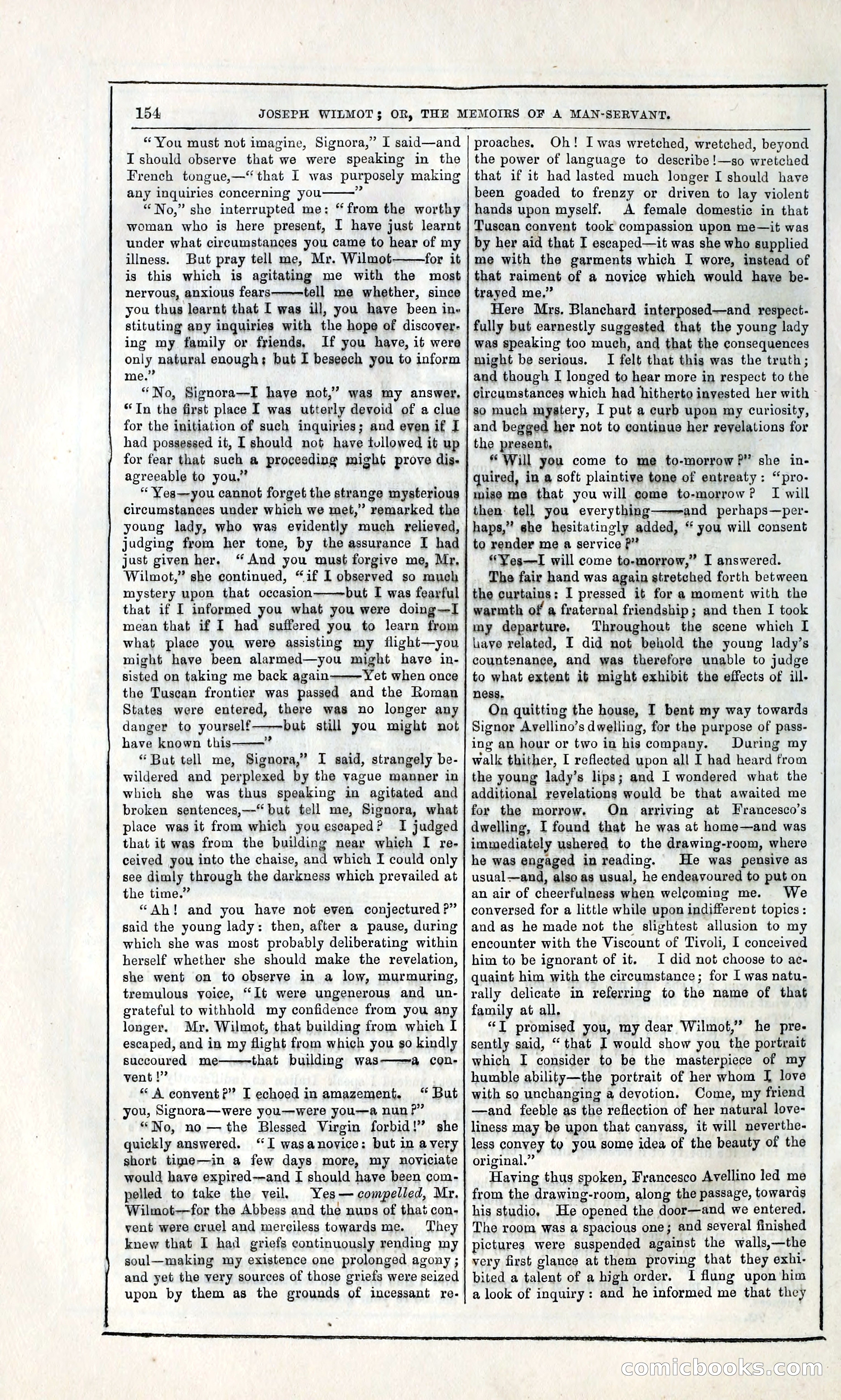
A restored page from Penny Dreadfuls, 1854. Page through the whole issue in the reader above.
📄 Transcribed text from this page (OCR, searchable)
Machine-transcribed from the original scan — historical spelling and the odd misread are preserved.
sss ss ss 154 JOSEPH WILMOT$; OR, THE MEMOIRS OF A MAN-SERVANT. “You must not imagine, Signora,” I said—and I should observe that we were speaking in the French tongue,—“ that I was purposely making any inquiries concerning you ( “No,” she interrupted me: “from the worthy woman who is here present, I have just learnt under what circumstances you came to hear of my illness. But pray tell me, Mr. Wilmot for it is this which is agitating me with the most nervous, anxious fears tell me whether, since you thus learnt that [ was ill, you have been in» stituting apy inquiries with the hope of discover- ing my family or friends, If you have, it were only natural enough; but I beseech you to inform me.” “No, Signora—I have not,” was my answer, “In the first place I was utterly devoid of a clue for the initiation of such inquiries; and eyen if I had possessed it, I should not have tullowed it up for fear that such a proceeding might prove dis. agreeable to you,” Yes—you cannot forget the strange mysterious circumstances under which we met,” remarked the young lady, who was evidently much relieved, judging from her tone, by the assurance I had just given her. ‘And you must forgive me, Mr, Wilmot,” she continued, “if I observed so much mystery upon that occasion but I was fearful that if I informed you what you were doing—TI mean that if I had suffered you to learn from what place you were assisting my flight—you might have been alarmed—you might have in- sisted on taking me back again———Yet when once the Tuscan frontier was passed and the Roman States were entered, there was no longer any danger to yourself——but still you might not have known this———” “But tell me, Signora,” I said, strangely be- wildered and perplexed by the vague manner in which she was thus speaking in agitated and broken sentences,—-“ but tell me, Signora, what place was it from which you escaped? I judged that it was from the building near which I re- ceived you into the chaise, and which I could only see dimly through the darkness which prevailed at the time.” “Ah! and you have not even conjectured ?” said the young lady: then, after a pause, during which she was most probably deliberating within herself whether she should make the revelation, she went on to observe in a low, murmuring, tremulous yoice, “It were ungenerous and un- grateful to withhold my confidence from you any longer. Mr, Wilmot, that building from which I escaped, and in my flight from which you so kindly succoured me that building was & con- vent !” “ A convent?” IT echoed in amazement. “ But you, Signora—were you—were you—a nun?” “No, no— the Blessed Virgin forbid!’ she quickly answered. “I wasanovice: but in avery short time—in a few days more, my noviciate would have expired-—-and I should have been com- pelled to take the veil, Yes— compelled, Mr. Wilmot—for the Abbess and the nuns of that con- vent were cruel and merciless towards me. They knew that I had griefs continuously rending my soul—making my existence one prolonged agony ; and yet the very sources of those griefs were seized upon by them as the grounds of incessant re- . proaches, Oh! I was wretched, wretched, beyond the power of language to describe!—so wretched that if it had lasted much longer I should have been goaded to frenzy or driven to lay violent hands upon myself. A female domestic in that Tuscan convent took compassion upon me—it was by her aid that I escaped—it was she who supplied me with the garments which I wore, instead of that raiment of a novice which would have be- trayed me,” Here Mrs. Blanchard interposed—and respect- fully but earnestly suggested that the young lady was speaking too much, and that the consequences might be serious. I felt that this was the truth; and though I longed to hear more in respect to the circumstances which had hitherto inyested her with — so much mystery, I put a curb upon my curiosity, and begged her not to continue her reyelations for the present, * Will you come to me to-morrow?” she in- quired, in a soft plaintive tone of entreaty: “pro- mise me that you will gome to-morrow? I will then: tell you everything——~and perhaps—per- haps,” ghe hesitatingly added, “ you will consent to render me a service ?” *Yes—I will come to-morrow,” I answered. The fair hand was again stretched forth between the curtains; I pressed it for a moment with the warmth of a fraternal friendship; and then I took my departure. Throughout the scene which I lave related, I did not behold the young lady’s countenanee, and was therefore unable to judge to what extent if might exhibit the effects of ill- ness. On quitting the house, I bent my way towards Signor Avellino’s dwelling, for the purpose of pass- ing an hour or two in his company. During my walk thither, I reflected upon all I had heard from the young lady’s lips; and I wondered what the additional revelations would be that awaited me for the morrow. On arriving at Francesco’s dwelling, I found that he was at home—and was immediately ushered to the drawing-room, where he was engaged in reading. He was pensive as usual—and, also as usual, he endeavoured to put on an air of cheerfulness when welcoming me. We conversed for a little while upon indifferent topics : and as he made not the slightest allusion to my encounter with the Viscount of Tivoli, I conceived him to be ignorant of it. I did not choose to ac- quaint him with the circumstance; for I was natu- rally delicate in referring to the name of that family at all. “TI promised you, my dear Wilmot,” he pre- sently said, “that I would show you the portrait which I consider to be the masterpiece of my humble ability—the portrait of her whom [ love with so unchanging a devotion. Come, my friend —and feeble as the reflection of her natural love- liness may be upon that canvass, it will neverthe- less convey ty you some idea of the beauty of the original.” Haying thus spoken, Francesco Avellino led me from the drawing-room, along the passage, towards his studio, He opened the door—and we entered. The room was a spacious one; and several finished pictures were suspended against the walls,—the very first glance at them proving that they exhi- bited a talent of a high order. I flung upon him a look of inquiry: and he informed me that they retain ieee eee PR €om COmicooolks