
Penny Dreadfuls, 1854 · page 155 of 399
Joseph Wilmot, or, The Memoirs of a Man-Servant — page 155: what you’re looking at
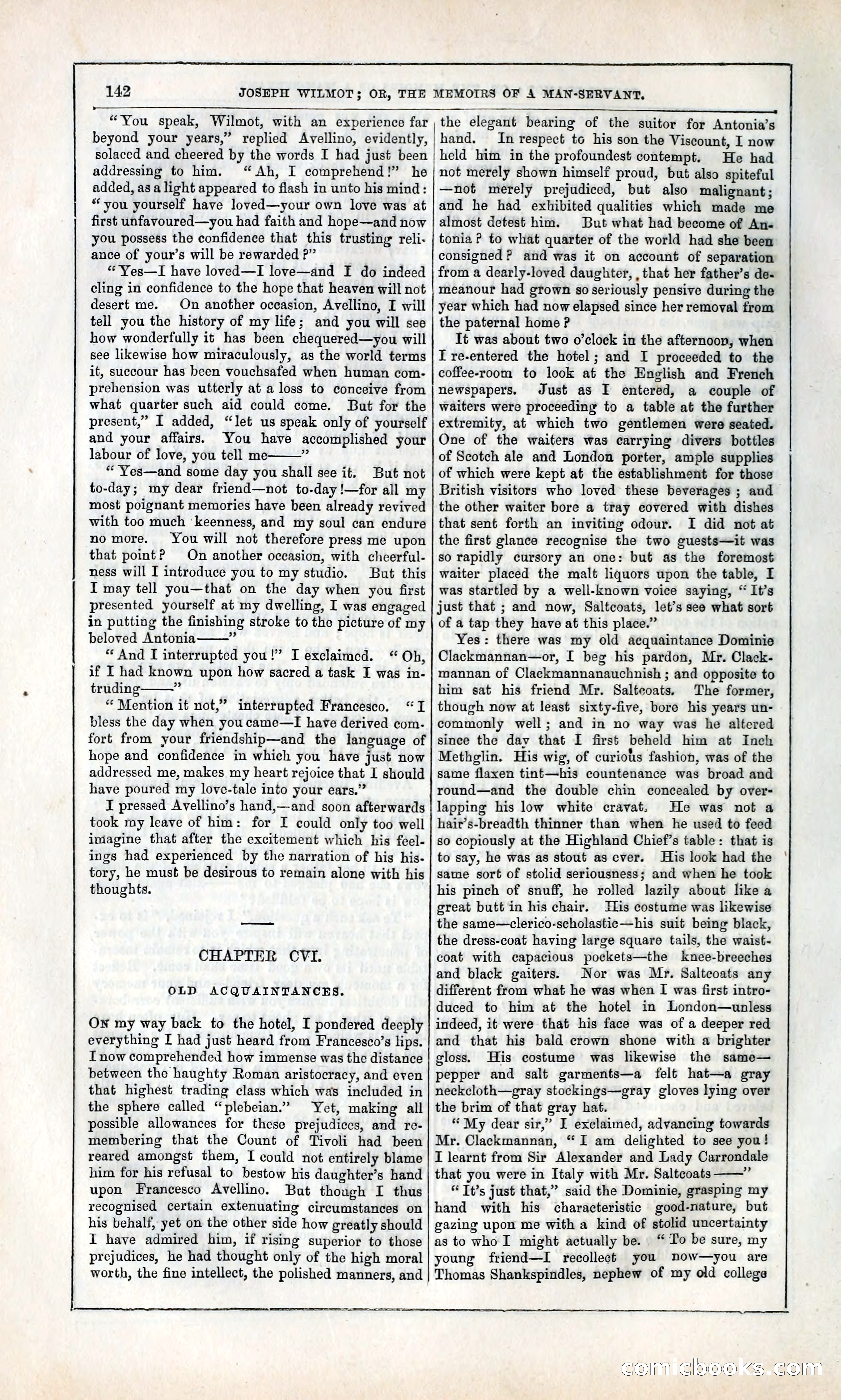
A restored page from Penny Dreadfuls, 1854. Page through the whole issue in the reader above.
📄 Transcribed text from this page (OCR, searchable)
Machine-transcribed from the original scan — historical spelling and the odd misread are preserved.
142 “You speak, Wilmot, with an experience far beyond your years,” replied Avellino, evidently, solaced and cheered by the words I had just been addressing to him. “Ah, I comprehend!” he added, as a light appeared to flash in unto his mind: “you yourself have loved—your own love was at first unfavoured—you had faith and hope—and now you possess the confidence that this trusting reli- ance of your’s will be rewarded P” ““‘Yes—I have loved—I love—and I do indeed cling in confidence to the hope that heaven will not desert me. On another occasion, Avellino, I will tell you the history of my life; and you will see how wonderfully it has been chequered—you will see likewise how miraculously, as the world terms it, succour has been vouchsafed when human com- prehension was utterly at a loss to conceive from what quarter such aid could come. But for the present,” I added, “let us speak only of yourself and your affairs. You have accomplished your labour of love, you tell me a **'Yes—and some day you shall see it. But not to-day; my dear friend—not to-day !—for all my most poignant memories have been already revived with too much ‘keenness, and my soul can endure no more. You will not therefore press me upon that point? On another occasion, with cheerful- ness will I introduce you to my studio. But this I may tell you—that on the day when you first presented yourself at my dwelling, I was engaged in putting the finishing stroke to the picture of my beloved Antonia a “And I interrupted you!” I exclaimed. “ Oh, if I had known upon how sacred a task I was in- truding 4 “ Mention it not,” interrupted Francesco. “I bless the day when you came—I have derived com- fort from your friendship—and the language of hope and confidence in which you have just now addressed me, makes my heart rejoice that I should have poured my love-tale into your ears.” I pressed Avellino’s hand,—and soon afterwards took my leave of him: for I could only too well imagine that after the excitement which his feel- ings had experienced by the narration of his his- tory, he must be desirous to remain alone with his thoughts. a CHAPTER CVI. OLD ACQUAINTANCES. On my way back to the hotel, I pondered deeply everything I had just heard from Francesco’s lips. IT now comprehended how immense was the distance between the haughty Roman aristocracy, and even that highest trading class which was included in the sphere called “plebeian.” Yet, making all possible allowances for these prejudices, and re- membering that the Count of Tivoli had been reared amongst them, I could not entirely blame him for his refusal to bestow his daughter’s hand upon Francesco Avellino. But though I thus recognised certain extenuating circumstances on his behalf, yet on the other side how greatly should I have admired him, if rising superior to those prejudices, he had thought only of the high moral worth, the fine intellect, the polished manners, and JOSEPH WILMOT; OR, THE MEMOIRS OF A MAN-SERVANT, the elegant bearing of the suitor for Antonia’s hand. In respect tc his son the Viscount, I now held him in the profoundest contempt. He had not merely shown himself proud, but also spiteful —not merely prejudiced, but also malignant ; and he had exhibited qualities which made me almost detest him. But what had become of Ans tonia ? to what quarter of the world had she been consigned? and was it on account of separation from a dearly-loved daughter, , that her father’s de- meanour had grown so seriously pensive during the year which had now elapsed since her removal from the paternal home ? It was about two o’clock in the afternoon, when I re-entered the hotel; and I proceeded to the coffee-room to look at the English and French newspapers. Just as I entered, a couple of waiters were proceeding to a table at the further extremity, at which two gentlemen were seated. One of the waiters was carrying divers bottles of Scotch ale and London porter, ample supplies of which were kept at the establishment for those British visitors who loved these beverages ; aud the other waiter bore a tray covered with dishes that sent forth an inviting odour. I did not at the first glance recognise the two guests—it was so rapidly cursory an one: but as the foremost waiter placed the malt liquors upon the table, I was startled by a well-known voice saying, “It’s just that ; and now, Saltcoats, let’s see what sort of a tap they have at this place.” Yes: there was my old acquaintance Dominic Clackmannan—or, I beg his pardon, Mr. Clack- mannan of Clackmannanauchnish ; and opposite to him sat his friend Mr. Salteoats. The former, though now at least sixty-five, bore his years un- commonly well; and in no way was he altered since the day that I first beheld him at Inch Methglin. His wig, of curious fashion, was of the same flaxen tint—hbis countenance was broad and round—and the double chin concealed by over- lapping his low white cravat: He was not a hair’s-breadth thinner than when he used to feed so copiously at the Highland Chief’s table: that is to say, he was as stout as ever. His look had the same sort of stolid seriousness; and when he took his pinch of snuff, he rolled lazily about like a great butt in his chair. His costume was likewise the same—clerico-scholastie—his suit being black, the dress-coat having large square tails, the waist- coat with capacious pockets—the knee-breeches and black gaiters. Nor was Mr. Saltcoats any different from what he was when I was first intro- duced to him at the hotel in London—unless indeed, it were that his face was of a deeper red and that his bald crown shone with a brighter gloss. His costume was likewise the same— pepper and salt garments—a felt hat—a gray neckcloth—gray stockings—gray gloves lying over the brim of that gray hat. * My dear sir,” I exclaimed, advancing towards Mr. Clackmannan, “I am delighted to see you! I learnt from Sir Alexander and Lady Carrondale that you were in Italy with Mr. Saltcoats Ss “It’s just that,” said the Dominie, grasping my hand with his characteristic good-nature, but gazing upon me with a kind of stolid uncertainty as to who I might actually be. “ To be sure, my young friend—I recollect you mow—you are Thomas Shankspindles, nephew of my old college EloOOk<S (Cc)