
Penny Dreadfuls, 1854 · page 153 of 399
Joseph Wilmot, or, The Memoirs of a Man-Servant — page 153: what you’re looking at
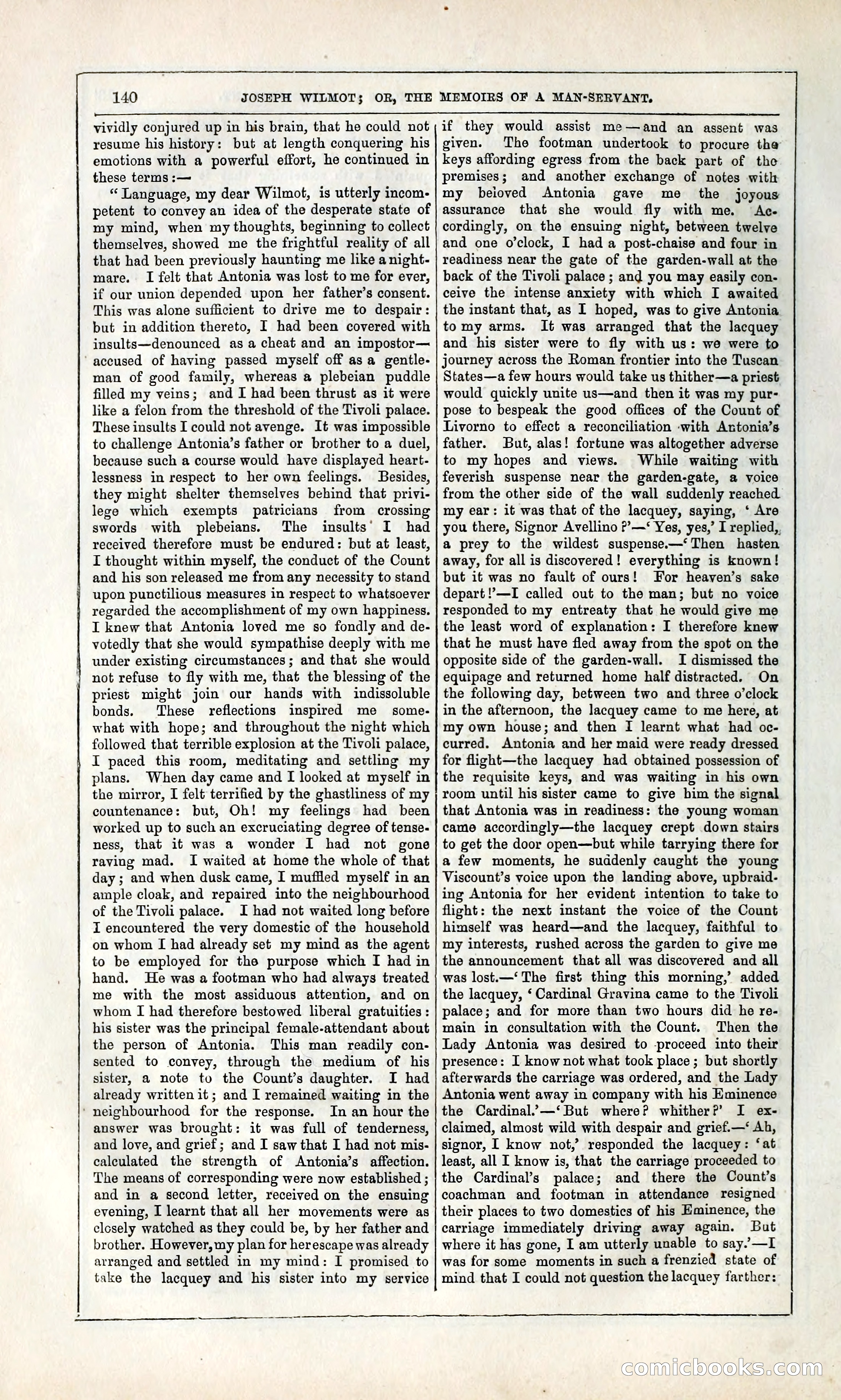
A restored page from Penny Dreadfuls, 1854. Page through the whole issue in the reader above.
📄 Transcribed text from this page (OCR, searchable)
Machine-transcribed from the original scan — historical spelling and the odd misread are preserved.
140 JOSEPH WILMOT; OR, THE vividly conjured up in his brain, that he could not resume his history: but at length conquering his emotions with a powerful effort, he continued in these terms :— “ Language, my dear Wilmot, is utterly incom- petent to convey an idea of the desperate state of my mind, when my thoughts, beginning to collect themselves, showed me the frightful reality of all that had been previously haunting me like a night- mare. I felt that Antonia was lost to me for ever, if our union depended upon her father’s consent. This was alone sufficient to drive me to despair: but in addition thereto, I had been covered with insults—denounced as a cheat and an impostor— ~accused of having passed myself off asa gentle- man of good family, whereas a plebeian puddle filled my veins; and I had been thrust as it were like a felon from the threshold of the Tivoli palace. These insults I could not avenge. It was impossible to challenge Antonia’s father or brother to a duel, because such a course would have displayed heart- lessness in respect to her own feelings. Besides, they might shelter themselves behind that privi- lege which exempts patricians from crossing swords with plebeians. The insults’ I had received therefore must be endured: but at least, I thought within myself, the conduct of the Count and his son released me from any necessity to stand upon punctilious measures in respect to whatsoever regarded the accomplishment of my own happiness. I knew that Antonia loved me so fondly and de- votedly that she would sympathise deeply with me under existing circumstances; and that she would not refuse to fly with me, that the blessing of the priest might join our hands with indissoluble bonds. These reflections inspired me _ some- what with hope; and throughout the night which followed that terrible explosion at the Tivoli palace, I paced this room, meditating and settling my plans. When day came and I looked at myself in the mirror, I felt terrified by the ghastliness of my countenance: but, Oh! my feelings had been worked up to such an excruciating degree of tense- ness, that it was a wonder I had not gone raving mad. I waited at home the whole of that day ; and when dusk came, I muffled myself in an ample cloak, and repaired into the neighbourhood of the Tivoli palace. I had not waited long before I encountered the very domestic of the household on whom [ had already set my mind as the agent to be employed for the purpose which I had in hand. He was a footman who had always treated me with the most assiduous attention, and on whom I had therefore bestowed liberal gratuities : his sister was the principal female-attendant about the person of Antonia. This man readily con- sented to convey, through the medium of his sister, a note to the Count’s daughter. I had already written it; and I remained waiting in the ‘neighbourhood for the response. In an hour the answer was brought: it was full of tenderness, and love, and grief; and I saw that I had not mis- calculated the strength of Antonia’s affection. The means of corresponding were now established ; and in a second letter, received on the ensuing evening, I learnt that all her movements were as elcsely watched as they could be, by her father and brother. However, my plan for herescape was already arranged and settled in my mind: I promised to take the lacquey and his sister into my service -—_——_- - MEMOIRS OF A MAN-SERVANT, if they would assist me—and an assent was given. keys affording egress from the back part of the premises; and another exchange of notes with my beioved Antonia gave me the joyous assurance that she would fly with me Ace. cordingly, on the ensuing night, between twelve and one o'clock, I hada post-chaise and four in readiness near the gate of the garden-wall at the back of the Tivoli palace ; and you may easily con- ceive the intense anxiety with which I awaited the instant that, as I hoped, was to give Antonia tomy arms. It was arranged that the lacquey and his sister were to fly with us: we were to journey across the Roman frontier into the Tuscan States—a few hours would take us thither—a priest would quickly unite us—and then it was my pur- pose to bespeak the good offices of the Count of Livorno to effect a reconciliation with Antonia’s father. But, alas! fortune was altogether adverse to my hopes and views. While waiting with feverish suspense near the garden-gate, a voice from the other side of the wall suddenly reached my ear: it was that of the lacquey, saying, ‘ Are you there, Signor Avellino ??—‘ Yes, yes,’ I replied,, a prey to the wildest suspense.—‘ Then hasten away, for all is discovered! everything is known! but it was no fault of ours! ‘For heavyen’s sake depart !’"—I called out to the man; but no voice responded to my entreaty that he would give me the least word of explanation: I therefore knew that he must have fled away from the spot on the opposite side of the garden-wall. I dismissed the equipage and returned home half distracted. On the following day, between two and three o’clock in the afternoon, the lacquey came to me here, at my own house; and then I learnt what had oc- curred. Antonia and her maid were ready dressed for flight—the lacquey had obtained possession of the requisite keys, and was waiting in his own room until his sister came to give him the signal that Antonia was in readiness: the young woman came accordingly—the lacquey crept down stairs to get the door open—but while tarrying there for a few moments, he suddenly caught the young Viscount’s voice upon the landing above, upbraid- ing Antonia for her evident intention to take to flight: the next instant the voice of the Count himself was heard—and the lacquey, faithful to my interests, rushed across the garden to give me the announcement that all was discovered and all was lost.—‘ The firs$ thing this morning,’ added the lacquey, ‘ Cardinal Gravina came to the Tivoli palace; and for more than two hours did he re- main in consultation with the Count. Then the Lady Antonia was desired to -proceed into their presence: I know not what took place; but shortly afterwards the carriage was ordered, and the Lady Antonia went away in company with his Eminence the Cardinal.’—‘ But where? whither?’ I ex- claimed, almost wild with despair and grief.—‘ Ah, signor, I know not,’ responded the lacquey: ‘at least, all I know is, that the carriage proceeded to the Cardinal’s palace; and there the Count’s coachman and footman in attendance resigned their places to two domestics of his Eminence, the carriage immediately driving away again. But where it has gone, I am utterly unable to say.’—I was for some moments in such a frenzied state of mind that I could not question the lacquey farther: The footman undertook to procure the ElO@QO) Ss (C@) A