
Penny Dreadfuls, 1854 · page 15 of 399
Joseph Wilmot, or, The Memoirs of a Man-Servant — page 15: what you’re looking at
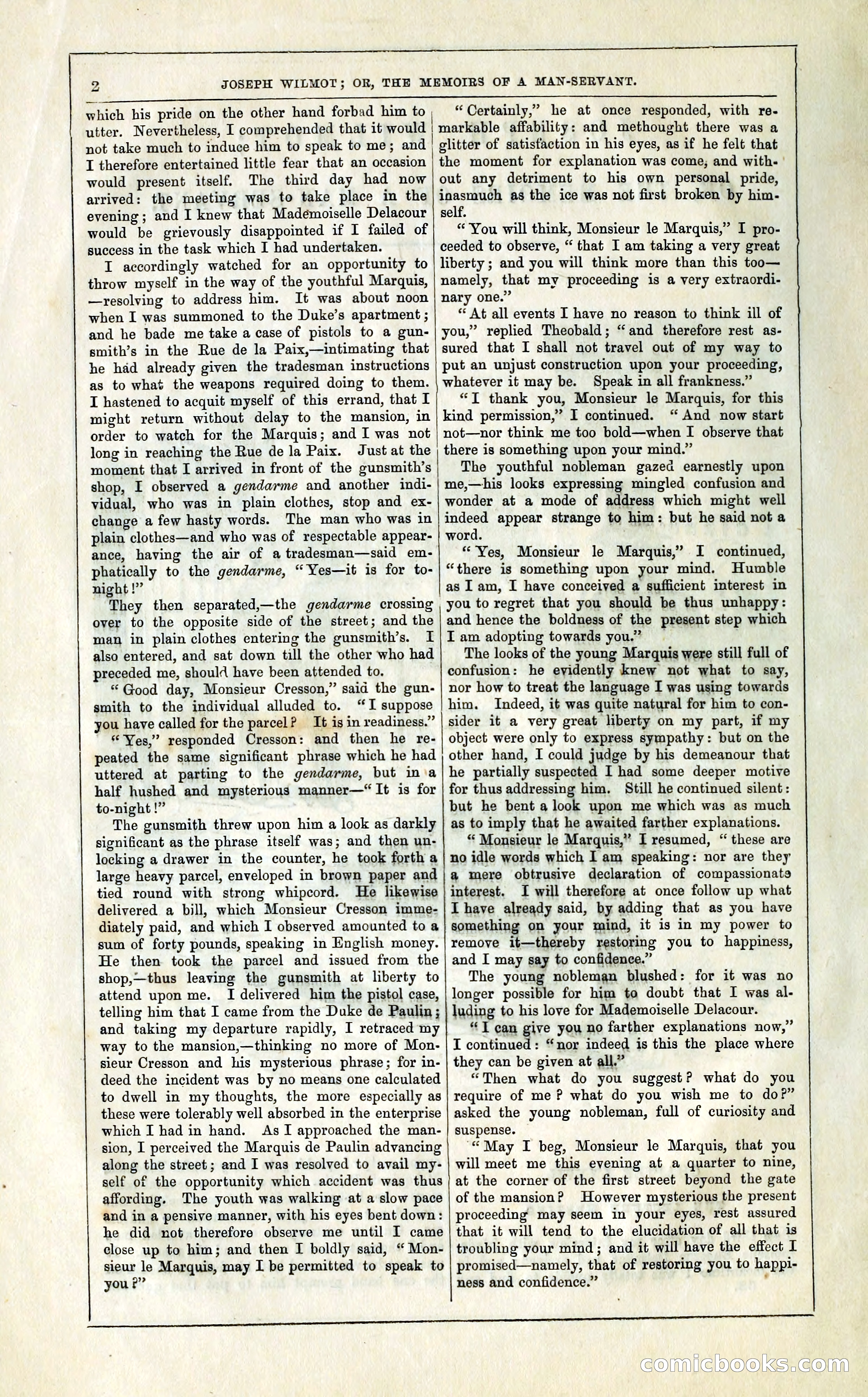
A restored page from Penny Dreadfuls, 1854. Page through the whole issue in the reader above.
📄 Transcribed text from this page (OCR, searchable)
Machine-transcribed from the original scan — historical spelling and the odd misread are preserved.
2 JOSEPH WILMOT; OR, THE MEMOIRS OF A MAN-SERVANT. which his pride on the other hand forbad him to * Certainly,’ he at once responded, with re- utter. Nevertheless, I comprehended that it would | markable affability: and methought there was a not take much to induce him to speak to me; and | glitter of satisfaction in his eyes, as if he felt that I therefore entertained little fear that an occasion would present itself. The third day had now arrived: the meeting was to take place in the evening; and I knew that Mademoiselle Delacour would be grievously disappointed if I failed of success in the task which I had undertaken. I accordingly watched for an opportunity to throw myself in the way of the youthful Marquis, —resolving to address him. It was about noon when I was summoned to the Duke’s apartment ; and he bade me take a case of pistols to a gun- smith’s in the Rue de la Paix,—intimating that he had already given the tradesman instructions as to what the weapons required doing to them. I hastened to acquit myself of this errand, that I might return without delay to the mansion, in order to watch for the Marquis; and I was not long in reaching the Rue de la Paix. Just at the moment that I arrived in front of the gunsmith’s shop, I observed a gendarme and another indi- vidual, who was in plain clothes, stop and ex- change a few hasty words. The man who was in plain clothes—and who was of respectable appear- ance, having the air of a tradesman—said em- phatically to the gendarme, “Yes—it is for to- night !”’ They then separated,—the gendarme crossing over to the opposite side of the street; and the man in plain clothes entering the gunsmith’s. I also entered, and sat down till the other who had preceded me, should have been attended to. “Good day, Monsieur Cresson,” said the gun- smith to the individual alluded to. “I suppose you have called for the parcel P It ig in readiness.” Yes,” responded Cresson: and then he re- peated the same significant phrase which he had uttered at parting to the gendarme, but in\a half hushed and mysterious manner—* It is for to-night !” The gunsmith threw upon him a look as darkly significant as the phrase itself was; and then un- locking a drawer in the counter, he took forth a large heavy parcel, enveloped in brown paper and tied round with strong whipcord. He likewise delivered a bill, which Monsieur Cresson imme- diately paid, and which I observed amounted to a sum of forty pounds, speaking in English money. He then took the parcel and issued from the shop,—thus leaving the gunsmith at liberty to attend upon me. I delivered him the pistol case, telling him that I came from the Duke de Paulin; and taking my departure rapidly, I retraced my way to the mansion,—thinking no more of Mon- sieur Cresson and his mysterious phrase; for in- deed the incident was by no means one calculated to dwell in my thoughts, the more especially as these were tolerably well absorbed in the enterprise which I had in hand. As I approached the man- sion, I perceived the Marquis de Paulin advancing along the street; and I was resolved to avail my- self of the opportunity which accident was thus affording. The youth was walking at a slow pace and in a pensive manner, with his eyes bent down: he did not therefore observe me until I came close up to him; and then I boldly said, “ Mon- sieur le Marquis, may I be permitted to speak to you ?” eeeeeerereeennnrese teen LE the moment for explanation was come; and with. — out any detriment to his own personal pride, inasmuch as the ice was not first broken by him- self. “You will think, Monsieur le Marquis,” I pro- ceeded to observe, “ that I am taking a very great liberty ; and you will think more than this too— namely, that my proceeding is a very extraordi- nary one.” *‘ At all events I have no reason to think ill of you,” replied Theobald; “and therefore rest as- sured that I shall not travel out of my way to put an unjust construction upon your proceeding, whatever it may be. Speak in all frankness.” “T thank you, Monsieur le Marquis, for this kind permission,” I continued. “And now start not—nor think me too bold—when I observe that there is something upon your mind.” The youthful nobleman gazeca earnestly upon me,—his looks expressing mingled confusion and wonder at a mode of address which might well indeed appear strange to him: but he said not a word. “Yes, Monsieur le Marquis,” I continued, “there is something upon your mind. Humble as I am, I have conceived a sufficient interest in you to regret that you should be thus unhappy: and hence the boldness of the present step which I am adopting towards you.” The looks of the young Marquis were still full of confusion: he evidently knew not what to say, nor how to treat the language I was using towards him. Indeed, it was quite natural for him to con- sider it a very great liberty on my part, if my object were only to express sympathy: but on the other hand, I could judge by his demeanour that he partially suspected I had some deeper motive for thus addressing him. Still he continued silent: but he bent a look upon me which was as much as to imply that he awaited farther explanations. “ Monsieur le Marquis,” I resumed, “ these are no idle words which I am speaking: nor are they @ mere obtrusive declaration of compassionats interest. I will therefore at once follow up what I have already said, by adding that as you have something on your mind, it is in my power to remove it—thereby restoring you to happiness, and I may say to confidence.” The young nobleman blushed: for it was no longer possible for him to doubt that I was al- luding to his love for Mademoiselle Delacour. “I can give you no farther explanations now,” I continued: “nor indeed is this the place where they can be given at all.” “Then what do you suggest? what do you require of me P what do you wish me to do?” asked the young nobleman, full of curiosity and suspense. “© May I beg, Monsieur le Marquis, that you will meet me this evening at a quarter to nine, at the corner of the first street beyond the gate of the mansion? However mysterious the present proceeding may seem in your eyes, rest assured that it will tend to the elucidation of all that is troubling your mind; and it will have the effect I promised—namely, that of restoring you to happi- ness and confidence.” ‘ Pe eR a a a Go 6)(6)(0) <S (EO) im