
Penny Dreadfuls, 1854 · page 146 of 399
Joseph Wilmot, or, The Memoirs of a Man-Servant — page 146: what you’re looking at
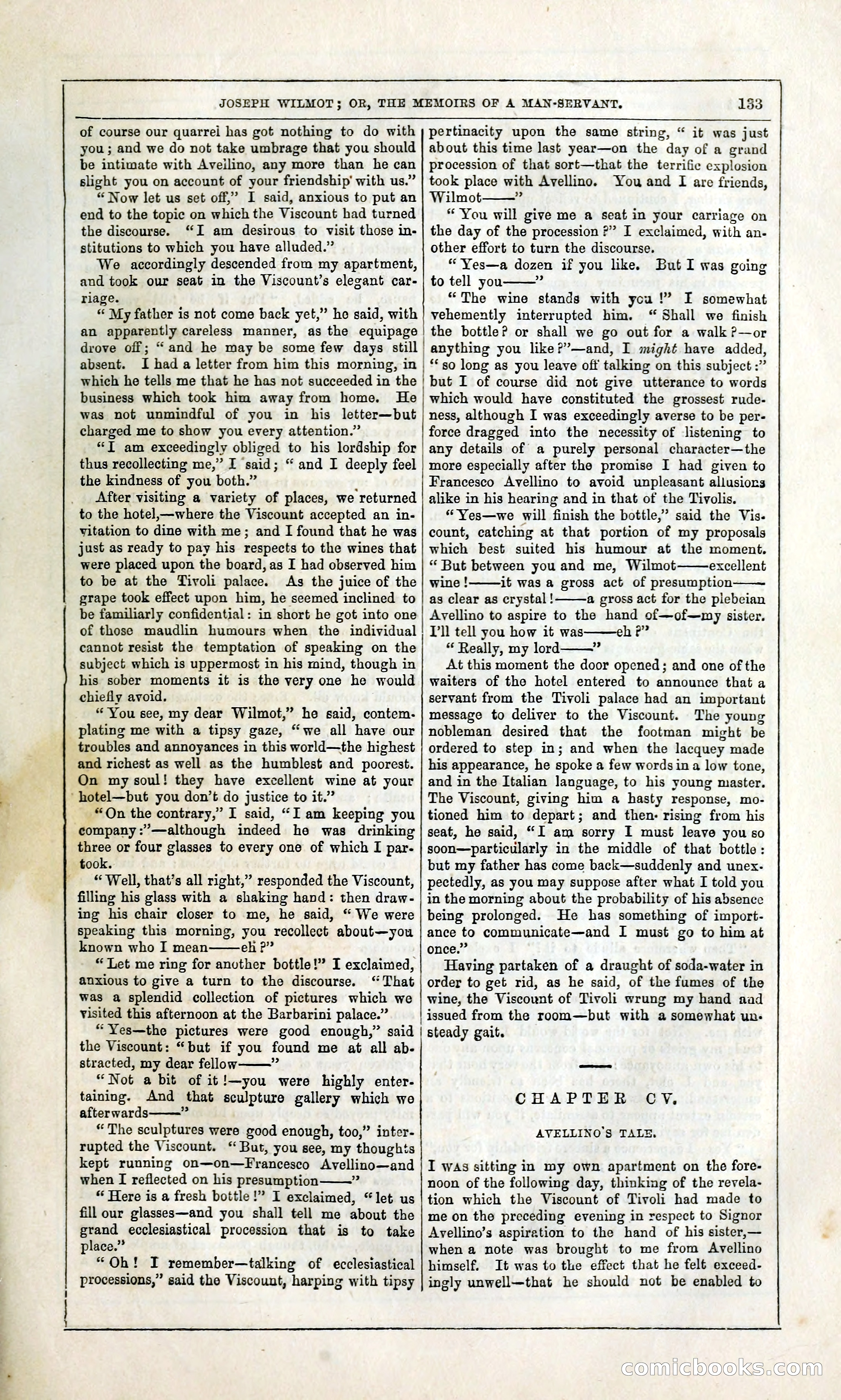
A restored page from Penny Dreadfuls, 1854. Page through the whole issue in the reader above.
📄 Transcribed text from this page (OCR, searchable)
Machine-transcribed from the original scan — historical spelling and the odd misread are preserved.
JOSEPH WILMOT; OR, THE MEMOIRS OF A MAN-SERVANT. of course our quarrei has got nothing to do with you ; and we do not take umbrage that you should be intimate with Aveilino, any more than he can slight you on account of your friendship’ with us.” “ Now let us set off,’ I said, anxious to put an end to the topic on which the Viscount had turned the discourse. “I am desirous to visit those in- stitutions to which you have alluded.” We accordingly descended from my apartment, and took our seat in the Viscount’s elegant car- riage. “ My father is not come back yet,” ho said, with an apparently careless manner, as the equipage drove off; “and he may be some few days still absent. I had a letter from him this morning, in which he tells me that he has not succeeded in the business which took him away from home. He was not unmindful of you in his letter—but charged me to show you every attention.” “IT am exceedingly obliged to his lordship for thus recollecting me,’ I said; “ and I deeply feel the kindness of you both.” After visiting a variety of places, we returned to the hotel,—where the Viscount accepted an in- vitation to dine with me; and I found that he was just as ready to pay his respects to the wines that were placed upon the board, as I had observed him to be at the Tivoli palace. As the juice of the grape took effect upon him, he seemed inclined to be familiarly confidential: in short he got into one of those maudlin humours when the individual cannot resist the temptation of speaking on the subject which is uppermost in his mind, though in his sober moments it is the very one he would chiefly avoid. : “You see, my dear Wilmot,” he said, contem- plating me with a tipsy gaze, “we all have our troubles and annoyances in this world—the highest and richest as well as the humblest and poorest. On my soul! they have excellent wine at your ‘ hotel—but you don’t do justice to it.” “On the contrary,” I said, “I am keeping you company:’—although indeed he was drinking three or four glasses to every one of which I par- took. “Well, that’s all right,” responded the Viscount, filling his glass with a shaking hand: then draw- ing his chair closer to me, he said, “ We were speaking this morning, you recollect about—you known who I mean eh P” “Let me ring for another bottle!” I exclaimed, anxious to give a turn to the discourse. “That was a splendid collection of pictures which we visited this afternoon at the Barbarini palace.” 153 pertinacity upon the same string, “ it was just about this time last year—on the day of a grand procession of that sort—that the terrific explosion took place with Avellino. You and I are friends, Wilmot is “ You will give me a seat in your carriage on | the day of the procession ?” I exclaimed, with an- other effort to turn the discourse. “Yes—a dozen if you like. But I was going to tell you "2 “The wine stands with you !” I somewhat vehemently interrupted him. “ Shall we finish the bottle? or shall we go out for a walk ?—or anything you like?”’—and, I might have added, **so long as you leave off talking on this subject :” but I of course did not give utterance to words which would have constituted the grossest rude- ness, although I was exceedingly averse to be per- force dragged into the necessity of listening to any details of a purely personal character—the more especially after the promise I had given to Francesco Avellino to avoid unpleasant allusiors alike in his hearing and in that of the Tivolis. “Yes—we will finish the bottle,” said the Vis. count, catching at that portion of my proposals which best suited his humour at the moment. “ But between you and me, Wilmot excellent wine! it was a gross act of presumption as clear as crystal! a gross act for the piebeian Avellino to aspire to the hand of~—of—ny sister. [ll tell you how it was——eh ?” “ Really, my lord “4 At this moment the door opened; and one of the waiters of the hotel entered to announce that a servant from the Tivoli palace had an important message to deliver to the Viscount. The young nobleman desired that the footman might be ordered to step in; and when the lacquey made his appearance, he spoke a few words in a low tone, and in the Italian language, to his young master. The Viscount, giving him a hasty response, mo- tioned him to depart; and then: rising from his seat, he said, “I am sorry I must leave you so soon—particularly in the middle of that bottle: but my father has come back—suddenly and unex- pectedly, as you may suppose after what I told you in the morning about the probability of his absence being prolonged. He has something of import- ance to communicate—and I must go to him at once.” Having partaken of a draught of soda-water in order to get rid, as he said, of the fumes of the wine, the Viscount of Tivoli wrung my hand aad issued from the room—but with a somewhat un- “Yes—the pictures were good enough,” said | steady gait. the Viscount: “but if you found me at all ab- stracted, my dear fellow 4 “Not a bit of it!—you were highly enter- taining. And that sculpture gallery which we afterwards fe “The sculptures were good enough, too,” inter- rupted the Viscount. ‘But, you see, my thoughis kept running on—on—Francesco Avellino—and when I reflected on his presumption 2 “ Here is a fresh bottle!” I exclaimed, “let us fill our glasses—and you shall tell me about the grand ecclesiastical procession that is to take place.” “Oh! I remember—talking of ecclesiastical processions,” said the Viscount, harping with tipsy CHAPTER CY, AVELLINO’S TALE. I wAs sitting in my own apartment on the fore- noon of the following day, thinking of the revela- tion which the Viscount of Tivoli had made to me on the preceding evening in respect to Signor Avellino’s aspiration to the hand of his sister,— when a note was brought to me from Avellino himself. It was to the effect that he felt exceed- ingly unwell—that he should not be enabled to S OOO) (CO