
Penny Dreadfuls, 1854 · page 135 of 399
Joseph Wilmot, or, The Memoirs of a Man-Servant — page 135: what you’re looking at
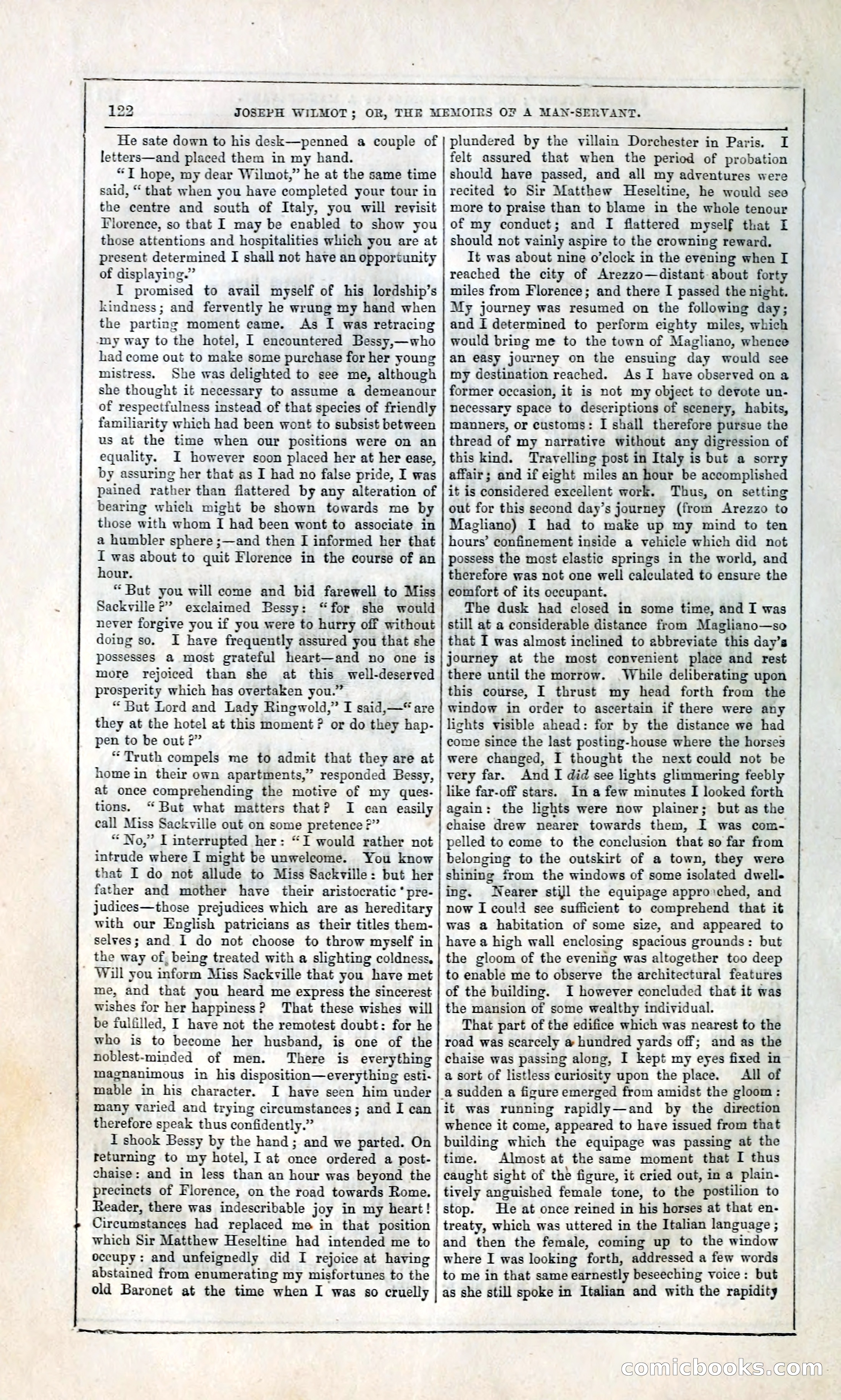
A restored page from Penny Dreadfuls, 1854. Page through the whole issue in the reader above.
📄 Transcribed text from this page (OCR, searchable)
Machine-transcribed from the original scan — historical spelling and the odd misread are preserved.
tipper enenttecendcitiseee ae ae aa 122 JOSEPH WILMOT; OR, THE MEMOIRS OF A MAN-SERVANT. He sate down to his desk—penned a couple of letters—and placed them in my hand. “T hope, my dear Wilmot,” he at the same time said, “ that when you have completed your tour in the centre and south of Italy, you will revisit Florence, so that I may be enabled to show you those attentions and hospitalities which you are at present determined I shall not have an opportunity of displaying.” I promised to avail myself of his lordship’s kindness; and fervently he wrung my hand when the parting moment came. As I was retracing my way to the hotel, I encountered Bessy,—who had come out to make some purchase for her young mistress. She was delighted to see me, although she thought it necessary to assume a demeanour of respectfulness instead of that species of friendly familiarity which had been wont to subsist between us at the time when our positions were on an equality. I however soon placed her at her ease, by assuring her that as I had no false pride, I was pained rather than flattered by any alteration of bearing which might be shown towards me by those with whom I had been wont to associate in a humbler sphere ;—and then I informed her that I was about to quit Florence in the course of an hour. “But you will come and bid farewell to Miss Sackville?’ exclaimed Bessy: “for she would never forgive you if you were to hurry off without doing so. I have frequently assured you that she possesses a most grateful heart—and no one is more rejoiced than she at this well-deserved prosperity which has overtaken you.” “ But Lord and Lady Ringwold,” I said,—* are they at the hotel at this moment? or do they hap- pen to be out ?” “Truth compels me to admit that they are at home in their own apartments,” responded Bessy, at once comprehending the motive of my ques- tions. “But what matters that? I can easily call Miss Sackville out on some pretence ?” “ No,” I interrupted her: “I would rather not intrude where I might be unwelcome. You know that I do not allude to Miss Sackville: but her father and mother have their aristocratic * pre- judices—those prejudices which are as hereditary with our English patricians as their titles them- selves; and I do not choose to throw myself in the way of, being treated with a slighting coldness, _ Will you inform Miss Sackville that you have met me, and that you heard me express the sincerest wishes for her happiness? That these wishes will be fulfilled, I have not the remotest doubt: for he who is to become her husband, is one of the noblest-minded of men. There is everything magnanimous in his disposition—everything esti- mable in his character. I have seen him under many varied and trying circumstances; and I can therefore speak thus confidently.” 1 shook Bessy by the hand; and we parted. On returning to my hotel, I at once ordered a post- chaise: and in less than an hour was beyond the precincts of Florence, on the road towards Rome. Reader, there was indescribable joy in my heart! Circumstances had replaced me in that position which Sir Matthew Heseltine had intended me to occupy: and unfeignedly did I rejoice at having abstained from enumerating my misfortunes to the old Baronet at the time when I was so cruelly plundered by the villain Dorchester in Paris. I felt assured that when the period of probation should have passed, and all my adventures were recited to Sir Matthew MHeseltine, he would see more to praise than to blame in the whole tenour of my conduct; and I flattered myself that I should not vainly aspire to the crowning reward. Jt was about nine o’clock in the evening when I reached the city of Arezzo—distant about forty miles from Florence; and there I passed the night. My journey was resumed on the following day; and I determined to perform eighty miles, which would bring me to the town of Magliano, whence an easy journey on the ensuing day would see my destination reached. As I have observed on a former occasion, it is not my object to devote un- necessary space to descriptions of scenery, habits, manners, or customs: I shall therefore pursue the thread of my narrative without any digression of this kind. Travelling post in Italy is but a sorry affair; and if eight miles an hour be accomplished it is considered excellent work. Thus, on setting out for this second day’s journey (from Arezzo to Magliano) I had to make up my mind to ten hours’ confinement inside a vehicle which did not possess the most elastic springs in the world, and therefore was not one well calculated to ensure the comfort of its occupant. The dusk had closed in some time, and I was still at a considerable distance from Magliano—so that I was almost inclined to abbreviate this day’s journey at the most convenient place and rest there until the morrow. While deliberating upon this course, I thrust my head forth from the window in order to ascertain if there were any lights visible ahead: for by the distance we had come since the last posting-house where the horses were changed, I thought the next could not be very far. And I did see lights glimmering feebly like far-off stars. In a few minutes I looked forth again: the lights were now plainer; but as the chaise drew nearer towards them, I was com- pelled to come to the conclusion that so far from belonging to the outskirt of a town, they were shining from the windows of some isolated dwelle ing. Nearer stiJl the equipage approxched, and now I could see sufficient to comprehend that it was a habitation of some size, and appeared to have a high wall enclosing spacious grounds: but the gloom of the evening was altogether too deep to enable me to observe the architectural features of the building. I however concluded that it was the mansion of some wealthy individual. That part of the edifice which was nearest to the road was scarcely # hundred yards off; and as the chaise was passing along, I kept my eyes fixed in a sort of listless curiosity upon the place. All of a sudden a figure emerged from amidst the gloom: it was running rapidly—and by the direction whence it come, appeared to have issued from that building which the equipage was passing at the time. Almost at the same moment that I thus caught sight of the figure, it cried out, in a plain- tively anguished female tone, to the postilion to stop. He at once reined in his horses at that en- treaty, which was uttered in the Italian language ; and then the female, coming up to the window where I was looking forth, addressed a few words to me in that same earnestly beseeching voice: but as she still spoke in Italian and with the rapidity (E@) CoOmicaoolks