
Penny Dreadfuls, 1854 · page 103 of 399
Joseph Wilmot, or, The Memoirs of a Man-Servant — page 103: what you’re looking at
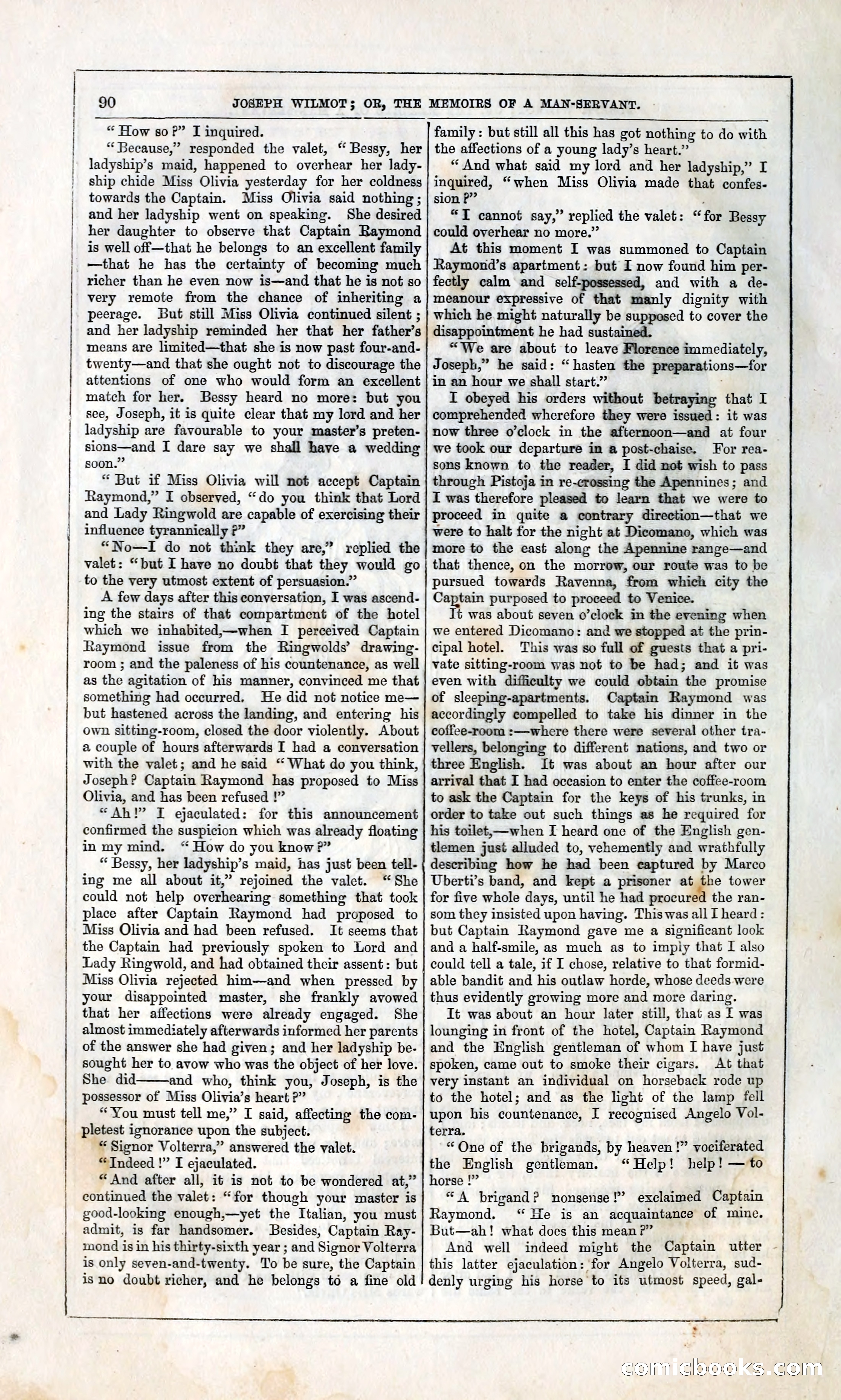
A restored page from Penny Dreadfuls, 1854. Page through the whole issue in the reader above.
📄 Transcribed text from this page (OCR, searchable)
Machine-transcribed from the original scan — historical spelling and the odd misread are preserved.
nn ae gee a esse eseranssencteetiecissanesaneses=n—aee- pases sovmseeatioihosthdiassscinpemaastic eisai mere “ How so P” I inquired. “Because,” responded the valet, “Bessy, her ladyship’s maid, happened to overhear her lady- ship chide Miss Olivia yesterday for her coldness towards the Captain. Miss Olivia said nothing; and her ladyship went on speaking. She desired her daughter to observe that Captain Raymond is well off—that he belongs to an excellent family —that he has the certainty of becoming much richer than he even now is—and that he is not so very remote from the chance of inheriting a peerage. But still Miss Olivia continued silent ; and her ladyship reminded her that her father’s means are limited—that she is now past four-and- twenty—and that she ought not to discourage the attentions of one who would form an excellent match for her. Bessy heard no more: but you see, Joseph, it is quite clear that my lord and her ladyship are favourable to your master’s preten- sions—and I dare say we shall have a wedding soon.” “ But if Miss Olivia will not accept Captain Raymond,” I observed, “do you think that Lord and Lady Ringwold are capable of exercising their influence tyrannically ?” “No—I do not think they are,” replied the valet: “but I have no doubt that they would go to the very utmost extent of persuasion.” A few days after this conversation, I was ascend- ing the stairs of that compartment of the hotel which we inhabited,—when I perceived Captain Raymond issue from the Ringwolds’ drawing- room ; and the paleness of his countenance, as well as the agitation of his manner, convinced me that something had occurred. He did not notice me— but hastened across the landing, and entering his own sitting-room, closed the door violently. About a couple of hours afterwards I had a conversation with the valet; and he said “ What do you think, Joseph? Captain Raymond has proposed to Miss Olivia, and has been refused !” “Ah!” I ejaculated: for this announcement confirmed the suspicion which was already floating in my mind. “How do you know?” “ Bessy, her ladyship’s maid, has just been tell- ing me all about it,” rejoined the valet. ‘She could not help overhearing something that took place after Captain Raymond had proposed to Miss Olivia and had been refused. It seems that the Captain had previously spoken to Lord and Lady Ringwold, and had obtained their assent: but Miss Olivia rejected him—and when pressed by your disappointed master, she frankly avowed that her affections were already engaged. She almost immediately afterwards informed her parents of the answer she had given; and her ladyship be- sought her to avow who was the object of her love. She did and who, think you, Joseph, is the possessor of Miss Olivia’s heart ?” “You must tell me,” I said, affecting the com- pletest ignorance upon the subject. “Signor Volterra,” answered the valet. “Indeed !” I ejaculated. “And after all, it is not to be wondered at,” continued the valet: “for though your master is good-looking enough,—yet the Italian, you must admit, is far handsomer. Besides, Captain Ray- mond isin his thirty-sixth year ; and Signor Volterra is only seven-and-twenty. To be sure, the Captain is no doubt richer, and he belongs to a fine old JOSEPH WILMOT; OR, THE MEMOIRS OF A MAN-SERVANT. family: but still all this has got nothing to do with the affections of a young lady’s heart.” “And what said my lord and her ladyship,” I inquired, “when Miss Olivia made that confes- sion P” “I cannot say,” replied the valet: could overhear no more.” At this moment I was summoned to Captain Raymond’s apartment: but I now found him per- fectly calm and self-possessed, and with a de- meanour expressive of that manly dignity with which he might naturally be supposed to cover the disappointment he had sustained. “We are about to leave Florence immediately, Joseph,” he said: “hasten the preparations —for in an hour we shall start.” I obeyed his orders without betraying that I comprehended wherefore they were issued: it was 23 for Bessy now three o’clock in the afternoon—and at four — we took our departure in a post-chaise. For rea- sons known to the reader, I did not wish to pass through Pistoja in re-crossing the Apennines; and I was therefore pleased to learn that we were to proceed in quite a contrary direction—that we were to halt for the night at Dicomano, which was more to the east along the Apennine range—and that thence, on the morrow, our route was to be pursued towards Ravenna, from which city the Captain purposed to proceed to Venice. It was about seven o’clock im the evening when we entered Dicomano: and we stopped at the prin- cipal hotel. This was so full of guests that a pri- vate sitting-room was not to be had; and it was even with difficulty we could obtain the promise of sleeping-apartments. Captain Raymond was accordingly compelled to take his dinner in the coffee-room :—where there were several other tra- vellers, belonging to different mations, and two or three English. It was about an hour after our arrival that I had occasion to enter the coffee-room to ask the Captain for the keys of his trunks, in order to take out such things as he required for his toilet,—when I heard one of the English gen- tlemen just alluded to, vehemently and wrathfully describing how he had been eaptured by Marco Uberti’s band, and kept a prisoner at the tower for five whole days, until he had procured the ran- som they insisted upon having. This was all I heard : but Captain Raymond gave me a significant look and a half-smile, as much as to impiy that I also could tell a tale, if I chose, relative to that formid- able bandit and his outlaw horde, whose deeds were thus evidently growing more and more daring. It was about an hour later still, that as I was lounging in front of the hotel, Captain Raymond and the English gentleman of whom I have just spoken, came out to smoke their cigars. At that very instant an individual on horseback rode up to the hotel; and as the light of the lamp fell upon his countenance, I recognised Angelo Vol- terra. “One of the brigands, by heaven !” vociferated the English gentleman. “Help! help! — to horse !” “A brigand? nonsense!’ exclaimed Captain Raymond. “He is an acquaintance of mine. But—ah! what does this mean ?” And well this latter ejaculation: for Angelo Volterra, sud- denly urging his horse to its utmost speed, gal- indeed might the Captain utter - ElOOOkKS (C)