
Penny Dreadfuls, 1854 · page 98 of 394
Joseph Wilmot, or, The Memoirs of a Man-Servant — page 98: what you’re looking at
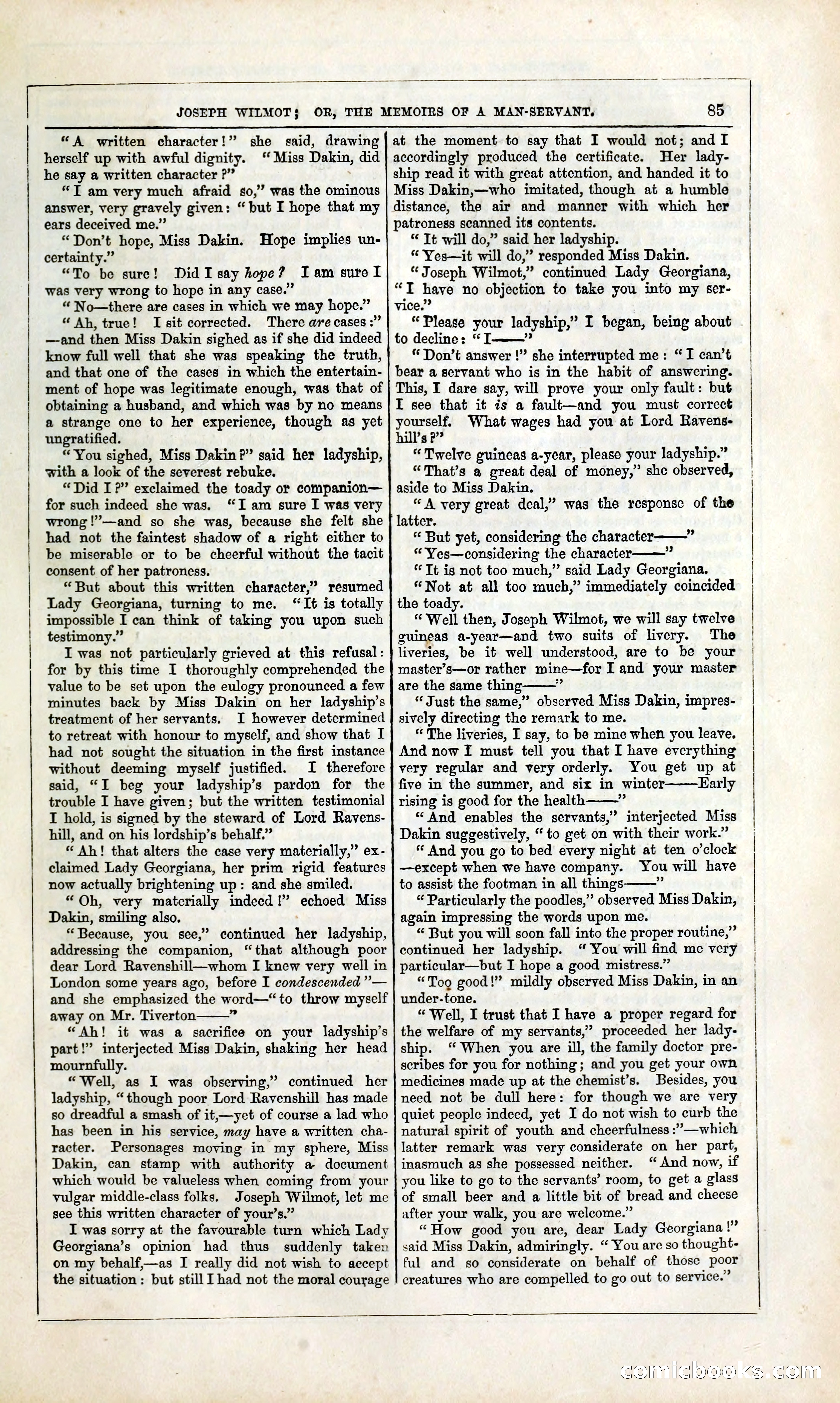
A restored page from Penny Dreadfuls, 1854. Page through the whole issue in the reader above.
📄 Transcribed text from this page (OCR, searchable)
Machine-transcribed from the original scan — historical spelling and the odd misread are preserved.
| JOSEPH WILMOT; A written character!” she said, drawing herself up with awful dignity. ‘ Miss Dakin, did he say a written character ?” “T am very much afraid so,” was the ominous answer, very gravely given: “but I hope that my ears deceived me.” “Don’t hope, Miss Dakin. Hope implies un- certainty.” “To be sure! DidI say hope? Iam surel was very wrong to hope in any case.” “ No—there are cases in which we may hope.” “ Ah, true! Isit corrected. There are cases :” —and then Miss Dakin sighed as if she did indeed know full well that she was speaking the truth, and that one of the cases in which the entertain- ment of hope was legitimate enough, was that of obtaining a husband, and which was by no means a strange one to her experience, though as yet ungratified. “You sighed, Miss Dakin?” said her ladyship, with a look of the severest rebuke. “Did I?” exclaimed the toady or companion— for such indeed she was. “I am sure I was very wrong !”—and so she was, because she felt she had not the faintest shadow of a right either to be miserable or to be cheerful without the tacit consent of her patroness. “But about this written character,’ resumed Lady Georgiana, turning to me. “It is totally impossible I can think of taking you upon such testimony.” I was not particularly grieved at this refusal: for by this time I thoroughly comprehended the value to be set upon the eulogy pronounced a few minutes back by Miss Dakin on her ladyship’s treatment of her servants. I however determined to retreat with honour to myself, and show that I had not sought the situation in the first instance without deeming myself justified. I therefore said, “I beg your ladyship’s pardon for the trouble I have given; but the written testimonial I hold, is signed by the steward of Lord Ravens- hill, and on his lordship’s behalf.” « Ah! that alters the case very materially,” ex- claimed Lady Georgiana, her prim rigid features now actually brightening up: and she smiled. “Oh, very materially indeed!” echoed Miss Dakin, smiling also. : “Because, you see,’ continued her ladyship, addressing the companion, “that although poor dear Lord Ravenshill—whom I knew very well in London some years ago, before I condescended ”— and she emphasized the word—*“ to throw myself away on Mr. Tiverton ? “Ah! it was a sacrifice on your ladyship’s part!” interjected Miss Dakin, shaking her head mournfully. “Well, as I was observing,” continued her ladyship, “though poor Lord Ravenshill has made so dreadful a smash of it,—yet of course a lad who has been in his service, may have a written cha- racter. Personages moving in my sphere, Miss Dakin, can stamp with authority a document which would be valueless when coming from your vulgar middle-class folks. Joseph Wilmot, let me see this written character of your’s.” I was sorry at the favourable turn which Lady Georgiana’s opinion had thus suddenly taken on my behalf,—as I really did not wish to accept the situation: but still Ihad not the moral courage eee a -—_—_——— ee ee OR, THE MEMOIRS OF A MAN-SERVANT. 85 at the moment to say that I would not; and I accordingly produced the certificate. ship read it with great attention, and handed it to Her lady- Miss Dakin,—who imitated, though at a humble distance, the air and manner with which her patroness scanned its contents. Tt will do,” said her ladyship. “ Yes—it will do,” responded Miss Dakin. * Joseph Wilmot,” continued Lady Georgiana, “T have no objection to take you into my ser- vice.” “Please your ladyship,” I began, being about y yship g g to decline: “I——” “Don’t answer !”” she interrupted me: “I can’t bear a servant who is in the habit of answering. This, I dare say, will prove your only fault: but I see that it is a fault—and you must correct yourself. What wages had you at Lord Ravens- hill’s Pp”? “Twelve guineas a-year, please your ladyship.” “That’s a great deal of money,” she observed, aside to Miss Dakin. “A very great deal,” was the response of the latter. * But yet, considering the character——” “ Yes—considering the character-———” Tt is not too much,” said Lady Georgiana. “Not at all too much,” immediately coincided the toady. “Well then, Joseph Wilmot, we will say twelve guineas a-year—and two suits of livery. The liveries, be it well understood, are to be your master’s—or rather mine—for I and your master are the same thing ? “ Just the same,” observed Miss Dakin, impres- sively directing the remark to me. « The liveries, I say, to be mine when you leave. And now I must tell you that I have everything very regular and very orderly. You get up at five in the summer, and six in winter Early rising is good for the health g « And enables the servants,” interjected Miss Dakin suggestively, “to get on with their work.” « And you go to bed every night at ten o’clock —except when we have company. You will have to assist the footman in all things ‘e “ Particularly the poodles,” observed Miss Dakin, again impressing the words upon me. “ But you will soon fall into the proper routine,” continued her ladyship. “ You will find me very particular—but I hope a good mistress.”’ “Too good!” mildly observed Miss Dakin, in an under-tone. “ Well, I trust that I have a proper regard for the welfare of my servants,’’ proceeded her lady- ship. ‘“ When you are ill, the family doctor pre- scribes for you for nothing; and you get your own medicines made up at the chemist’s. Besides, you need not be dull here: for though we are very quiet people indeed, yet I do not wish to curb the natural spirit of youth and cheerfulness :”—which latter remark was very considerate on her part, inasmuch as she possessed neither. “And now, if you like to go to the servants’ room, to get a glass of small beer and a little bit of bread and cheese after your walk, you are welcome.” “How good you are, dear Lady Georgiana!” said Miss Dakin, admiringly. “ You are so thought- ful and so considerate on behalf of those poor creatures who are compelled to go out to service.” Teen ee ae Ree a ee LOGO S co im