
Penny Dreadfuls, 1854 · page 95 of 394
Joseph Wilmot, or, The Memoirs of a Man-Servant — page 95: what you’re looking at
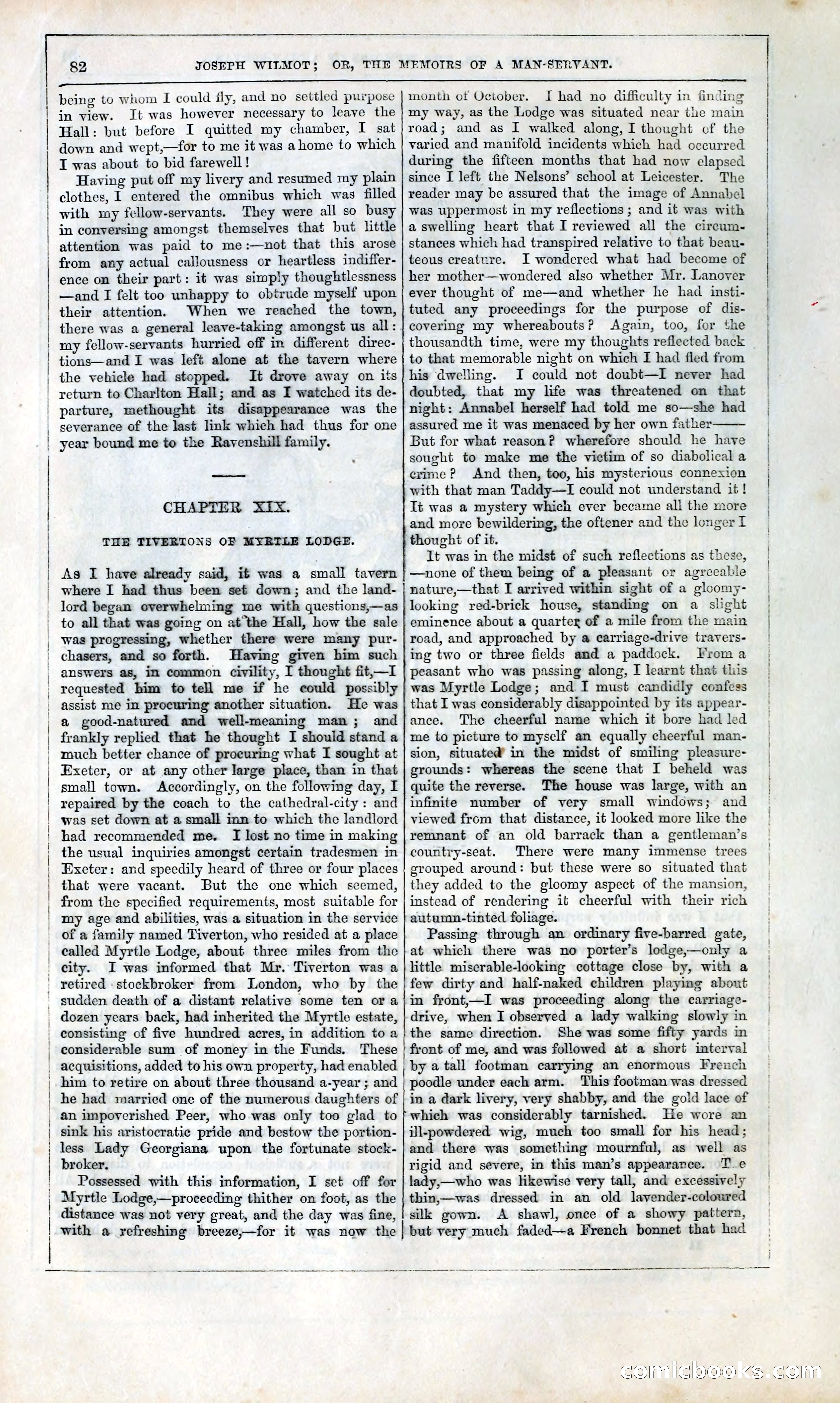
A restored page from Penny Dreadfuls, 1854. Page through the whole issue in the reader above.
📄 Transcribed text from this page (OCR, searchable)
Machine-transcribed from the original scan — historical spelling and the odd misread are preserved.
_—— a cn a 2 ee eS ES a ae 82 JOSEPH WILMOT; being to whom I could fly, and no settled purpose in view. It was however necessary to leave the Hall: but before I quitted my chamber, I sat down and wept,—for to me it was ahome to which I was about to bid farewell! Having put off my livery and resumed my plain clothes, I entered the omnibus which was filled with my fellow-servants. They were all so busy in conversing amongst themselves that but little attention was paid to me:—not that this arose from any actual callousness or heartless indiffer- ence on their part: it was simply thoughtlessness —and I felt too unhappy to obtrude myself upon their attention. When we reached the town, there was a general leave-taking amongst us all:. my fellow-servants hurried off in different direc- tions—and I was left alone at the tavern where the vehicle had stopped. It drove away on its return to Charlton Hall; and as I watched its de- parture, methought its disappearance was the severance of the last link which had thus for one year bound me to the Ravenshill family. —_—_—_—_—_——~ CHAPTER XIX. THE TIVERTONS OF MYRTLE LODGE. As I have already said, it was a small tavern where I had thus been set down; and the land- lord began overwhelming me with questions,—as to all that was going on at the Hall, how the sale was progressing, whether there were many pur- chasers, and so forth. Having given him such answers as, in common civility, I thought fit,—I requested him to tell me if he eould possibly assist me in procuring another situation. He was a good-natured and well-meaning man; and frankly replied that he thought I should stand a much better chance of proeuring what I sought at Exeter, or at any other large place, than in that small town. Accordingly, on the following day, I repaired by the coach to the cathedral-city : and was set down at a small inn to which the landlord had recommended me. [I lost no time in making the usual inquiries amongst certain tradesmen in Exeter: and speedily heard of three or four places that were vacant. But the one which seemed, from the specified requirements, most suitable for my age and abilities, was a situation in the service of a family named Tiverton, who resided at a place called Myrtle Lodge, about three miles from the city. I was informed that Mr. Tiverton was a retired stockbroker from London, who by the sudden death of a distant relative some ten or a dozen years back, had inherited the Myrtle estate, consisting of five hundred acres, in addition toa considerable sum of money in the Funds. These acquisitions, added to his own property, had enabled him to retire on about three thousand a-year ; and he had married one of the numerous daughters of an impoverished Peer, who was only too glad to sink his aristocratic pride and bestow the portion- less Lady Georgiana upon the fortunate stock- broker. Possessed with this information, I set off for Myrtle Lodge,—proceeding thither on foot, as the distance was not very great, and the day was fine, with a refreshing breeze,;—for it was now the i ir i RE EF OR, THE MEMOIRS OF A MAN-SERVANT. month of October. I had no difficulty in finding my way, as the Lodge was situated near the main road; and as I walked along, I thought of the varied and manifold incidents which had occurred during the fifteen months that had now clapsed since I left the Nelsons’ school at Leicester. The reader may be assured that the image of Annabel was uppermost in my reflections ; and it was with a swelling heart that I reviewed all the cireum- stances which had transpired relative to that beau- teous creature. I wondered what had become of her mother—wondered also whether Mr. Lanover ever thought of me—and whether he had insti- tuted any proceedings for the purpose of dis- covering my whereabouts? Again, too, for the thousandth time, were my thoughts reflected back to that memorable night on which I had fled from his dwelling. I could not doubt—I never had doubted, that my life was threatened on that night: Annabel herself had told me so—she had assured me it was menaced by her own father But for what reason? wherefore should he have sought to make me the victim of so diabolical a crime P And then, too, his mysterious connexion with that man Taddy—I could not understand it! Té was a mystery which ever became all the more and more bewildering, the oftener and the longer f thought of it. It was in the midst of such reflections as these, —none of them being of a pleasant or agreeable nature,—that I arrived within sight of a gloomy- looking red-brick house, standing on a slight eminence about a quarter of a mile from the main road, and approached by a earriage-drive travers- ing two or three fields and a paddock. From a peasant who was passing along, I learnt that this was Myrtle Lodge; and I must candidly confess that I was considerably disappointed by its appear- ance. The cheerful name which it bore had led me to picture to myself an equally cheerful man- sion, situated’ in the midst of smiling pleasure- grounds: whereas the scene that I beheld was quite the reverse. The house was large, with an infinite number of very small windows; and viewed from that distance, it looked more like the remnant of an old barrack than a gentleman’s country-seat. There were many immense trees grouped around: but these were so situated that they added to the gloomy aspect of the mansion, instead of rendering it cheerful with their rich autumn-tinted foliage. Passing through an ordinary five-barred gate, at which there was no porter’s lodge,—only a little miserable-looking cottage close by, with a few dirty and half-naked children playing about in front,—I was proceeding along the carriage- drive, when I observed a lady walking slowly in the same direction. She was some fifty yards in front of me, and was followed at a short imterval by a tall footman carrying an enormous French poodle under each arm. This footman was dressed in a dark livery, very shabby, and the gold lace of which was considerably tarnished. He wore an ill-powdered wig, much too small for his head; and there was something mournful, as well as rigid and severe, in this man’s appearance. T'e lady,—who was likewise very tall, and excessively thin,—was dressed in an old lavender-colowred silk gown. <A shawl, once of a showy pattern, but very much faded—a French bonnet that had | 2 Eee _— 6 me es ot ee ee 8 es re er ee eames partes Satine anil —— SS Cc Doo (0)