
Penny Dreadfuls, 1854 · page 87 of 394
Joseph Wilmot, or, The Memoirs of a Man-Servant — page 87: what you’re looking at
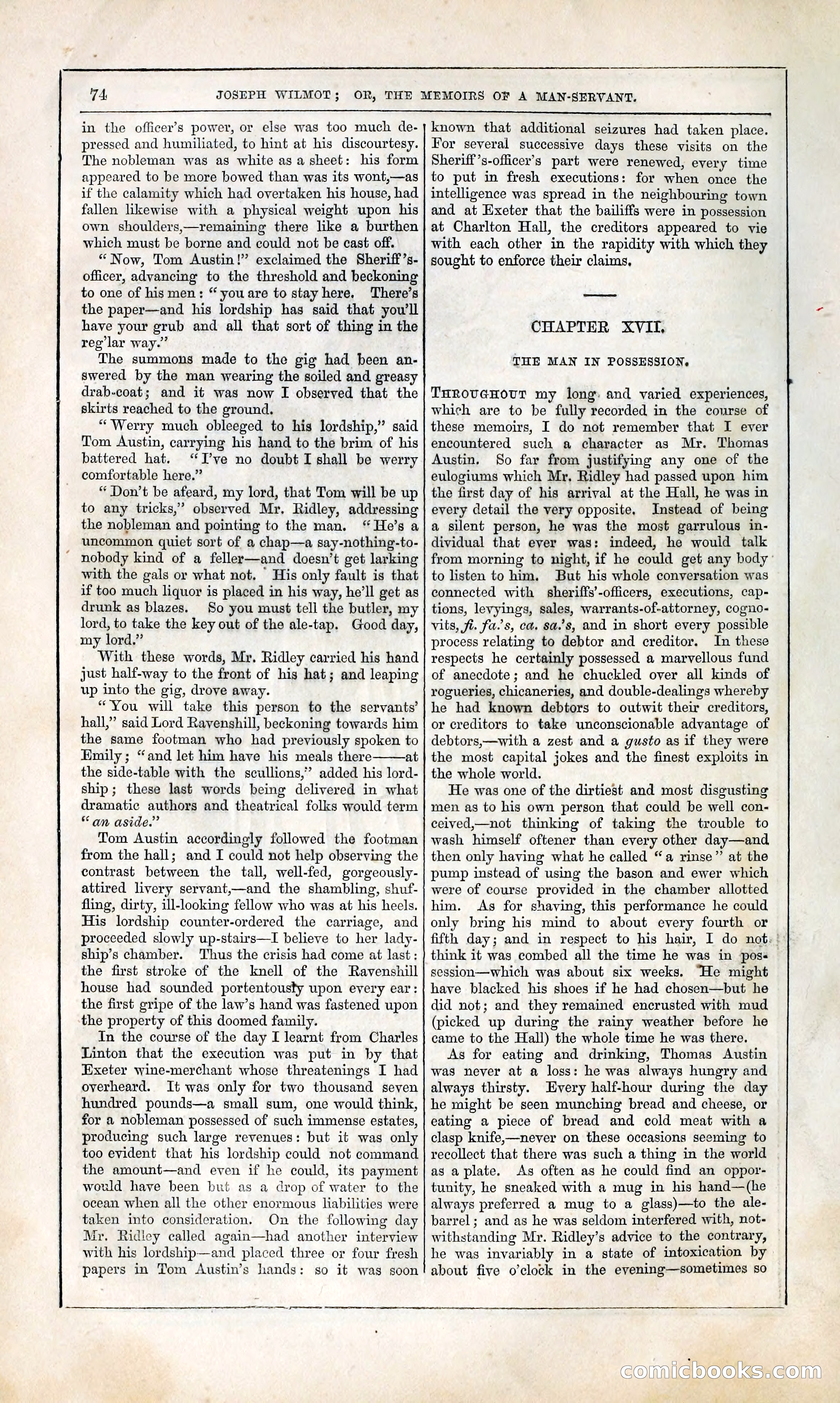
A restored page from Penny Dreadfuls, 1854. Page through the whole issue in the reader above.
📄 Transcribed text from this page (OCR, searchable)
Machine-transcribed from the original scan — historical spelling and the odd misread are preserved.
74 JOSEPH WILMOT; OR, THE MEMOIRS OF A MAN-SERVANT. a ee ee ee ee eee in the officer’s power, or else was too much de- pressed and humiliated, to hint at his discourtesy. The nobleman was as white asa sheet: his form appeared to be more bowed than was its wont,—as if the calamity which had overtaken his house, had fallen likewise with a physical weight upon his own shoulders,—remaining there like a burthen which must be borne and could not be cast off. “ Now, Tom Austin!” exclaimed the Sheriff’s- officer, advancing to the threshold and beckoning to one of his men: “ you are to stay here. There’s the paper—and his lordship has said that you'll have your grub and all that sort of thing in the reg lar way.” The summons made to the gig had been an- swered by the man wearing the soiled and greasy drab-coat; and it was now I observed that the skirts reached to the ground. “Werry much obleeged to his lordship,” said Tom Austin, carrying his hand to the brim of his battered hat. “I’ve no doubt I shall be werry comfortable here.” “ Don’t be afeard, my lord, that Tom will be up to any tricks,” observed Mr, Ridley, addressing the nobleman and pointing to the man. “ He’s a uncommon quiet sort of a chap—a say-nothing-to- _ nobody kind of a feller—and doesn’t get larking with the gals or what not. His only fault is that if too much liquor is placed in his way, he’ll get as drunk as blazes. So you must tell the butler, my lord, to take the key out of the ale-tap. Good day, my lord.” With these words, Mr. Ridley carried his hand just half-way to the front of his hat; and leaping up into the gig, drove away. “You will take this person to the servants’ hall,” said Lord Rayenshill, beckoning towards him the same footman who had previously spoken to Emily ; “and let him have his meals there at the side-table with the scullions,’’ added his lord- ship; these last words being delivered in what dramatic authors and theatrical folks would term “an aside.” Tom Austin accordingly followed the footman from the hall; and I could not help observing the contrast between the tall, well-fed, gorgeously- attired livery servant,—and the shambling, shuf- fling, dirty, ill-looking fellow who was at his heels. His lordship counter-ordered the carriage, and proceeded slowly up-stairs—I believe to her lady- ship’s chamber. Thus the crisis had come at last: the first stroke of the knell of the Ravenshill house had sounded portentousty upon every ear: the first gripe of the law’s hand was fastened upon the property of this doomed family. In the course of the day I learnt from Charles Linton that the execution was put in by that Exeter wine-merchant whose threatenings I had overheard. It was only for two thousand seven hundred pounds—a small sum, one would think, for a nobleman possessed of such immense estates, producing such large revenues: but it was only too evident that his lordship could not command the amount—and even if he could, its payment would have been but as a drop of water to the ocean when all the other enormous liabilities were taken into consideration. On the following day Mr. Ridley called again—had another interview with his lordship—and placed three or four fresh papers in Tom Austin’s hands: so it was soon LE known that additional seizures had taken place. For several successive days these visits on the Sheriff’s-officer’s part were renewed, every time to put in fresh executions: for when once the intelligence was spread in the neighbouring town and at Exeter that the bailiffs were in possession at Charlton Hall, the creditors appeared to vie with each other in the rapidity with which they sought to enforce their claims, CHAPTER XVII, THE MAN IN POSSESSION. THROUGHOUT my long: and varied experiences, which are to be fully recorded in the course of these memoirs, I do not remember that I ever encountered such a character as Mr. Thomas Austin. So far from justifying any one of the eulogiums which Mr, Ridley had passed upon him the first day of his arrival at the Hall, he was in every detail the very opposite, Instead of being a silent person, he was the most garrulous in- dividual that ever was: indeed, he would talk from morning to night, if he could get any body’ to listen to him. But his whole conversation was connected with sheriffs’-officers, executions, cap- tions, levyings, sales, warrants-of-attorney, cogno- vits, ft. fa.’s, cad. sa.’s, and in short every possible process relating to debtor and creditor. In these respects he certainly possessed a marvellous fund of anecdote; and he chuckled over all kinds of rogueries, chicaneries, and double-dealings whereby he had known debtors to outwit their creditors, or creditors to take unconscionable advantage of debtors,—with a zest and a gusto as if they were the most capital jokes and the finest exploits in the whole world. He was one of the dirtiest and most disgusting men as to his own person that could be well con- ceived,—not thinking of taking the trouble to wash himself oftener than every other day—and then only having what he called “a rinse” at the pump instead of using the bason and ewer which were of course provided in the chamber allotted him. As for shaving, this performance he could only bring his mind to about every fourth or fifth day; and in respect to his hair, I do not. | think it was combed all the time he was in poss session—which was about six weeks. “He might have blacked his shoes if he had chosen—but he did not; and they remained encrusted with mud (picked up during the rainy weather before he came to the Hall) the whole time he was there. As for eating and drinking, Thomas Austin was never at a loss: he was always hungry and always thirsty. very half-hour during the day he might be seen munching bread and cheese, or eating a piece of bread and cold meat with a clasp knife,—never on these occasions seeming to recollect that there was such a thing in the world as a plate. As often as he could find an oppor- tunity, he sneaked with a mug in his hand—(he always preferred a mug to a glass)—to the ale- barrel; and as he was seldom interfered with, not- withstanding Mr. Ridley’s advice to the contrary, he was invariably in a state of intoxication by about five o’clock in the evening—sometimes so DOoOks (EO) im