
Penny Dreadfuls, 1854 · page 77 of 394
Joseph Wilmot, or, The Memoirs of a Man-Servant — page 77: what you’re looking at
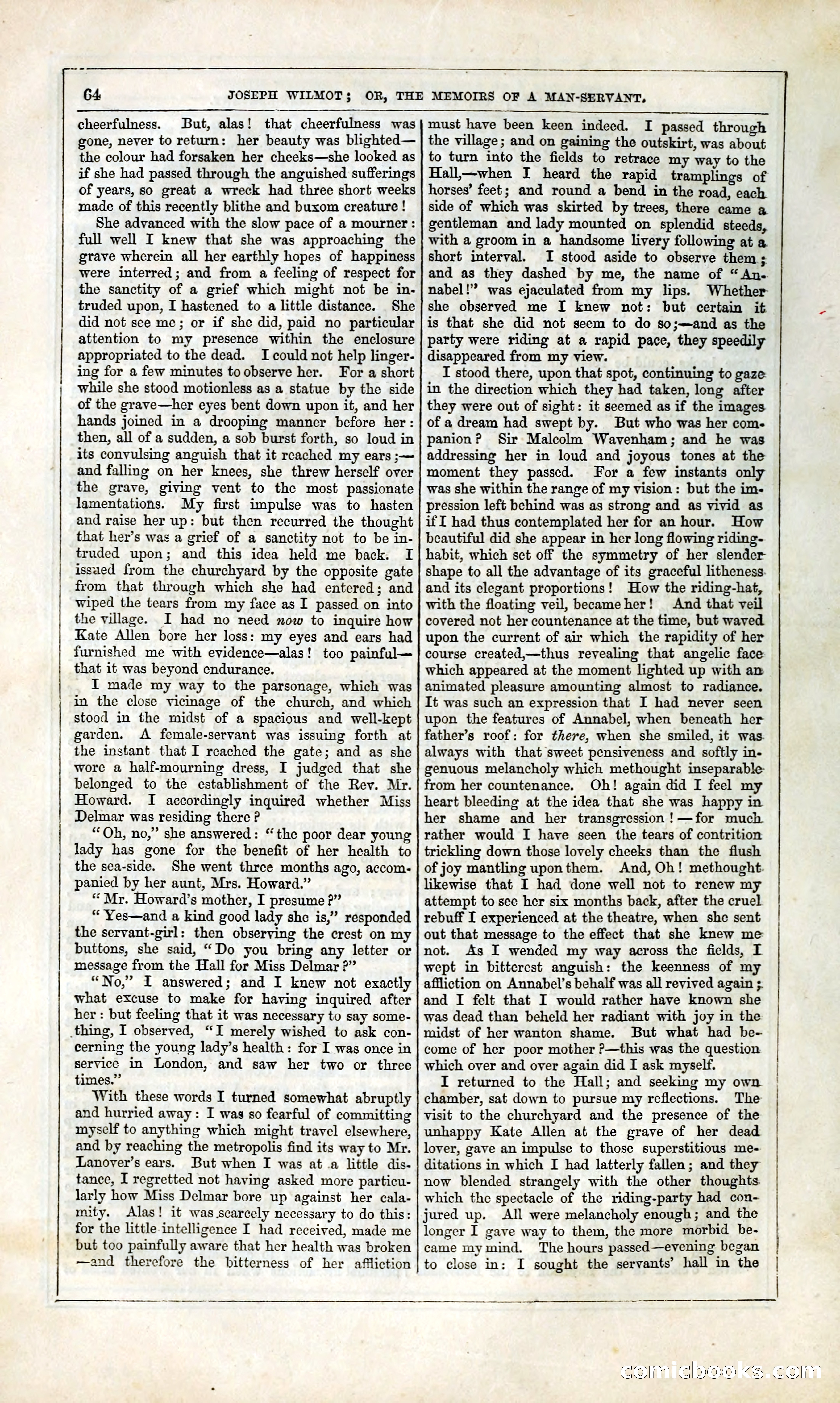
A restored page from Penny Dreadfuls, 1854. Page through the whole issue in the reader above.
📄 Transcribed text from this page (OCR, searchable)
Machine-transcribed from the original scan — historical spelling and the odd misread are preserved.
64 cheerfulness. But, alas! that cheerfulness was gone, never to return: her beauty was blighted— the colour had forsaken her cheeks—she looked as if she had passed through the anguished sufferings of years, so great a wreck had three short weeks made of this recently blithe and buxom creature! She advanced with the slow pace of a mourner: full well I knew that she was approaching the grave wherein all her earthly hopes of happiness were interred; and from a feeling of respect for the sanctity of a grief which might not be in- truded upon, I hastened to a little distance. She did not see me; or if she did, paid no particular attention to my presence within the enclosure appropriated to the dead. I could not help linger- ing for a few minutes toobserve her. For a short while she stood motionless as a statue by the side of the grave—her eyes bent down upon it, and her hands joined in a drooping manner before her: then, all of a sudden, a sob burst forth, so loud in its conyulsing anguish that it reached my ears ;— and falling on her knees, she threw herself over the grave, giving vent to the most passionate lamentations. My first impulse was to hasten and raise her up: but then recurred the thought that her’s was a grief of a sanctity not to be in- truded upon; and this idea held me back. I issued from the churchyard by the opposite gate from that through which she had entered; and wiped the tears from my face as I passed on into the village. I had no need now to inquire how Kate Allen bore her loss: my eyes and ears had furnished me with evidence—alas! too painful— that it was beyond endurance. I made my way to the parsonage, which was in the close vicinage of the church, and which stood in the midst of a spacious and well-kept garden. A female-servant was issuing forth at the instant that I reached the gate; and as she wore a half-mourning dress, I judged that she belonged to the establishment of the Rev. Mr. Howard. I accordingly inquired whether Miss Delmar was residing there P “Oh, no,” she answered: “the poor dear young lady has gone for the benefit of her health to the sea-side. She went three months ago, accom- panied by her aunt, Mrs. Howard.” “ Mr. Howard’s mother, I presume ?” “Yes—and a kind good lady she is,’ responded the servant-girl: then observing the crest on my buttons, she said, “Do you bring any letter or message from the Hall for Miss Delmar ?” “No,” I answered; and I knew not exactly what excuse to make for having inquired after her : but feeling that it was necessary to say some- JOSEPH WILMOT; thing, I observed, “I merely wished to ask con- cerning the young lady’s health: for I was once in service in London, and saw her two or three times.” With these words I turned somewhat abruptly and hurried away: I was so fearful of committing myself to anything which might travel elsewhere, and by reaching the metropolis find its way to Mr. Lanoyer’s ears. But when I was ata little dis- tance, I regretted not having asked more particu- larly how Miss Delmar bore up against her cala- mity. Alas! it was scarcely necessary to do this: for the little intelligence I had received, made me but too painfully aware that her health was broken —and therefore the bitterness of her affliction OR, THE MEMOIRS OF A MAN-SERVANT, must have been keen indeed. I passed through the village; and on gaining the outskirt, was about to turn into the fields to retrace my way to the Hall,—when I heard the rapid tramplings of horses’ feet; and round a bend in the road, each side of which was skirted by trees, there came a gentleman and lady mounted on splendid steeds, with a groom in a handsome livery following at a short interval. I stood aside to observe them; and as they dashed by me, the name of “An.-. nabel!”’ was ejaculated from my lips. Whether she observed me I knew not: but certain if is that she did not seem to do so;—and as the party were riding at a rapid pace, they speedily disappeared from my view. I stood there, upon that spot, continuing to gaze in the direction which they had taken, long after they were out of sight: it seemed as if the images of a dream had swept by. But who was her com- panion? Sir Malcolm Wavenham; and he was addressing her in loud and joyous tones at the moment they passed. For a few instants only was she within the range of my vision: but the im- pression left behind was as strong and as vivid as ifI had thus contemplated her for an hour. How beautiful did she appear in her long flowing riding- habit, which set off the symmetry of her slender shape to all the advantage of its graceful litheness. and its elegant proportions! How the riding-hat, with the floating veil, became her! And that veil covered not her countenance at the time, but waved upon the current of air which the rapidity of her course created,—thus revealing that angelic face which appeared at the moment lighted up with an animated pleasure amounting almost to radiance. It was such an expression that I had never seen upon the features of Annabel, when beneath her father’s roof: for there, when she smiled, it was. always with that sweet pensiveness and softly in- genuous melancholy which methought inseparable from her countenance. Oh! again did I feel my heart bleeding at the idea that she was happy in her shame and her transgression !—for much rather would I have seen the tears of contrition trickling down those lovely cheeks than the flush of joy mantling uponthem. And, Oh! methought. likewise that I had done well not to renew my attempt to see her six months back, after the cruel rebuff I experienced at the theatre, when she sent out that message to the effect that she knew me not. As I wended my way across the fields, I wept in bitterest anguish: the keenness of my affliction on Annabel’s behalf was all revived again ;. and I felt that I would rather have known she was dead than beheld her radiant with joy in the midst of her wanton shame. But what had be- come of her poor mother P—this was the question which over and over again did I ask myself. I returned to the Hall; and seeking my own chamber, sat down to pursue my reflections. The visit to the churchyard and the presence of the unhappy Kate Allen at the grave of her dead lover, gave an impulse to those superstitious me- ditations in which I had latterly fallen; and they now blended strangely with the other thoughts which the spectacle of the riding-party had con- jured up. All were melancholy enough; and the longer I gave way to them, the more morbid be- came mymind. The hours passed—evening began to close in: I sought the servants’ hall in the Gbooks | | Oe ———e——E—E (Cc) im