
Penny Dreadfuls, 1854 · page 53 of 394
Joseph Wilmot, or, The Memoirs of a Man-Servant — page 53: what you’re looking at
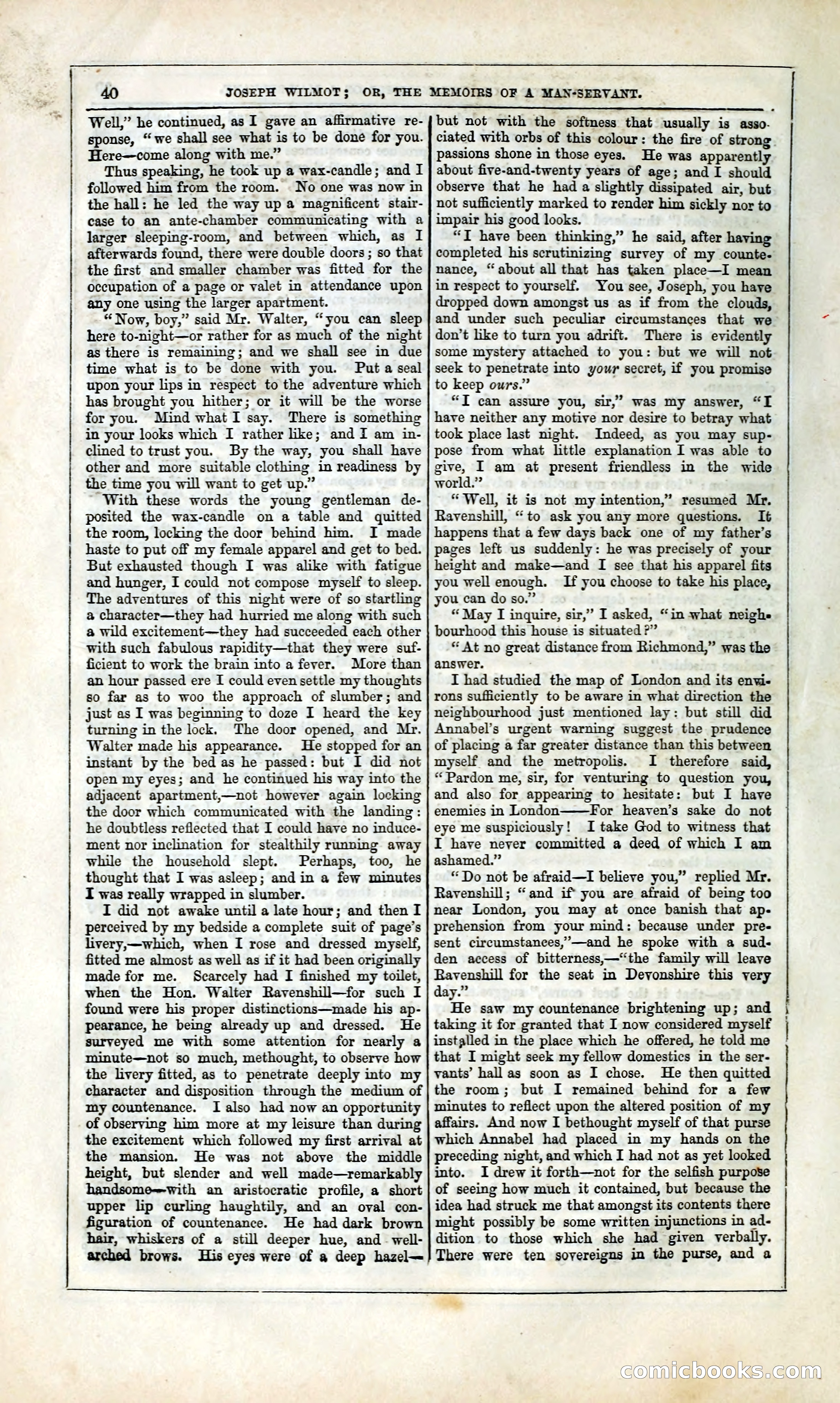
A restored page from Penny Dreadfuls, 1854. Page through the whole issue in the reader above.
📄 Transcribed text from this page (OCR, searchable)
Machine-transcribed from the original scan — historical spelling and the odd misread are preserved.
7 40 JOSEPH WILMOT; OR, THE MEMOIRS OF A MAN-SERVANT. Well,” he continued, as I gave an affirmative re- sponse, “we shall see what is to be done for you. Here—come along with me.” Thus speaking, he took up a wax-candle; and I followed him from the room. No one was now in the hall: he led the way up a magnificent stair- case to an ante-chamber communicating with a larger sleeping-room, and between which, as I afterwards found, there were double doors; so that the first and smaller chamber was fitted for the occupation of a page or valet in attendance upon any one using the larger apartment. “ Now, boy,” said Mr. Walter, “you can sleep here to-night—or rather for as much of the night as there is remaining; and we shall see in due time what is to be done with you. Put a seal upon your lips in respect to the adventure which has brought you hither; or it will be the worse for you. Mind what I say. There is something in your looks which I rather ike; and i am in- clined to trust you. By the way, you shall have other and more suitable clothing in readiness by the time you will want to get up.” With these words the young gentleman de- posited the wax-candle on a table and quitted the room, locking the door behind him. I made haste to put off my female apparel and get to bed. But exhausted though I was alike with fatigue and hunger, I could not compose myself to sleep. The adventures of this night were of so startling a character—they had hurried me along with such a wild excitement—they had succeeded each other with such fabulous rapidity—that they were suf- ficient to work the brain into a fever. More than an hour passed ere I could even settle my thoughts so far as to woo the approach of slumber; and just as I was beginning to doze I heard the key turning in the lock. The door opened, and Mr. Walter made his appearance. He stopped for an instant by the bed as he passed: but I did not open my eyes; and he continued his way into the adjacent apartment,—not however again locking the door which communicated with the landing: he doubtless reflected that I could have no induce- ment nor inclination for stealthily running away while the household slept. Perhaps, too, he thought that I was asleep; and in a few minutes I was really wrapped in slumber. I did not awake until a late hour; and then I perceived by my bedside a complete suit of page’s livery,—which, when I rose and dressed myself, fitted me almost as well as if it had been originally made for me. Scarcely had I finished my toilet, when the Hon. Walter Ravenshill—for such I found were his proper distinctions—made his ap- pearance, he being already up and dressed. He surveyed me with some attention for nearly a minute—not so much, methought, to observe how the livery fitted, as to penetrate deeply into my character and disposition through the medium of my countenance. I also had now an opportunity of observing him more at my leisure than during the excitement which followed my first arrival at the mansion. He was not above the middle height, but slender and well made—remarkably handsome—with an aristocratic profile, a short upper lip curling haughtily, and an oval con- figuration of countenance. He had dark brown hair, whiskers of a still deeper hue, and - well- arched brows. His eyes were of a deep hazel— but not with the softness that usually is asso. ciated with orbs of this colour: the fire of strong passions shone in those eyes. He was apparently about five-and-twenty years of age; and I should observe that he had a slightly dissipated air, but not sufficiently marked to render him sickly nor to impair his good looks. “TI have been thinking,” he said, after having completed his scrutinizing survey of my counte- nance, “about all that has taken place—I mean in respect to yourself. You see, Joseph, you have dropped down amongst us as if from the clouds, and under such peculiar circumstances that we don’t like to turn you adrift. There is evidently some mystery attached to you: but we will not seek to penetrate into your secret, if you promise to keep ours.” “T can assure you, sir,’ was my answer, “I have neither any motive nor desire to betray what took place last night. Indeed, as you may sup- pose from what little explanation I was able to give, I am at present friendless in the wide world.” “Well, it is not my intention,” resumed Mr. Ravenshill, “to ask you any more questions. It happens that a few days back one of my father’s pages left us suddenly: he was precisely of your height and make—and I see that his apparel fits you well enough. If you choose to take his place, you can do so.” “ May I inquire, sir,” I asked, “in what neighe bourhood this house is situated ?” “ At no great distance from Richmond,” was the answer. I had studied the map of London and its envi- rons sufficiently to be aware in what direction the neighbourhood just mentioned lay: but still did Annabel’s urgent warning suggest the prudence of placing a far greater distance than this between myself and the metropolis. I therefore said, “Pardon me, sir, for venturing to question you, and also for appearing to hesitate: but I have enemies in London——For heaven’s sake do not eye me suspiciously! I take God to witness that I have never committed a deed of which I am ashamed.” “Do not be afraid—I believe you,” replied Mr. Ravenshill; “and if you are afraid of being too near London, you may at once banish that ap- prehension from your mind: because under pre- sent circumstanees,’—and he spoke with a sud- den access of bitterness,—“the family will leave Ravenshill for the seat in Devonshire this very day.” He saw my countenance brightening up; and taking it for granted that I now considered myself installed in the place which he offered, he told me that I might seek my fellow domestics in the ser- vants’ hall as soon as I chose. He then quitted the room; but I remained behind for a few minutes to reflect upon the altered position of my affairs. And now I bethought myself of that purse which Annabel had placed in my hands on the preceding night, and which I had not as yet looked into. I drew it forth—not for the selfish purpose of seeing how much it contained, but because the idea had struck me that amongst its contents there might possibly be some written injunctions in ad- dition to those which she had given verbally. There were ten sovereigns in the purse, and a ENOL KS (f(@) m * 3