
Penny Dreadfuls, 1854 · page 400 of 394
Joseph Wilmot, or, The Memoirs of a Man-Servant — page 400: what you’re looking at
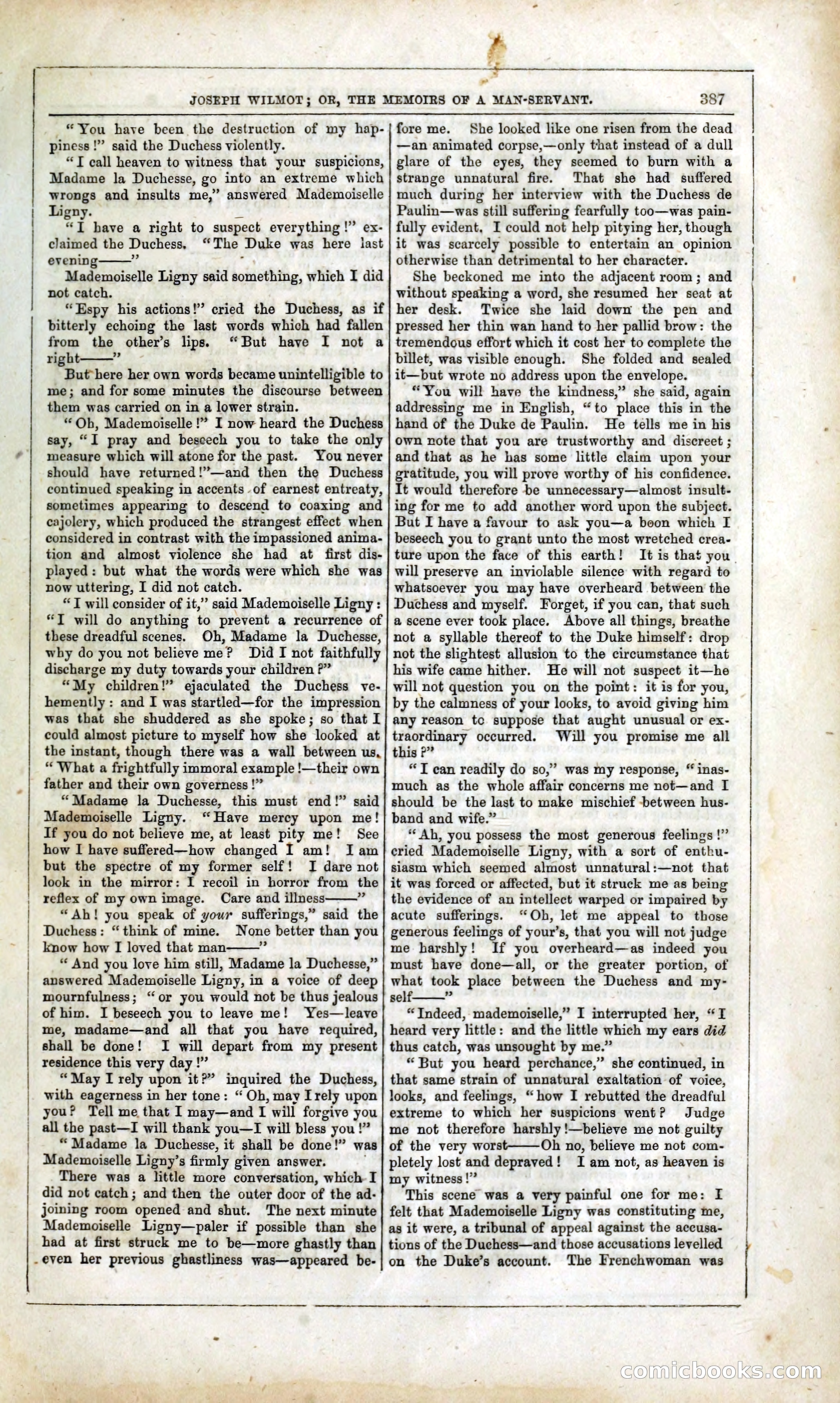
A restored page from Penny Dreadfuls, 1854. Page through the whole issue in the reader above.
📄 Transcribed text from this page (OCR, searchable)
Machine-transcribed from the original scan — historical spelling and the odd misread are preserved.
rn re a | JOSEPH WILMOT; OR, THE MEMOIRS OF A MAN-SERVANT. , -——— we 387 “You have been the destruction of my hap- piness !” said the Duchess violently. “T call heaven to witness that your suspicions, Madame la Duchesse, go into an extreme which wrongs and insults me,” answered Mademoiselle Ligny. “T have a right to suspect everything!” ex- claimed the Duchess, “The Duke was here last evening “4g ‘ Mademoiselle Ligny said something, whieh I did not catch. “Espy his actions!’ cried the Duchess, as if bitterly echoing the last words which had fallen from the | other’s lips. “But have I not a right ome her own words became unintelligible to me; and for some minutes the discourse between them was carried on in a lower strain. * Oh, Mademoiselle !” I now heard the Duchess say, “I pray and beseech you to take the only measure which will atone for the past. You never should have returned!”—and then the Duchess continued speaking in accents of earnest entreaty, sometimes appearing to descend to coaxing and eajolery, which produced the strangest effect when considered in contrast with the impassioned anima- tion and almost violence she had at first dis- played: but what the words were which she was now uttering, I did not catch. “T will consider of it,” said Mademoiselle Ligny : “J will do anything to prevent a recurrence of these dreadful scenes. Oh, Madame la Duchesse, why do you not believe me 2 Did I not faithfully discharge my duty towards your children ?” “My children!” ejaculated the Duchess ve- hemently : and I was startled—for the impression was that she shuddered as she spoke; so that I could almost picture to myself how she looked at the instant, though there was a wall between us, “What a frightfully immoral example !—their own father and their own governess !” “Madame la Duchesse, this must end!” said Mademoiselle Ligny.. “Have merey upon me! If you do not believe me, at least pity me! See how I have suffered—how changed I am! Iam but the spectre of my former self! I dare not look in the mirror: I recoil in horror from the reflex of my own image. Care and illness ~ “Ah! you speak of your sufferings,” said the Duchess: “think of mine. None better than you know how I loved that man “‘ And you love him still, Madame la Duchesse,” answered Mademoiselle Ligny, in a yoice of deep mournfulness; “or you would not be thus jealous of him. I beseech you to leave me! Yes—leave me, madame—and all that you have required, shall be done! I will depart from my present residence this very day !” “May I rely upon it?” inquired the Duchess, with eagerness in her tone: “ Oh, may Irely upon you? Tell me that I may—and I will forgive you all the past—I will thank you—I will bless you !” “Madame la Duchesse, it shall be done!” was Mademoiselle Ligny’s firmly given answer. There was a little more conversation, which I did not catch; and then the onter door of the ad- joining room ‘opened and shut. The next minute Mademoiselle Ligny—paler if possible than she had at first struck me to be—more ghastly than -eyen her previous ghastliness was—appeared be- fore me. She looked like one risen from the dead —an animated corpse,—only that instead of a dull glare of the eyes, they seemed to burn with a strange unnatural fire. That she had suffered much during her interview with the Duchess de Paulin—was still suffering fearfully too—was pain- fully evident, I could not help pitying her, though it was scarcely possible to entertain an opinion otherwise than detrimental to her character. She beckoned me into the adjacent room; and without speaking a word, she resumed her seat at her desk. Twice she laid down the pen and pressed her thin wan hand to her pallid brow: the tremendous effort which it cost her to complete the billet, was visible enough. She folded and sealed it—but wrote no address upon the envelope. “You will have the kindness,” she said, again addressing me in English, “to place this in the hand of the Duke de Paulin. He tells me in his own note that you are trustworthy and discreet ; and that as he has some little claim upon your gratitude, you will prove worthy of his confidence. It would therefore be unnecessary—almost insult- ing for me to add another word upon the subject. But I have a fayour to ask you—a boon which I beseech you to grant unto the most wretched crea- ture upon the face of this earth! will preserve an inviolable silence with regard to whatsoever you may have overheard between the Duchess and myself. Forget, if you can, that such a scene ever took place. Above all things, breathe not a syllable thereof to the Duke himself: drop not the slightest allusion to the circumstance that his wife came hither. He will not suspect it—he will not question you on the point: it is for you, by the calmness of your looks, to avoid giving him any reason tc suppose that aught unusual or ex- traordinary occurred. Will you promise me all this ?” “T can readily do so,” was my response, “ inas- much as the whole affair concerns me not—and I should be the last to make mischief -between hus- band and wife.” ‘Ah, you possess the most generous feelings !” cried Mademoiselle Ligny, with a sort of enthu- siasm which seemed almost unnatural:—not that it was forced or affected, but it struck me as being the evidence of an intellect warped or impaired by acute sufferings. “Oh, let me appeal to those generous feelings of your’s, that you will not judge me harshly! If you overheard—as indeed you must have done—all, or the greater portion, of what took place between the Duchess and my- self “Indeed, mademoiselle,” I interrupted her, “TI heard very little: and the little which my ears did thus catch, was unsought by me.” “But you heard perchance,” she continued, in that same strain of unnatural exaltation of voice, looks, and feelings, “how I rebutted the dreadful extreme to which her suspicions went? Judge me not therefore harshly !—believe me not guilty of the very worst——Oh no, believe me not com- pletely lost and depraved! I am not, as heaven is my witness !” This scene was a very painful one for me: I felt that Mademoiselle Ligny was constituting me, as it were, a tribunal of appeal against the accusa- tions of the Duchess—and those accusations levelled on the Duke’s account. The Frenchwoman was Tt is that you. Giyoo <S) (c@) im